
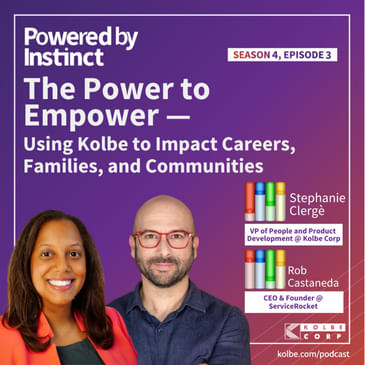
How do you ensure you’re equipped to grow as a business leader? As a family member? As a trusted member of your community? And how can you help others do the same?
In this episode, Stephanie Clergé, VP of People and Product Development at Kolbe Corp, and Rob Castaneda, Founder and CEO of ServiceRocket, discuss how to infuse Kolbe Wisdom™ into a business in ways that will empower team members and clients alike. Rob shares his experience with taking the Kolbe A™ Index and how it has helped him understand himself and others better. Learn how ServiceRocket has integrated Kolbe into their hiring process and the use of technology to support their people operations, how they have fostered a diversity of strengths on their teams, and the value empowering “Rocketeers” to learn and grow has added for everyone involved.
Host: Stephanie Clergé (8363)
Guest-at-a-Glance
💡 Name: Rob Castaneda (3384)
💡What they do: As Founder and CEO of ServiceRocket, Rob aims to help “Rocketeers” learn and grow so that they can have an impact on their careers, their families, and their communities. He partners with smart, fast-growing enterprise software companies and helps them build out their ecosystems.
💡Company: ServiceRocket
💡 Where to find them: LinkedIn
Takeaways
- Understanding and leveraging instinctive strengths can help individuals be more deliberate and make better choices in different situations.
- Empowering employees with knowledge about their instinctive strengths can lead to better collaboration and communication.
- Using Kolbe in the hiring process can help identify candidates who are a good fit for the role and the team.
- Investing in leadership development and proactive initiatives can have a significant impact on the growth and success of a company.
Key Quotes from Rob
“The part that I really enjoyed initially was being able to compare my profile with other executives in the company to give some pointers and, you know, take the edge off some frustration that you might be having.”
“We have a lot of migrants in our business from all corners of the world, and there's a very big calling for me to be able to empower them. And not just on technical skills. I actually think interpersonal soft skills are probably the most important. It has an impact on their careers, but also — knowing this stuff — I'm a better husband. I'm a better father. I'm a better community leader. And I think that's what actually has a better impact on the world.”
“It's kind of like, here's who you are; you're done. With Kolbe, it's just a system of understanding. And then I know what levers I have to pull, right? So that I can adjust my behavior the way that fits the situation.”
“I think educating your managers and investing in programs like this...managers actually love this kind of stuff. And starting to challenge them to say, okay... hey, every time you guys hire somebody, did you realize that you hire the same profile all the time? We all have biases, and this is a great framework and tool and infrastructure to use to make yourself better, make your team better, or make your company better.”
Chapters
00:00 Introduction and Background
03:12 Service Rocket and its Mission
06:00 Empowering Rocketeers
09:18 Understanding and Leveraging Instinctive Strengths
14:34 Rollout of Kolbe in the Company
19:42 Using Kolbe to Make a Difference
26:23 Advice for Leaders in the People Part of Business
32:02 Final Thoughts and Encouragement
If you would like to be a guest on Powered by Instinct or get in touch with any of our Kolbe Experts, send us a quick email: info@kolbe.com
[00:00:00] We have a lot of migrants and our business that are from all corners of the world in all different offices and locations. And there's ever a big calling for me to be able to empower them.
[00:00:10] And not just from technical skills, but I actually think the interpersonal soft skills is probably the most important one to not only have any impact on their career, but like knowing this stuff, I'm a better husband, I'm a better father, a better community leader.
[00:00:24] And I think that's what actually has a better impact on the world. Welcome to Powered by Instinct, a podcast for professionals who think about how your fundamental nature drives performance. If you're interested in getting more done, more naturally, then let's jump in.
[00:00:38] Hello and welcome to another episode of Powered by Instinct. I'm Stephanie Clerej, VP of People Development at Kolbe Corp, and I'm excited to be welcoming the CEO and founder of Service Rocket Rob Castaneta. Hi Rob, thanks so much for being here today.
[00:00:56] Good day, thanks for having me, Stephanie. So as a reminder to the folks in the audience, my four number Kolbe M.O is 8363 and Rob's M.O is 3384.
[00:01:07] So Rob, I'm really curious. Do you remember when you first took the Kolbe A index and what was the impact that it made up? It was many years ago. We were going through a bunch of different profiling systems and tools.
[00:01:18] Aaron LCO at the time was it was a big fan of Kolbe and suggested that we do it. I found it to be very practical in what it gave. I thought it was accurate and as a quick start, I was like, okay, what's next?
[00:01:31] So do you have a sense of how does your M.O show up every day? How do you use it in your life and work? I think that's evolved a little bit. Initially when you do these kind of profiling things, it's about you and you're like, oh wow.
[00:01:44] This is cool. I think being a computer nerd, I kind of then took a step back and said, okay, let me look at all the things around it. Understanding kind of everyone else in the team,
[00:01:55] and also I think for me a big part of it is helping be deliberate and make a choice about the mode that I need to be in at different times.
[00:02:04] Like the part that I really enjoyed initially was being able to compare my profile with Aaron's or other executives in the company. Give some point as and take the edge off some frustration that you might be having. Is your leadership team pretty similar to you?
[00:02:20] No, not everyone. I think we have a good variety of folks on the team. I think it's important to have a lot of different perspectives and a lot of different backgrounds and different roles.
[00:02:29] And I think for me, just generally having a philosophy that when we're trying to fill a role, we're looking as an opportunity for somebody to grow into the role, whereas sometimes you can have a strategy of looking somebody to sit in the seat that you already have,
[00:02:45] which means they'll do exactly what they did before. And I think that's a key part of what makes us unique. Absolutely, how about you tell us a little bit about service rocket, what you do?
[00:02:54] Yeah, I started the company in 2001 when I was 21 and really didn't know what a business was and didn't really know any of this kind of stuff. But what we do is we partner with smart, fast growing enterprise software companies and we help them build out their ecosystem.
[00:03:08] And what does that mean? Well, whenever a company buys a software product, it's great that they just turn it on and it's running, but it needs to be integrated with all the different processes, systems, change management, the right support, the right customizations, the right workflows.
[00:03:23] And then we get into building apps and other extensions that are needed to really get the most out of the software. So we partner with great software companies. We do a lot of work with partner of ours called Atlassian, who is a very popular company,
[00:03:37] working with them since 2003 and really helping customers expand and get more and more out of the software. And that requires us to have rocket tiers who are able to be creative in their thinking and not just hey, I'm just going to do a and b
[00:03:52] and migrate data and I'm done, but they're going to really be inquisitive about the customer and the challenges that are there. So it really helps them to be inquisitive and understanding about themselves, but also if you're in a room of five or six people trying to solve
[00:04:07] a problem as a consultant or a trainer, having that awareness of the tendencies that are in the room can really give you confidence that you know, okay, this is how I should run the session or this is maybe I need to explain something in detail.
[00:04:22] I'll go back over again and just, you know, get people to confidence that they can handle the situation. I love that. I love that year kind of bringing together, you know, people's strengths and not just their contributions,
[00:04:33] but the confidence that it gives them and their results in output. But I want to roll back for a minute because you said, Rocket tiers, can you tell us what is a rocket tier? That's what we call ourselves versus employees.
[00:04:45] I think we're all on the same team, we're all on the same aligned emissions together and the overall mission of the company. We have each other's backs and, you know, for us, the underlying premise of the people side of the business
[00:04:58] is to help Rocket tiers learn and grow. So they can have an impact on their careers, they can have an impact on their families, and they can have an impact on their community. It sounds like you have a broader mission beyond just,
[00:05:09] you know, what you're doing for your customers every day. It starts kind of from the inside with your employees and what they care about most. Yeah, I mean, we're all people right, there's so much stuff in the world today that when you think about it,
[00:05:21] you're spending a third of your life all more at work and, you know, a mentor of mine just did this exercise with me many years ago and he just kept saying, and then what? Right, like so, what do you want? And then what? Then what?
[00:05:34] And if you ask yourself and then what over and over and over again, you know, at the start it's more material stuff right? Well, they want to get a house and I want to get a nice house
[00:05:43] and I want to happen to car or make sure my kids get a college or maybe a vacation home and they'll take care of my parents. And what? It becomes, I guess, but for me it became more about, okay,
[00:05:55] well, what am I contributing back myself being, you know, by parents and migrants? I'm a migrant now across the USA as an Aussie. We have a lot of migrants in our business that are from all corners of the world
[00:06:08] and all different offices and locations and there's a very big calling for me to be able to empower them. And not just from technical skills like I can write code there for I'm going to do well
[00:06:18] but I actually think the interpersonal soft skills is probably the most important one to not only have an impact on their career, but like knowing this stuff I'm a better husband and I'm a better father and a better community leader.
[00:06:29] And I think that's what actually has a better impact on the world. We all have to figure out how we're going to use our instinctive strengths along with, you know, our intelligence and our personalities to really make that difference for the long term.
[00:06:42] But what made you decide that everyone in your company needed to know their instinctive strengths? I think you also have maybe doubled in some other assessments as well. I kind of love playing around with all this stuff.
[00:06:52] I think the curiosity of learning and having that help you get better. I always feel like CEOs, we're kind of spoiled in that we can do a lot of these kind of things and we can attend a lot of training or be part of CEO organizations.
[00:07:09] I think sometimes we're delicate flowers from that point of view but all of my rocketeers, they're the CEOs of their lives. So how can I empower them? We'll give them a hand up and give them some knowledge to help. But really it takes away, you know,
[00:07:24] untangle stuff or if you've got a sore muscle with a knot and you massage it out. These are the kind of tools and understanding to know that in the organization or the little dysfunction that get created are all these little things of awareness
[00:07:38] that can help solve themselves and every big problem you have in a company, every big problem starts off as a small problem or repetitive habit of a small problem. Very few times if any that I can remember that,
[00:07:50] oh my god that's a big problem and it started off as a big problem. Right? Especially the ones that are controllable. Most things start off as annoying habits and what is something that's annoying? And our default reaction is that something someone is doing to us and you know,
[00:08:07] I think there's always parts on both sides that can be looked at. I think that's so interesting with two people who have different set of strengths. If one person does something you immediately think, oh it's about you,
[00:08:20] you know, Stephanie's trying to do this to Rob like her eight in fact. She's trying to do this to Rob but once you understand it's, you know, this is how she naturally takes action right? It kind of, Oh yeah.
[00:08:32] Possibilities that maybe I wasn't intentionally trying to give you too much information but instead I just need that information in order to move forward. Yeah and I joke around a little bit. I mean the fact find is an now company cop a little bit for me.
[00:08:45] I'm like, how fact find is please hold over right now right? Like just just bear with me right? But I think just calling it out stuff like that makes it. I'm a big fan of humor and I'll pick on myself just as much as
[00:08:56] as kind of generic things like that but it just, it also helps people be aware. Oh yeah by ten of these going to be to ask a thousand questions. And I'm going to miss the message right?
[00:09:04] And so I think it can help you in that regard quite a lot. And ultimately as a leader you want to be an affected communicator. So you know why wouldn't you want a little bit of an insight into the audience that you're trying to communicate with?
[00:09:18] Absolutely well and you know that's one of the things that we do. I think we did this exercise with your team as well, which is you know what's one tip that you can give somebody for working with you right?
[00:09:28] So you can just wait until the problems happen and have to detangle them and try to solve them or you can you know again, get ahead of it by understanding how people naturally problem solve and make decisions and then start to totally each other.
[00:09:41] Hey you know I'm just in brainstorming mode right? So let's hold back on the justification until we get through this part or you know this person really needs their questions answers. So why don't we get those questions answered before the meeting so it doesn't drag the meeting on
[00:09:55] those kinds of things that can really can really help. So I love it that you invested in your team with Colby obviously that's something that's really important to you.
[00:10:04] And I remember talking to you, we got on a call with one of your HR leaders and what really impressed me about working with you and I think this was back in 2021 was you didn't just kind of want it to be a one-end sort of thing.
[00:10:20] You came in and you said we're going to do four sessions, you know you have people all across the world I think we did it live but also there was some recording and people jumped in
[00:10:28] even you know they woke up early or stayed up late in order to hear the Colby information. So I thought that's really great. Yeah I think it's a human trait right especially if you're working in a creative environment where everyone has an absolute
[00:10:43] hunger and thirst to learn because they're not spending their time defending and justifying what they've done. And that that for me is whenever I see someone justifying defending what they've done they're not created.
[00:10:55] Right so they're on the back foot and I think a big part of our philosophy at service rock it is how do we empower as many rock it is as possible and be there most reliable partner in helping them grow right.
[00:11:07] And so this is a big part of me is really trying to democratize a lot of the stuff that that I learn right now saying before I get access
[00:11:15] and I learn about these things and it's okay we did these doesn't exactly mean it's the same or see you. It's now kind of standard procedure right you know everyone has it everyone has access we run those sessions
[00:11:24] like various different times in it because we're in 12 locations and people have it managers also having the opportunity to learn how to do it.
[00:11:30] The comparison feature is fantastic for a manager to at least get to know their team and say great here's my profile and someone else is what I might do that might piss them off.
[00:11:41] Okay let me make sure I don't do that sometimes what I do is I make fun of that right and you know just kind of call it out.
[00:11:48] What really bugs me sometimes is that all of the profiles little information is kind of held in HR teams kind of like well like to me that's like a POW don't make that doesn't need to exist right
[00:11:58] and so what we did is we put all of that with the Colby infrastructure work with your team and we everyone has their Colby number the MO on their profile but we have a little software system that people can pick themselves and pick somebody else and they can get the comparison report and so that means hey it can be like someone can compare their report to me right and I get rock yes every chance I'm just like you and I'm like oh I'm so sorry right.
[00:12:26] like we.
[00:12:28] You know I know how it feels right so but but also empowering people to do that doesn't mean that like you have to go back to HR and ask them questions all the time and trying to really know and empower people to do that is a big part of our voice.
[00:12:44] Yeah so I want to kind of step back to the initial rollout and then I want to hear more about how individuals are able to get access to the comparisons ADA information that you were just talking about.
[00:12:56] So when we you did the initial rollouts we did one for the full company then we brought in just the managers to kind of talk more about how they could work with their teams.
[00:13:05] And then we did a session with HR and managers on hiring and then we brought the whole company back to talk about productivity and collaboration.
[00:13:13] And so after we did kind of that you know staged rollout now it sounds like people they so they still take it as a part of onboarding is that kind of how that works.
[00:13:23] Yeah we still do it we still do it on onboarding I think with a lot of these things we think about the cadence of like if you run things every corner on the same stuff it loses its polish right.
[00:13:33] So probably every couple of years it's due to come back it's kind of like a like a Taylor Swift tour right you know it's going to call me to us coming on.
[00:13:41] You know shake it off shake it off and then everyone you know get back into it and you know after that week of concept you're like okay I'm done for a while.
[00:13:50] But the song still playing your head right so the things are still there so I think at the right time it's good to do that and also you guys have been a really great part in in terms of not just like here's a credit to get on to the website.
[00:14:02] It's got on to the website you know be done.
[00:14:04] So a lot of the other platforms out there are kind of like that I kind of like that there is a good engagement between us and and you've been very flexible with some of our weird times on requests and how we want to roll out the training and do things because that's the way we are.
[00:14:17] But in that there's a little bit of nuance in like for us and I think for every company but for us in particular we really really value above anything else the impact that a manager can have on the rocket here's experience it.
[00:14:30] And when you look at as a company grows and scales how effective your managers are is really directly correlated to your ability to scale.
[00:14:39] So putting in a lot of time and energy and effort in trying to empower managers and that's why when we do training we want to be democratic and let everyone do things but we also want to make something special for managers.
[00:14:52] I think it's important for them to have a safe space because they don't only try to take on the material for themselves.
[00:14:58] They in turn then have to turn around and be empowered to use it to help drive the performance of someone else if they're not confident they wouldn't do it right the impacts of them not being fully empowered is quite significant.
[00:15:12] Now I love that you did take that space and then when it came to something more like hiring and you brought HR and the hiring managers together so that they can turn together because a lot of times as you mentioned HR can kind of work in a silo and managers can kind of work in a silo or we're in a space scenario they kind of have to do it out and to figure out what does hiring really look like.
[00:15:32] So bringing the various constituencies together and I also let what you said about you know leaders having access because I think that is so true.
[00:15:40] I know you were a member of EO and some other organization and some other organizations that really you get the coaching and the nurturing and all of that kind of stuff and so the fact that you're willing to invest that in every single employee versus just your managers I think is is amazing.
[00:15:56] I like to think of enlightened leaders as people who know that there's something that needs to be done but you're really one of those exceptional leaders that actually does it and then. Thank you.
[00:16:08] I mean like first impressions make a lot right you see some companies when someone you employ joins they'll give you a box of gifts and chocolates and all this kind of stuff.
[00:16:16] And then I think that's kind of cool but I'm like well what can we give them that that they can take with them forever right so if we help someone grow and learn about themselves and you give them profile information and.
[00:16:28] Leadership training and other things that go with it it's I think it's a lot more impactful than swag right not that swag isn't we don't love it right it's all there and you know waiting for my call be t-shirt or whatever you guys do.
[00:16:43] I'm making sure sure it's right. There we go I'm a medium.
[00:16:51] So but there's something really really interesting is just that in many of the other profile systems not all of them but many of them it's kind of like here's who you are you're done and I think here it's with call be.
[00:17:07] Especially on an individual level and without growing very heavy weight it's for me it's just a system of understanding and and then I know what levers I have to pull what levels I have to pull right so that I can I can adjust my behavior the way that fits the situation also if I'm going to do something that I'm not naturally comfortable with.
[00:17:26] I'm going to do that and then I'll hack my environment to make it work for me. Yeah I love that you're taking those technical skills of hacking and applying it to your collaboration. And getting results a different perspective for sure.
[00:17:43] Okay so you know are there some specific examples that you wanted to sort of focus on about how COVID made a difference in your company it sounds like it certainly made a difference for you and the way that you interact as a leader.
[00:17:55] Anything come to mind that you wanted to talk about.
[00:17:58] Yeah I think that that point that I'll just chat in about is so being aware of okay your natural tendency isn't these things I think what we try and do is explain it people look you might be low follow through doesn't mean you can't get stuff done just means that you need to be aware of it right so you know I'm I'm low follow through and I'm low in fact finding right.
[00:18:24] I'm high quick stuff but other computer science guide and from from the time of like 2018 2019 we rebuilt this business.
[00:18:33] Like we were not in a good shape as a company we kind of got to the next stage and then kind of like okay wow everything's broken nothing's working it's all falling apart.
[00:18:41] And we systematically I'll talk about I right because I systematically broke down everything in front of me was very driven by data and had a high follow through for years that I had to keep doing.
[00:18:53] I had to keep doing this quarter by quarter week by week you know month by month day by day you know system by system to the point of like you know knowing every day don't ever sell and what's going on and whatever we're doing so.
[00:19:07] And I was talking about before about hacking the environment like if I'm going to be in the day together and a high fact finding mode there's like three or four songs that I listen to and I'll put headphones on and that's the mode I'm in.
[00:19:21] And those will help me focus and help me get on with what I'm doing that the simplest thing for me for a follow through because it's not my natural thing is.
[00:19:32] You know I'll carry around a piece of paper with the three things that I said I would do today and I'll make sure I get them done right and every time on my hand on my pocket then what's this freaking paper again oh I've got to do it right and so.
[00:19:44] And the that's very different than just saying well I'm not following high follow through someone else can clean up my crap right and then they do it so I think there is an honest of accountability.
[00:19:53] And self responsibility to say cool on the same token I'm high quick start but I also know that every new idea that I throw out a whole bunch of people have a whole bunch of work to do or a whole bunch of stuff to process.
[00:20:09] So we we use JIRA like we're a big at last in company here and we use JIRA and the top of our workflow was like you know I've got a new open issue right so when people have new ideas they go let's put all the ideas in the project and in the go.
[00:20:24] And as I was putting in all these ideas they go to the stage for us called discovery which is we're not committed to it but we're just going to look at it.
[00:20:32] But what what I realized is that I put things into discovery and then I'm in a general eyes a bit but the high fact find us would grab it and they would start doing discovery and if you think about the brain.
[00:20:44] And if a normal person generate lots of ideas the drain of a brain of an entrepreneur doesn't stop generating ideas and as a systematic person I'm parling in all my ideas in the system.
[00:20:56] Little do I know that everyone's wasting time doing discovery on these half baked crappy ideas that I have. So what we did is in that system we then created a new status of YC and I know why she's head of technology.
[00:21:10] And so this new status called great idea and it was like what is great idea and it literally is that's a great idea right roll your eyes right a little bit look at my apple camera. Wow so.
[00:21:22] So the the great idea and kind of became this sarcastic thing to say oh that's just one of Rob's great ideas like that's just a great idea that's a great like and so.
[00:21:32] The whole point in the company now is that if you see a great idea you can just call it a great idea and you do not have to do anything.
[00:21:40] We will come back later on and you know a week later they have like a radioactive half life right of like a week.
[00:21:46] Right or maybe even a day like a great idea you have today tomorrow is kind of half good and then just diminishes so after a week you come back and most of the great ideas you can just get rid of but there's a couple there that are really good.
[00:22:00] Okay, let's do discovery on those so that was an idea of like how do we use a system between heavy fact find a heavy follow through engineers and crazy entrepreneur generating lots of ideas.
[00:22:13] How do you balance between them just and then kind of you know have been a fun with it and again the humor just takes it to another level right you feel like oh yeah great idea might.
[00:22:24] You mean fire milk go off every time yeah if I was going that's you know on on cue. And so when you see it for analysis language like that's a great idea and the cool thing is we call out great idea in workshops and in meetings.
[00:22:42] And it kind of kills the conversation in a good way it stops going down the rabbit hole because you like because you know quick starts in the meeting just like this podcast right now we're going everywhere right.
[00:22:53] And so by having that kind of said that that's a great idea I've tracked it that's a great idea and then say as a quick start you're like well that they gave me what I want it right.
[00:23:02] I got the recognition for my idea I'm done you know let's celebrate fireworks great idea fantastic and then you're kind of laughing at yourself at the same time right. So anyway so that's an example of using technology with the with the awareness.
[00:23:17] I love that and I love that it's you know not just one system that you're putting in but it sounds like you're infusing it throughout the culture right it comes back in other meetings and you know it's a way of working together it's a way of collaboration it's not just.
[00:23:30] Oh this is something that helps Rob it's something that everybody can kind of engage and use our strengths a little bit different to come together.
[00:23:37] Yeah I mean that's that's a direct outcome of setting up the model where you're empowering other people with the knowledge and then you can use that knowledge to elevate the whole company right. I use the word model there because model always gets forgotten in the in the rank.
[00:23:56] Well and I love that you say empowered that's how we measure our successes lives empowered because we do believe that Colby is.
[00:24:03] It's helping to empower lives and so it's great it's great to see entrepreneurs like you in companies like yours that are you know using Colby to do that empowerment that's great.
[00:24:15] Okay well I think you know we have covered a lot of ground so kind of one or two more questions here what is your best piece of advice for leaders who want to get better at the people part of their business because it feels like you figured this out.
[00:24:28] Or at least are on a great part of your journey here what would you say the other where people have you business right and.
[00:24:36] The success and growth of our rocket tiers is our business we do fun projects that have great outcomes for our customers where they're most reliable partners.
[00:24:44] But we can't be reliable if we're not you know in turn learning and growing as rocket years it wasn't by design that I took over on the people area.
[00:24:54] I just got to a point where the way I thought about it and the way I thought we should do it wasn't what was common and I think what what gets taught you know maybe in business school or what have you a lot of folks tend to want to roll out what they learnt.
[00:25:08] And I think this whole space is a vault right human performance we used to be told that even me I used to like hey separate work from from.
[00:25:15] Now it's like well we're all just people you know this is out tribe we're all together we'll have fun while we're here and. We'll celebrate when you leave because you've been a part of us and you've helped him so I think it's too easy for.
[00:25:29] Eos or entrepreneurs to be like okay let me hire someone you do that you do the culture part I'll do the other part of business and I think.
[00:25:37] You need to be a true partner and think about that you're growing a tree and you are the base of where the root and trunk live or are there.
[00:25:50] And if you do it the other way where you're just like a sub branch then someone else is going to grow that with their knowledge and influence and it's just not going to be the same as if you're unless you're both together right so.
[00:26:02] But we've done is really break apart what is a traditional HR function.
[00:26:09] We've actually put all of our operational groups together and we call it rocket ops and what that means is every project operation that comes through the company has a lens from people they charge side from the legal side from the finance item from the IT technology side.
[00:26:26] And so it's one channel of projects and processes that come out.
[00:26:32] So as rocket tiers customers right of what comes out of rocker up so if they're saying I need a jar help then like no I need help or I need help as a manager I need help as a rocket tier.
[00:26:44] And so what we've done is really build things in an integrated way and so then within the people area by using technology the Alasian service desks so that we can automate as much of these kind of HR and and so the Spanish with type things and make them help this related.
[00:27:01] We have and then without performance framework that we've rolled out and all of our all the benefits work and all that kind of stuff we've done.
[00:27:08] We've realized that we don't need kind of like traditional HR instead the bulk of our budget now goes into leadership development and proactive things that provide value versus I think the traditional approach is a lot about defending it company and you know HR is seen as a very.
[00:27:26] It's an interesting play on power and dynamics on where it sits and what it does we just kind of like okay let me.
[00:27:32] What do we need that for why wouldn't we optimize all the process stuff make things very fair and as transparent as we legally and ethically can make everything fair make it pass a fairness test internally and then push all of our energy and effort into growing leaders and leadership development so that's what we've been doing.
[00:27:51] That's great so I first of all I was waiting for that foreign implementer to come out I love your analogy about the tree.
[00:27:57] And so don't be a sub branch is certainly one key tape away right you can't be a sub branch when it comes to managing your people you kind of have to be there. Yeah, and building the roots and.
[00:28:09] Yeah, you can find a great partner to work with but I also think it's unfair to say I'm going to hire HR leader and you go do that and I'll go to product or sales or something and say well.
[00:28:19] I think you're going to have limited success and I think a lot of when I you know he has stories of a lot of other founders and folks that might have had issues with their company or whatever.
[00:28:29] You know there is you can trace back a lot of things to not getting some of that stuff right.
[00:28:34] Well, and you're not just doing this within your own company you're starting to spread some of the word of that to others through your blog right you have a blog where you talk about some of it what you've done in some of the leadership.
[00:28:44] Oh, yeah, so yeah, we the journey that we went on from 2018 onwards and building everything. My mentors had hey you're a model for a lot of other companies out there when you share more and so I set up a sub stack.
[00:28:58] At leadership behaviors the org whenever I have energy as a quick start over right in our medical. And I'll get through them when I release them you know read them quickly before they run out.
[00:29:11] But no, it's a good place and actually I coach and mentor a lot of other entrepreneurs. And so as some of them ask me questions I just so let me write an article on what we've done and and I'll share that so hope I can keep that going.
[00:29:27] That's great. That's great. Yeah, I'm I am a reader. I am a subscriber to your to your blog. I love hearing what you have to say.
[00:29:34] And just we don't have time to go to it and definitely the podcast that everybody needs to hear what Rob has to say about core values versus leadership behaviors. That was a really key insight for me.
[00:29:46] You know because you can well anyway all I do I go find that on your own but just really some great great insights for leaders so that's fantastic. Thank you Stephanie. All right, so is there anything else that we haven't talked about that you wanted to mention regarding.
[00:30:01] Colby or the people part of your business otherwise well we'll rock this up. Yeah, I would just encourage folks to lean into it and I think you know educating your your managers and investing in your managers and programs like this are.
[00:30:15] It doesn't seem natural. Well, let's let's give this to managers and they actually love this kind of stuff. And starting to challenge them to saying okay hey every time you guys hire somebody did you realize that you hire the same profile all the time.
[00:30:29] Right and it's like okay and then so what defines a good fit is not one of us right.
[00:30:36] So so this is a good challenge as you can do as a leader and find some you know we all have biases and and this is a great framework and tool infrastructure to use to make yourself better. Thank your team better or make your company better.
[00:30:50] Absolutely well Rob thank you so much for spending time with me. So much fun. I've actually been you know had this on my list of things and could not wait to jump on with you.
[00:31:02] Have had so much fun working together look forward to doing more of that in the future and also I think you get the award for most innovative description of will be including Taylor Swift. I think there we go deserves.
[00:31:14] I have two daughters in a wife that are they're a swifties so I'm the the driver. I love it. Everybody's gonna have their role. I went to one as well too I think like I was a long time ago. I mean blacked out through part of it.
[00:31:31] Too much sparkles. All right well thank you so much for having your time today. I really appreciate it. So thank you so much to Rob cast and data to learn more about service rocket.
[00:31:42] Go to service rocket dot com and we also talked about Rob's blog on that's Zach so definitely find that and and
[00:31:49] take a read is awesome and as always the best place to start using Colby is to go to Colby dot com and find the freedom to be yourself.
[00:31:58] Also we have Colby certified consultants all around the world so just go to our consultant search on Colby dot com to find a consultant near you. Thanks and I'll see you next time.
[00:32:08] Thanks for checking out this episode of powered by instinct if you enjoyed this episode then follow powered by instinct wherever you get your favorite podcast or join us online at Colby dot com at Colby dot com slash podcast for all the latest episodes.