
Everyone has natural ways in which they take action. These are measured in four areas — Fact Finder, Follow Thru, Quick Start, and Implementor — called Kolbe Action Modes®.
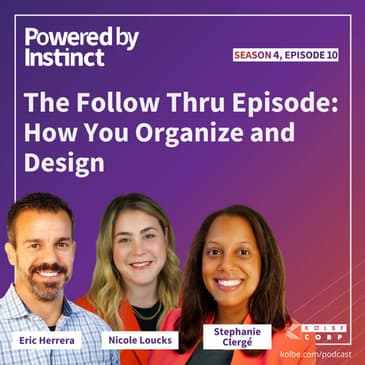
In this second episode of our Kolbe Action Mode® series, Kolbe experts Stephanie Clergé, Eric Herrera, and Nicole Loucks break down the Follow Thru Action Mode and discuss the different strengths within it, such as adapting, maintaining, and systematizing.
Whether you naturally create systems for everything (like Nicole), maintain flexibility and create shortcuts (like Stephanie and Eric) or find yourself in between keeping those systems running, you’ll benefit greatly from the coaching tips provided here.
The hosts address common misconceptions, break down how to work with people across the Follow Thru spectrum, and explain how you can maximize your Follow Thru strength for more productivity, better communication, and improved collaboration.
Join three Kolbe experts as they follow through on their promise to share how people naturally organize and design.
Hosts:
💡 Names: Stephanie Clergé (8363), Eric Herrera (5392), and Nicole Loucks (5824)
💡What they do:
Stephanie is Kolbe’s VP of People and Product Development.
Eric is Kolbe’s VP of Sales.
Nicole is Kolbe’s Director of Training, as well as VP of Education and Youth Programs.
💡Company: Kolbe Corp
💡 Where to find them: Kolbe.com
Takeaways
The Kolbe Action Mode Follow Thru measures how individuals naturally take action when striving, focusing on how they organize and design.
Effective coaching and communication strategies are essential for supporting individuals with different strengths in the Follow Thru Action Mode.
Recognize and utilize the diverse strengths of team members for effective collaboration.
Understanding the interdependence of different strengths is crucial for problem-solving and achieving optimal outcomes.
Key Quotes
“One of the myths about folks who have strengths in the 7 to 10 in Follow Thru that systematize is that because they naturally create structure that if you give them structure, they're going to be happy about that. But everybody kind of needs to create their own structure. So that's something to not impose on other people.”
“Don't assume that just because something looks unstructured or looks messy or unorganized to you, that there isn't an organizational method for that person. I can usually tell you exactly where something is in my pile. It's the pile to the right, about halfway in.”
“Bottom line is, you can't change someone's MO. Somebody is not going to get more Follow Thru energy, or less for that matter, right? This is who you are, so you can lean into it.”
Chapters
00:00 Introduction to Follow Thru Strengths
00:25 Meet the Hosts: Nicole, Stephanie, and Eric
00:39 Understanding Kolbe Action Modes
03:03 Deep Dive into Follow Thru Action Mode
06:47 Coaching Tips for Systematizers (7-10 Range)
16:59 Coaching Tips for Adapters (1-3 Range)
22:03 Navigating School with Different Strengths
23:17 Embracing Unique Approaches
24:22 The Importance of Collaboration
29:21 Recognizing Mid-Range (4-6) Strengths
33:07 Effective Team Dynamics
40:30 Misconceptions and Final Thoughts
***
Find the freedom to be yourself by taking the Kolbe A™ Index or The Student Aptitude Quiz for the youth in your life.
If you would like to be a guest on Powered by Instinct or get in touch with any of our Kolbe Experts, send us a quick email: info@kolbe.com
[00:00:00] Regardless of the team, the organization, whatever, you actually need all of these various follow-thru strikes. You have to create some step-by-step guides and have checklists and that kind of stuff. Things are going to go wrong so you have to change things on the fly
[00:00:12] and you have to figure out how to make things just a little bit better tweak it just a little bit here and there and so throughout your organization try to find people with these various strengths
[00:00:22] and part of them up on stuff that's going to get some really amazing results. Welcome to Powered by Instinct, a podcast for professionals who think about how your fundamental nature drives performance. If you're interested in getting more done more naturally, then let's jump in.
[00:00:38] Welcome to Powered by Instinct. I'm Nicole Loughk, I'm the Director of Training here at Kolbe Corp and also the VP of Youth and Education Services. My Kolbe M.L is 5-8-2-4.
[00:00:49] And today we're going to have a little fun. We're going to do a deep dive into one of the Kolbe Action modes follow through. And yes for those of you who are new here,
[00:00:57] we are definitely going to explain what an action mode is. First let me welcome my Kolbe for today. Kolbe experts, Stephanie Claire J and Eric Carrera. Stephanie and Eric spend a ton of time working with people, organizations help them get the most out of their
[00:01:12] instinctive strengths so you guys are in for a treat. Hi guys! Fun fact for those of you that are watching on video, you'll see that we all are wearing blue because it's followed through day and Nicole the ring leaders the one that set that up.
[00:01:25] That's true. I felt like there was a system in a rate color. Thank you for giving me a credit record at Stewart. Stephanie and Eric, do you guys want to share what your ammo is? Sure. Right? 8-8-3-6-3. And I'm a 5-3-9-2.
[00:01:40] So for those of you who have been around a little bit and listened to some of our other podcast, you'll notice that our numbers and follow through are quite a bit different. So that's what
[00:01:48] we're going to talk to you about today. Let's start at the very beginning. First, Stephanie, can you please give us an overview and intro about Kolbe as measuring? Sure. And at Kolbe 8-8
[00:01:57] index tells us about how we naturally take action that it's with an important caveat. It's how we take action when we're striding. So when we're taking action on purpose, not the kind of action
[00:02:08] that you take based on your learning behavior or your habit or even just out of emotion, it is when you are solving problems, making decisions. It's really about how you instinctively naturally execute and go on back to their three parts of the mind thinking, feeling doing.
[00:02:24] It's all about that doing cardin' line. That's all it is. Part of the line. Excellent. So now we know what Kolbe measures. Can you introduce us to what an action mode even is and how that is incorporated into the Kolbe theory? Yeah. So Stephanie mentioned we're measuring
[00:02:38] how people solve problems. And it turns out that we all solve problems in four what we call action modes. So the red one called FACFinder, we all have to gather and share information. We just
[00:02:50] do it at differing levels. Follow through. It's all about systems and processes. The green one quick start is all about dealing with risk and uncertainty and that yellow and implementers all about space and tangibles, the world around us. And so those are the four action modes that
[00:03:06] we measure. And like I said, we all do them at differing levels. And so that's actually what your Kolbe numbers mean. Awesome. Thank you Eric. And today we are going to be a hyper focus on that
[00:03:18] blue that follow through line in your Kolbe result. Stephanie, if you could start by giving us a little bit of an overview, a brief overview of the three different strengths that we see in that
[00:03:29] follow through action mode. Of course. So follow through there are three zones that they follow through. There are three zones within each of the action modes. But just a quick reminder, follow through is
[00:03:41] all about how we actually organize and design. I like to think about this line as how much structure do we need in terms of the problem solving process. So I'm one into the continuum
[00:03:51] in the seven to time range. This is all about how we naturally initiate action or start the problem solving process. People with strengths in the seven to ten range in fall through. We call
[00:04:03] this great strength system and size. And it's really all about, as I mentioned, putting that structure into place. So whether it's processes or procedures or plans, any of those things they're going to keep things organized. Keep things in order. Keep things in a sequence. That is
[00:04:20] what that seven to ten range system and size looks like. So they're going to naturally find patterns and push for closure. So if you're doing a project they're going to realize that you're going to
[00:04:30] merge that. We're maybe next to counting on their personality to make sure that things get finished, we check things off the list. So that is the seven to ten range. Now on that other
[00:04:41] scientific continuum, we have strengths in the one that rearrange and follow through. We call this strength adapt. This one is all about making sure that we don't have too much of a good thing
[00:04:52] because if we were all very organized and very structured, we might have what we consider to be bureaucracy. Too much, orderlyness, too much structure, too many cumbersome processes and procedures. So instead, folks have this great adapt string which is all about making sure that there are
[00:05:12] multiple pathways. Sometimes those might feel a little bit random, sometimes you could describe those as short cuts, right? Figuring out how to cut through that bureaucracy to make things more efficient. Because we all know the plans, the plans, the plans, the plan changes. And so you need some
[00:05:27] folks who are going to be away from those plans when they are no longer working and find a short cuts to get us overreficially. Then we have the strength in the 46 range. It's nearly
[00:05:38] called with slimming pain because it's all about if the structure is working so those plans, processes, procedures, whatever that structure is. If it's working, they're going to do a great job at maintaining it. They may not start new plans and procedures, but what individuals of this
[00:05:53] strength are really great at saying, you know what? Something is up right. Something is often the schedule for things. Maybe it should be adjusted in that plan. So they're going to be really great at identifying those in-systems and making those small tweaks. And they're also going to be
[00:06:10] great at being that bridge between folks on either end of that continuum. Thank you, Stephanie. And we're going to talk about people on either end of the continuum in just a little bit because
[00:06:22] not sure if you've followed that. Stephanie and Eric are both in that one through three range. And I'm an example of somebody who is in that 7310 range. So we can see when people have differing
[00:06:33] strengths that there might be a push and pull, there might be some potential for conflict, but certainly if we're doing it we can make sure that people are really utilizing those strengths
[00:06:43] really well with each other. So thank you, Stephanie. Now let's dig in, zone by zone even deeper, and see what kinds of actions we're seeing for people in each of those zones. And how we're
[00:06:53] going to coach some of the, how those people might communicate, how this is going to show up for individuals. So let's start with the initiating the 7 through 10 those systematizers. Eric, why don't we start with you? What are we going to see with those individuals?
[00:07:07] Yeah, so ask Stephanie mentioned, these are our planners. And these folks have a plan and a backup plan and often they have a backup plan for the backup plan in case all other plans fail.
[00:07:17] So when you're working with them, something to know is anytime you can choose something new, you're messing up their plan because it wasn't a part of it. So we'll talk about it in a
[00:07:26] communication how to introduce that, but just know they have a plan and that's really helpful in business, because even I can admit that we need systems and processes otherwise we're going to
[00:07:37] have chaos, right? We need standard operating procedures. We have to figure out we got to do this that do this 7 through 10s. That's your superpower. You come up with the plan, you come up with
[00:07:48] the standard operating procedure so that we can grow and scale and do things more effectively. And as we think about coaching these folks in the 7 to 10 range, the first piece of advice I'm
[00:07:59] going to give you is lean into that, do more of that. And that's actually true every Colby strength, but we're obviously talking about 7 through 10 and follow through here. So yes, you should create plans. You could, you should create step by step guides that others are
[00:08:15] going to follow and help to minimize some of that chaos. When you're working with the 7 through 10 and follow through their ideal world would be they map out their day and they know exactly what's going to happen at each minute increment of that day, practically speaking though,
[00:08:32] that's not how life works, right? A big client calls and they have a problem or something happens and we got to just jump in and we got to do things. And so for those of you in that 7 to 10 range,
[00:08:43] box out sometime for I don't know what's going to happen. Call it chaos time, call it whatever you want but build in a little bit of extra factor because stuff is always going to happen,
[00:08:55] stuff is always going to break so that you can jump in and you can help to solve that problem. That's such a great point and Stephanie, I'm going to ask you to jump in just a minute,
[00:09:05] but I will say as somebody with this strength, that is one thing I absolutely had to learn and it's creating a structure but being not flexible is too strong of a word, I'm going to say,
[00:09:16] but somewhat able to flex within that structure that's created. So building those blocks of time and things like that can be really helpful in making sure that you're able to take on a child,
[00:09:27] take on something that comes up that might be a last minute that wasn't initially part of your plan but is going to make things a lot better as you go through. Stephanie, what do you have to add?
[00:09:37] I was just thinking I do this to all the time and now I feel a little bit bad. I just stop by your dad's and I'm sure you had some other things going on but you're really great
[00:09:45] saying this is when I need to focus, I really need this strength and then can you come back later, those things are things that I think that's really great is learning to communicate with
[00:09:55] others that you're collaborating with so the thing now, this is what I need but also as you said, you know, needing a situation from the person ready are and so building that extra time
[00:10:05] for it is inevitable in your options. Absolutely, and it's wonderful to work with people who know your strengths and both appreciate and respect but also care to those strengths in a way
[00:10:17] and make sure that things are working for you but it's so important for people who are listening to know that you might not be in that environment so you're going to be your best number one
[00:10:26] advocate for the things that you need so you have to speak up right? If I'm in the office and I'm out in the middle of the marketplace, I'm going to have to expect that people might
[00:10:34] stop by they might set up a conversation right because that's the culture of the organization and we want to make sure that you're around. So if I was really having to block time and make
[00:10:45] sure that I was hyper focused on something with no interruptions, I could go into one of our drop-in rooms or I could block myself out on the counter or from home for a short period of time. So you have to be
[00:10:55] able to create the situation that's going to really work for you, understanding what you need to be successful. Awesome. What happens when you've mentioned this Eric communicating with an as 7 through 10 in follow through? What are some you said what not to do but let's talk
[00:11:13] about what to do? Yeah, some just basic communication tips are try to speak the other person's language right? So if they have a very different Colby result or different M.O., if you can just adjust
[00:11:25] slightly into their style, they're actually going to be much more agreeable. You're going to get a yes a lot more often. Obviously as head of sales that's something I'm looking for quite often
[00:11:34] right? I'm trying to influence folks and so I want to hear that yes but that's the first tip is adjusted of the person's style. With this 7 through 10 in follow through, again know that they have
[00:11:45] a plan and they've already laid all of the steps out. So when you roll up and you say hey I have this new idea or let's do this thing, you need to introduce it in a way that shows how it fits
[00:11:57] into the existing plan. So think of it like this. Hey Nicole, I know we have this thing already scheduled on the 15th and we have this other thing scheduled on the 5th. I insert this new
[00:12:07] thing in here on the 10 is that give you enough time to wrap up the first thing before the second thing kicks off. To call me have some questions, she may push back a little bit but I'm much more
[00:12:18] likely to get a yes. I introduce in a way if here's how it fits into the plan. Something else to know is they take a look at past, present and future and they have this amazing gift to connect
[00:12:30] the dots and they see how things are interconnected. Use that to your advantage and say hey Nicole, so we're working on this thing. We're working on this thing now. Here's what we're trying to
[00:12:41] ahead and so I had a thought what if we introduce this other thing? She goes through and see of all the pieces worked together and then her gifts kick in and she has to create the plan.
[00:12:52] So help us get that thing done. So again, she'll be decaying the other person's style and then let them use their strengths so that they're bought in and now you can move forward with
[00:13:02] the new plan. Awesome, yeah, creating that context for how it's going to fit into things. Yeah, big picture, absolutely. The other thing I wanted to make note of is we know that through our
[00:13:16] research it will be quirk and our large database, we see that a lot of teachers or educators have this strength and follow through. So let's talk about how that shows up for kids. So you're
[00:13:28] in middle school, you're at high school, what happens when you have six or seven teachers who likely have this strength? Stephanie, what do you think? I think it's really important to help kids understand that their teachers sometimes even their peers may be a little bit different from them?
[00:13:44] It's okay if your teacher asks you for a certain structure, maybe you can ask can you structure things in a little bit different way. Or maybe you do things that I
[00:13:53] different order. I do with my kids in school they get asked to write keepers and they're always told first you get an outline then you need a rough draft then you need the paper and then you can write
[00:14:02] the full deeper. But a lot of trends that structure doesn't work for them right now. It looks like I've got a 3N4 A follow through in my house and I say do it in whatever order you want and then go
[00:14:14] back, right? Write the paper first then go back and do the outline and make a rough draft if you have to. That is that is the way to work by or for you or negotiate with your teachers they
[00:14:23] can I do this in a different way? Do I do this in a different order? If it's really great help kids build some of those skills early on I got high community with other people about what their strengths
[00:14:34] and their needs are. You're the expert in education. I love hearing what you can add to that. Yeah it just made me think about we likely have these kids who either have this strength or
[00:14:46] different strength than follow through that we're going to talk about next and either way they likely have at least five my guests would be teachers at any given time who have this strength so
[00:14:58] a 7 through 10 in follow through is not just going to follow any plan. They create their own structure and so they likely these some of these kids are rolling into school and they're having they have
[00:15:10] five to seven different bosses with five to seven different types of structure or plan or organization method that they're likely going to have to figure out how to navigate and that can be
[00:15:21] a lot for some kids just one is hard and for those who are like me I hated being told what type of plan or structure to use at all because I had a need to do that myself. And so it's such an
[00:15:33] interesting relationship between student teacher if we think about whole school environment was follow through because one teacher might want to binder. Another teacher might say okay you have folders and in and out another teacher might do spiral notebooks and really lean on that
[00:15:48] and require it for success in the classroom which can handicap some kids so it's just something to think about when we're thinking talking to our kids or if you know any kids or teens in your
[00:15:59] life who are dealing with that sort of thing I think really being aware that's happening and working through some different tips and tricks that might work for that individual having good conversations with the teachers is going to be super important for their success. Thank you,
[00:16:13] call it's interesting because I think that is I just as is true for adults as well. I think a lot of times I'm one of them is about folks who have strengths in the seven to 10 in follow
[00:16:23] through as a system of ties is that because they naturally create structure that you give from structure and they're going to be happy about that but everybody needs to create their own structure.
[00:16:35] So that's something to not impose on other people. Absolutely I had I worked with she was a teenager but she was transitioning into the business world. She said she couldn't use a planner.
[00:16:46] She couldn't use a planner that she bought it at the store because it was not structured the right way she literally would buy her own and draw lines and create her own planner so that it was
[00:16:59] exactly the structure that she needed to be successful because the number of minutes needed all these things had to take her. So it truly is what that person is in order to be successful. Absolutely.
[00:17:11] Okay let's talk about the other end of the continuum. These one or three or these individuals have a natural way of adapting and follow through. So how are we going to coach those individuals?
[00:17:23] What are certain things that they might procrastinate and certain things that might be an issue for them? Stephanie I'm going to have you start with this one. Sure. Individuals with this strength
[00:17:33] adapt might be like me. My desk is pretty clean right now because I wasn't sure how much my show on this podcast but we tend to organize in piles instead of piles so I actually picked up all my piles
[00:17:45] things that might not be so that it would help you parents of being clean but what are the things to some tips I would give is number one don't assume that just because something looks
[00:17:54] unstructured or looks messy or unorganized to you that there isn't an organizational method for that person right? I can usually tell you exactly where something is in my pile right? It's the
[00:18:06] pile to the right about halfway in. That's where that paper is right? That's really one thing that I would say but also understand that they are naturally very intractable. What I'm working is eyes have been working for sometimes only 15 minutes, 30 minutes an hour if I don't get naturally
[00:18:23] intracted I'm going to interact myself. So that means I get up start walking around what have you and so just know that it's not that I'm on focus or that I'm not going to get my work dug it's just
[00:18:33] that I need to switch up the energy. But we actually have lots of balls in the air lots of things going on at once. So that's a really convenient, really great strength. Did you learn how to take
[00:18:46] advantage of that with either people by giving them multiple products sticking to one thing and doing it in a sequential order and finishing everything you start is going to be really
[00:18:56] testing for somebody in that one to three to follow through. Eric what would you add? I would add a couple of things and you touched on an earlier where you said just because it doesn't seem like
[00:19:06] structured or something like that doesn't mean there isn't one. Same kind of goes with a plan. I generally have a plan but my plan is I think we're going to roughly go this way knowing
[00:19:17] that stuff is going to break things are going to go right and so I'm going to have to adapt and overcome things on the fly. I always think of the great American philosopher Mike Tyson,
[00:19:26] right? Everybody has a plan to tell they get punched in the face. My thought when I think of one to three isn't follow through is yeah we're roughly going to go over here but we're going
[00:19:34] to change things as needed to still get the job done to still get the work done. And I love being the part framework for my career as if I were to tell the call that my
[00:19:45] friends are friends. She would laugh at me just directly so like to say here's my framework or here's the general direction in which I would go and then utilize restraints to actually
[00:19:55] send it to the steps in please. Absolutely and I love that you both highlighted this but we all have a strength and follow through we all organize and design it's to wear on that continuum you
[00:20:09] fall so your organizational methods are pile organizational methods right? Your plans are more of those frameworks than like a sequential step I step right. It's just a degree that you do it so
[00:20:23] I love that you're you are organized in your own way. It's not how I would organize and perhaps if I looked at you or as I would say that's not organized because not how I
[00:20:33] can do it but it's certainly organized to you enough that I know you know where things are that you need. So it's so interesting and if you put things in a drawer I married to a two-in-follow
[00:20:43] through so when you put something in a drawer it's lost forever it might as well have been burned in a fire right because if you're a mess with your piles that stuff is gone it needs to be accessible
[00:20:56] right available when you need it because that's how you're working right? And I'm so literally and that reminded me too there's a lot of advice that people get gathered around structure right it's one of the things we're just talking about well it's one of those things that you
[00:21:11] learn even as a small child that you have to be organized this is the right way to do it so there's lots of experts and gurus and other things that are going to give you advice and so if you do have if
[00:21:21] you are in the one to three and ball three or maybe even in the fortest exchange and ball three really consider that advice and what's the source and where's it coming from and is it going to
[00:21:30] work for you? On the other hand look for people who are going to help you be free to be yourself sometimes that might mean that they're organizing for you in a more traditional way or sometimes
[00:21:40] and he is that they're taking your method and treating it into something great. One of my best examples is when I have my own business and how to do a county I looked for an extra
[00:21:49] 10% eye true pineals into files and I was like not exactly who I need and when I found because I've got piles and the county you actually do have to follow some very specific rules
[00:22:01] and it very specific sequence and I need someone who is going to do that but I understand that I was coming with a pile of stuff and she was going to help me first through I. Excellent and what
[00:22:10] do you touch on this a little bit but how do you think this affects some of our kids with this strength? We have one through three's again we have a large portion of the population who has this
[00:22:19] strength. How does that play out because there are as you mentioned lots of societal norms, values placed on being organized in some traditional way? How does that play out for you in the
[00:22:31] school environment do you think, Eric? Yeah so this definitely played out for me as a kid right so I had a whole bunch of teachers so I'm assuming we're like 9's and 10's maybe even 11's
[00:22:42] and follow through and they always had a you have to do it this way kind of thing and so as a kid it was really painful I didn't know my Kobe results until I was in adult but I don't know maybe
[00:22:53] like my freshman software year of high school I figured out a hack and Stephanie already mentioned it where I wrote the paper first then I did all of the other stuff and I did all the other stuff
[00:23:04] in 20 minutes like right before class I would do the outline and the rough draft and all of that. I would just I would focus on writing the paper that basically took all of my energy and I also
[00:23:13] like beat myself up man I can't follow a system they tell me to do all these steps why can't I follow steps even like putting together furniture with my wife she's always like why don't you just
[00:23:22] follow the steps and all those steps that's not how it works like I look at the picture and then I build it by looking at the picture so don't beat yourself up it's okay it's actually a string
[00:23:33] this helps me in sales adapt and change things on the fly as clients are talking you're when I'm speaking in front of a group and the audio goes out or the video goes out or something like
[00:23:43] for our superpowers kick in and we get to use it. Eric I know in the cool please excuse me I know this is a fall through podcast but I just have to say my eight in fact my daughter is dying
[00:23:54] there's no such thing as an 11 in follow through so just to be clear you never meant my teacher sure. I'm trying to get me her palpitations here not to get the details correct right out of the
[00:24:05] little. Yeah for our first time listeners please I'm gonna please know we'll put a foot no somewhere in the description there is no 11 in follow through thank you Stephanie for bringing that to every
[00:24:16] minute so but it can this is a really great point it can feel like a lot even if they were a 7 or 8 it's so much more follow through energy than you naturally have Eric and then such a different
[00:24:28] way that it can feel like a ton more like all they're doing is an initiating follow through and so I think that's a really good point when you're working or having to collaborate in whatever way
[00:24:39] with somebody else but it makes a big difference and I'm gonna have ice I when I was teaching high school I remember I can only imagine these one-to-rethread kids we had at one point and one of
[00:24:51] the schools I was teaching at we required binders and they work these binders that had literally the pages had to be the exact same for every single student there was an outline and
[00:25:03] they numbered the pages like ever and you had to you had to grade kids on this like you you truly had to give a letter grade after checking their binder which even I thought was like
[00:25:15] insane um and you'd see these kids coming to tutoring not to learn the content but because they could not keep their binder in order and they would just have papers in the bottom of their back
[00:25:25] pack and it'd be helping them and it's I don't know where that pages I think I got it back three weeks ago probably in the trash or at home on my floor who knows and I just remember
[00:25:34] feeling so sad because who knows it had nothing to do with the content and they were so stress putting so much energy into trying to fit into this organizational structure that clearly was not
[00:25:47] assisting them in anyway. It clearly was that helping them be better learners or learn the content more it was just a total waste of energy and time for everyone involved we do that to
[00:25:58] our kids so we do that to employees too so making sure like you said being able to figure out how you can do what you need to do what you need to get done in a way that's going to really work for
[00:26:10] you without beating yourself up for not conforming to some random structure that somebody created that says was said was really good I absolutely think that we need time to move more in that
[00:26:22] direction. One nice thing I wanted to add Nicole going along with that is sometimes we look at whether their kids are adults and look at people who have this one to three strength and follow
[00:26:32] through financially adapt and we think maybe they're flaky or that they're not. I've shown a ball but when we are committed those of us who have this strength are committed to something
[00:26:44] we're absolutely green to you get it done right so we don't have a need to finish everything we start but if we can understand why or are some otherwise motivated Eric is a fantastic example
[00:26:55] of this just by looking at him. I'll operate sometimes he wouldn't even know he was the one to forget all through because he's so very disciplined in certain things that he does because he is truly motivated to do that right so physical activities and stuff like that
[00:27:09] and so two things from that you can't just look at someone and understand their ML and two don't complete a accountability or responsibility with balladry because that's really um actually it's really not a more about your values or personality or not. Yeah absolutely if you
[00:27:27] lean into your strengths you can actually use it to your advantage like you mentioned the physical activity people ask me like how I work out every day is because I do different workouts every day
[00:27:36] like I do jiu jitsu when I do crossfit because it's essentially a wildly different experience every single time I go so then I can build the discipline of just going and not get bored with a repetition.
[00:27:49] Yeah that's an excellent example and what would you say to somebody who says I'm a boss or I'm a manager and I'm gonna say oh I'm gonna help this my assistant I'm gonna help this
[00:28:00] employee get a little bit more follow-through like they need to be a little bit more organized what are you gonna say to that don't is that I get to the headline but more of a practical
[00:28:11] how do you do it agree on what the end result needs to look like. It's got to be it's got to be done by this date cost of this much within these parameters whatever the end
[00:28:21] result has to be have that very clearly laid out and then get out of their way as long as they bring back the end result that's what you're looking for who cares how they did it. Absolutely anything to add Stephanie I think sometimes there is a very specific
[00:28:39] way that's where things needs to get done and so it's a great opportunity for collaboration sometimes with other people right so I can use my strengths to get part of the way there and then some like all constructions exactly the way it needs to be structured right.
[00:28:52] I just think that there's great opportunities for collaboration with some things this specifically because we say oh this is someone's job role it doesn't mean that every task in every part of that task needs to get done by that person so great salute to collaborate with us.
[00:29:06] One of the great joy is I have a working with you Nicole is when we get a chance to work together the result is something that are then either about individually. Absolutely and bottom line is you can't change someone's ammo somebody's not going to get more
[00:29:20] follow through energy say or less for that matter right this is who you are so you can lean into it I love how we started saying that's the podcast but lean into it let's talk
[00:29:31] about that great mid zone these individuals who naturally are going to maintain the systems and structure and how are we going to coach those individuals how are they going to function really well
[00:29:43] when they're free to be themselves. Stephanie will start with you on that one. I think for all at the strengths in this mid grade rate any strengths that you have in the four to six range
[00:29:51] sometimes think of these strengths is not heroes in terms of for follow through for the sports six and follow through this maintain strength sometimes it doesn't get the recognition then it deserves right there so much structure out there in the world as a process of
[00:30:05] procedures that just run because someone is maintaining them very a lot of things we recognize people who are in the seven to ten range who are implementing a new system or structure or
[00:30:16] we recognize people who will sound great short cut and may things faster or cheaper or what have you but this strength of maintain is just so important to keep things ready. So first of all
[00:30:28] I would say recognize that and then also recognize when they find those little slips in the schedule or those inconsistencies in the process of procedure and make those corrections or break it
[00:30:39] to some of the tensions so that those corrections can be made so I'm just a big proponent of making sure that you're recognizing those actual strengths because sometimes we just don't do that.
[00:30:48] Excellent Eric do you have anything to add for that midzone lean into it. So on top of that Stephanie mentioned they figure out how to tweak adapt things to make them run even more effectively
[00:31:01] and so look around your world look and see how do I make this work better look around your coworkers say how do I make my coworkers better more efficient work faster whatever it is
[00:31:12] and that's how that unsung hero you can become the hero by making the entire machine the entire system worked out much better. Yeah I love that Eric because I think you know that one of
[00:31:23] things we don't think about with any of our strengths is lean user strengths for ourselves before we can use them to help others right especially when we got sure a shared mission or shared goals
[00:31:35] if we really those strengths in touch and not just for ourselves but for others I think that is really fantastic use of strengths and solutions we don't push people to do that. I think the other thing is
[00:31:44] they're great to be this great bridge between individuals on the other it's the continuum in art organization I think about Amy Bruce, the president of our organization right she's right there in the little between fina hole and eye and so it's really great because she can provide a
[00:32:00] structure like an outline for example if we're working on a presentation or an event together she can provide an outline that isn't so detailed that's going to make me concerned about too much
[00:32:13] structure but it's also gonna be something that's going to be robust enough for a hold to continue to build on. Absolutely and going along with that when we have people who have strengths
[00:32:26] in each of those different zones each of the three different zones it makes for almost a work a more robust system I'm gonna say because if I'm working in a silo on my own I'm going to
[00:32:37] create a system or a structure that works for me right it might be bureaucratic at some points it might be 10 steps when three steps might do because I have those step-by-step structures but then when
[00:32:50] I work with Stephanie or Eric someone who is at the other end of that continuum they're able to bridge some of that unnecessary kind of structure that I would be likely to keep going with and make it
[00:33:05] even better for everyone in the organization and Amy Burskis of our of Colby Corp and of the world can then continue on with those really good systems and structures that people will follow so absolutely
[00:33:19] let's look at now when we are collaborating we already started talking about that a little bit but we none of us are in this world alone and we are collaborating with people all the time so
[00:33:29] some of our most important collaborations we might see people who have that same strength and follow through but sometimes more best collaborations or best partners in crime are going to be individuals
[00:33:40] who have very different strengths in that fall of three so I'm going to bring up Stephanie and myself as an example so she's already touched on it but we're going to look at a few different comparisons
[00:33:51] to see what people with certain strengths do and how they work together even though they might have differences of strengths. What do you tell us about working together Stephanie what that looks like? I'm just thinking about what you were just saying and putting when I work with you
[00:34:07] and you create these great structures and I think sometimes what I should add to that is hey by the way what happens when someone is at the end of all this right and then kind of person
[00:34:17] you give me some steps to follow and I might want to skip a few of them or you give me a form to fill out in this alone to three and follow through I may actually not do it in order I go to the
[00:34:28] doctor's office all the time and I go through and actually do all the ones that are easy and essentially I go back and fill them with lace and so sometimes that may have even occurred to someone
[00:34:38] because on the seven to ten range in ballroom they think that's really great indeed. Then not go step by step and follow but I can't be that voice of the customer or that segment of
[00:34:47] the customer or create may not do it in the way that you do it so I think that's a really great great strength to think about. But maybe that can also be really annoying to you if I have
[00:34:58] if you give me a process and I am not following it so we really have to have conversations about okay does this have to be followed exactly the order exactly step by step like or is there
[00:35:10] some of that wiggle room there and it does have to be done in a certain way and lie the right for a sense to do it right having those conversations I think can be really helpful.
[00:35:20] Absolutely bringing in the communication piece I think is key and talking about and goals exactly like what you said is it required to do it this exact way and I'm going to double up on
[00:35:31] what you said Stephanie is in our department so in the training department for example we have quite a few initiating follow-throughs and so we can get in kind of deep into this is our process
[00:35:43] without any outside influence that could be cumbersome for person people or like you said our clients who were trying to step through that process and be successful and a lot of times
[00:35:55] you'll come in and say why are we doing it that way or just post questions that are going to help us think about we are likely to continue on with something it's an outside force is acted on it
[00:36:06] because that's what we've been doing and if that's what the structure was that's what we are likely to continue to do unless there's some change imposed oftentimes there will be that voice of
[00:36:16] reason coming in and saying do we need to do it that way are there are there other ways that we could do it with technology or something else that could get a similar result that's going to take
[00:36:26] less time let's revisit this process or procedure because this is maybe no longer working right so you step in was that I'm going to say disruptor but in a very positive way right because it
[00:36:38] kicks us out of how we would naturally sequentially do stuff and makes us think you're holistically and in the end truly makes a better outcome I think for our internal customers our employees but also for our real customers so things aren't getting too laborous.
[00:36:57] Yeah I think a great example of that is a training efficiencies meeting that I started with but just because I wanted things to be more efficient and look at each task one by one that is
[00:37:08] not something I could have done alone and in fact now I've gotten that back to the team and then you guys find the training efficiencies because every single step and that's another great tip
[00:37:17] by the way is I think Eric said before we just get out of the way that do me true for everybody I've intentionally created a team of initiating followers that that means that sometimes I just need
[00:37:30] to back away and you guys do your thing that you do still out and examining some of those processes and finding some things that are in the right way to get and make it better. Absolutely similarly but like a little different because our working relationship is different
[00:37:52] let's look at me and Eric so Eric is also a one to three in follow through so Eric what is that look like what is our working relationship look like because you're one of our trainers and
[00:38:04] have to do follow through stuff all the time. Yeah and it's also different right because I'm on the sales side of it so I always try to look at from the customer perspective how do we make it as
[00:38:15] easy as possible for them to buy from us do business with us we receive our goods and services and that kind of stuff and so I'm always trying to figure out how do we cut out less stuff so
[00:38:24] we make it simpler easier faster for them I think part of it is it's a cognitive thing it's having an understanding that we do need systems and processes otherwise we're gonna have chaos
[00:38:37] and so saying okay great we have these now how do we make it easier how do we go from 10 steps to three or five or something like that and if we both can respect the others opinion and say cool I get
[00:38:50] it we have to go through the checklist time I fly get on a plane to go work with a client Nicole literally goes through a checklist with me and it's obviously not my favorite thing but
[00:39:01] right I understand it because by doing that she makes sure that I don't miss anything and I don't show up and I'm missing binders or whatever and so it's not a good look for the client and so it's balancing and understanding each other's strengths respecting that.
[00:39:16] Yeah and on that Eric it's funny because I've learned not to schedule those check checklist meetings with you I just pop in right I pop in hey are you busy let's spend like less than five minutes let's just quickly go through this and then I'm out right
[00:39:32] so it's not as official as it might be was some of our other trainers because it needs to get done but let's try not to make it stress you out more than it needs to right
[00:39:43] but the other thing with you is you're so flexible if things are not going to plan I think you mentioned it before you know the sound is how materials don't arrive on time something happens and
[00:39:55] things need to change on the fly or that plan needs to change on the fly you're able to handle that so well that it it's really wonderful to have somebody with that level of flexibility in that
[00:40:06] training department. Yeah regardless of the team the organization whatever you actually need all of these various follow-through strikes right you have to create some step-by-step guides and have checklist and that kind of stuff you things are going to go wrong so you have to change things on the
[00:40:25] fly and you have to figure out how to make things just a little bit better tweak it just a little bit here and there and so throughout your organization try to find people with these various
[00:40:35] strengths and part of them up on stuff that's going to get some really amazing results. Absolutely do either of you have any additional insights into this follow-through action mode before we wrap up
[00:40:49] our time today. I think I just wanted to turn a couple of misconceptions at so one is that sometimes people in the seven to 10 range and ball throws low things down and what I just
[00:41:00] found as I mentioned I have a whole team of initiating ball throws and starting to generate involved groups on what I have found is sometimes you need to slow down in order to speed things
[00:41:10] up later so whenever I you know blow off one of those checklist meetings with the whole I regret it later because then there's something that I had nothing to believe for God right that was important
[00:41:21] so sometimes you it does feel like maybe it's slowing things down but in the long run it should speed things up and over turn each of those skills and have it to make sure that it doesn't take as
[00:41:31] long as it does the first couple of turns or were you building the process so I think that's one thing just to remember. Absolutely and it's so interesting because it does it I see let's
[00:41:44] with a lot of initiating strengths not just with follow-through but for those seven through 10s that is where you spend a large portion of your time and energy right and so you have a lot of
[00:41:55] that energy to give on your work on your project that's where you spend so much of that time that when you're a one through three just have truly less time and energy to spend in that area
[00:42:06] so it can seem like a big like Teter Totter kind of in one direction in a little unbalanced but that's why we those people who start that problem-solving process with that follow-through
[00:42:18] starting keep it going and then we get that kick-in from those one through through to make it really excellent. It's a great point yeah and we we touched on it earlier but it's worth repeating
[00:42:29] a lot of folks in the one to three range think to themselves I need more follow-through and that probably started when they were little kids right because they had to follow those systems and processes and so they beat themselves up and then as they got into the workplace
[00:42:44] they mean sub-boss told them they need more follow-through you don't need more follow-through lean on coworkers lean on other members of your organization don't beat yourself up lean in so yeah mixed it in their agenda call so lean into that one to three and adapt and change
[00:43:01] things on the fly to get the job done. So I don't need more follow-through and just need more to call this out what you're saying. That girl steal from other people because that's what's good
[00:43:12] and that's what's gonna help you not steal. Because that's really how you're gonna you don't need more follow-through the situation might so find it elsewhere and just one last time lean in right into that follow-through. So we have obviously focused on follow-through today but can either
[00:43:28] view or remind us why it's so important to look at all four strengths. Good, Eric. I think it's because they while they're independent variables meaning just because you're a this and fact-finder it doesn't mean you're a that in follow-through they are interdependent
[00:43:45] and someone who let's say is an aid in follow-through is going to solve problems in a different way if they're also an aid in quick-star versus someone who let's say like you is a two and quick-star.
[00:43:57] Right, so you have to look at the entire ammo. If someone comes to you and says I need to hire someone I need an aid in follow-through. Awesome, so I have somebody who's an aid in follow-through
[00:44:08] they're gonna create an amazing system to then build a scale model and a prototype of what you need to do. I don't need a prototype. I don't need a model. If you just look at follow-through
[00:44:18] you don't look at implementer in this case. You're not seeing the entire picture. Absolutely anything to add Stephanie. Mr. Roy, who's me? Yes. It just reminded me of earlier with my
[00:44:32] aid and fact-finder. Eric, is that so attached to the details in the way I am right even though we're both reasons followed through and you can tell some of the differences in when you know herbal and
[00:44:42] milk and that comes across. Yes, all four numbers are important. We tend to get stuck on water too or remember one or two or a collar. No, I will follow it. We're what have you and not really need
[00:44:52] some really amazing talent that we all have. Awesome. Well thank you both, Stephanie and Eric, for your amazing wisdom today. We will be releasing episodes in all four of the Colby Action Mode so we already have a fact-finder and so quick start an implementer will be next.
[00:45:09] If you haven't already done it please go to Colby.com and take your Colby A index to see where you follow on this follow-through continuum and if you're interested in working with the Colby Consultant
[00:45:19] we have a global listing on Colby.com so you can absolutely find somebody in your area. So you all next time. Thanks for checking out this episode of Powered by Instinct. If you enjoyed this episode
[00:45:32] then follow powered by Instinct wherever you get your favorite podcast or join us online at Colby.com slash podcast for all the latest episodes.