
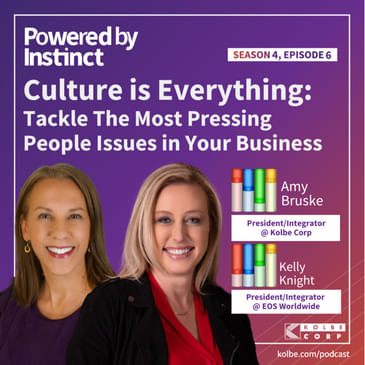
What’s the number one thing keeping entrepreneurs up at night? People problems.
So, we asked the President and Integrator of the company helping hundreds of thousands of entrepreneurial companies around the world how to turn their worst personnel nightmares into a dream scenario.
In this conversation, you’ll hear Kelly Knight of EOS Worldwide and Amy Bruske, President/Integrator of Kolbe Corp, dive into the best ways to solve your biggest people issues and ensure maximum productivity from your team. You’ll learn about the importance of Right People Right Seats, how building an intentional culture is everything, and even the power of love (yes, love) in leading your team.
Stop staying up late worrying and start building the culture your people need and deserve. The path begins with this episode of Powered by Instinct!
Host: Amy Bruske (3583)
Guest-at-a-Glance
💡 Name: Kelly Knight (7752)
💡What she does: As President/Integrator of EOS® Worldwide, Kelly helps provide entrepreneurs with simple concepts and practical tools to drive results for their businesses. Kelly is also an official member of the Forbes Business Council.
💡Company: EOS Worldwide
💡 Where to find them: LinkedIn
💡 Author of New Book: People: Dare to Build an Intentional Culture
Takeaways
- People are central to the success of any business.
- Using Kolbe’s RightFit™ Hiring Solution, and open-ended questions can help in hiring the right people.
- Building an intentional culture requires thoughtfulness and dedication.
- Balancing challenge and skill is crucial for employee development. Create an open and honest environment for employees to express their concerns and feelings.
- Practice heart-centered leadership and prioritize genuine care and concern for others.
- Have courageous conversations and make decisions that serve the greater good of the organization and individuals.
- Read 'People: Dare to Build an Intentional Culture' to learn about creating intentional cultures and access the resources available.
Key Quotes from Kelly
“When you see really spectacular cultures where people are loving what they do and thriving and companies are growing and you can see the kind of impact they’re making on the world, that didn’t just happen by accident.”
"Getting the most out of people really requires that you're showing up with that genuine caring concern. I always say, please do not become a manager or leader if you don't have genuine love for people."
"There are a couple really key things that we do across the board no matter what seat we're hiring for. And one of those is Kolbe. Kolbe has been absolutely instrumental every single hire."
Chapters
02:16 The Importance of People in Business
04:06 Common Problems in Companies Running on EOS
05:30 The Role of Values in Hiring
06:50 Key Tools for Hiring and Building Teams
08:19 The Importance of Culture in Business
10:14 Balancing Results and Culture
11:32 The Role of Love in Leadership
12:51 Building an Intentional Culture
14:59 The Importance of Strengths and Fit in Roles
16:19 Balancing Skill and Challenge in Roles
19:33 The Role of Heart-Centered Leadership
21:43 The EOS People Book and the Importance of Intentional Culture
38:36 The EOS People Book Launch and Resources
If you would like to be a guest on Powered by Instinct or get in touch with any of our Kolbe Experts, send us a quick email: info@kolbe.com
[00:00:00] When you see really spectacular cultures where people are loving what they do and thriving and companies are growing, both on a P&L but also just you can see that magnitude of impact that they're making in the world. That didn't just happen by accident.
[00:00:15] Welcome to Powered by Instinct, a podcast for professionals who think about how your fundamental nature drives performance. If you're interested in getting more done, more naturally, then let's jump in. Hi everyone, welcome to another episode of Powered by Instinct.
[00:00:32] I'm Amy Brouski, I'm the President and the Integrator here at Kolbe Corp. In season 1 we got to talk to Marco Donald who's the CEO and visionary for EOS Worldwide but today I am so excited to add to that conversation
[00:00:46] and have some fabulous insights from our guest, President and Integrator of EOS Worldwide. Kelly Knight. Thank you for joining us, Kelly. Amy, I am thrilled to be here. I'm looking forward to this for weeks. Yeah, I'm so excited to have some of your wisdom shared with everyone here.
[00:01:02] As a reminder, my four Colby numbers are 3583. Kelly's four Colby numbers are 7752 and Kelly we're going to talk a little bit later about your ammo in your journey and how you got to where you are in EOS in a little bit.
[00:01:17] So for everyone listening, let me just define EOS Dance for Entrepreneurial Operating System. Colby Corp here we run on EOS, it is helped us tremendously.
[00:01:27] It helps us with our structure, just how to structure the business but also some of the tools are really important I think for as a company is changing and growing rapidly, making sure that we have some simple ways to make decisions.
[00:01:40] So the tools kind of take it to the next level and we'll be talking about that in a little bit. What I love about EOS is they have an abundance mindset.
[00:01:48] So everyone stay tuned until the end because I want to talk about how you can get your hands on some of the free tools that EOS offers that you can start using right away with your team. So I love, I love that so thank you for that.
[00:02:01] All right, so there's this lovely intersection of Colby and EOS when it comes to the people part of the business. We're going to be talking about creating healthy teams. And we're going to talk about why building an intentional culture is critical to growing businesses.
[00:02:16] And there is a new EOS book for those of you on video I'm holding it up now that this is an advanced copy,
[00:02:22] but I'm so excited about the fact that the people part of the process is so important that you guys have actually written a book about it. So we're going to talk about the people book, dear to build an intentional culture.
[00:02:33] There's some unconventional ideas in there including maybe the word love so I want you all to stay tuned for that.
[00:02:39] I'll talk about that a little bit. All right, so Kelly you have such unique insights into rapidly growing companies not just because of what your role in EOS but all of the thousands of companies that you're working with worldwide.
[00:02:50] Tell us about the people component. Why is that so important?
[00:02:54] Well Amy first of all for my perspective it is just everything to me people is everything no matter what kind of industry or business that you're running people is central to everything anything that you want to accomplish as an entrepreneur starts with people.
[00:03:07] So that's really at the heart when we interview organizations, some running on EOS and some not running on EOS at the center of 82% of all entrepreneurs saying that they're just not getting enough out of their people.
[00:03:19] And what an amazing impact that either has if it's working while in your business or if it's not working while in your business.
[00:03:25] So it feels just at the heart of a good place to start out of the six key components of EOS following the first book in the deep dive collection which was all about process.
[00:03:35] Written by Mike Peyton and Lisa Gonzalez. So this is really the second book in the mastery series or mastery collection at EOS and we decided to go with this one next out of all six because it really is that important.
[00:03:48] Yeah, absolutely well and as you're saying this is what keeps entrepreneurs up at night right when we talk to them it's like oh it's about it's the people it's not just are we not getting enough out of them it's all of the other challenges that go through that so.
[00:04:01] And some of the most common problems that companies running on EOS face right now.
[00:04:06] I mean there's a good handful of them Amy, but I mean under the theme of not getting enough out of their people it just starts with getting what we call RPRS which stands for right people in the right seats.
[00:04:17] It's a combination of adhering to the core values of an organization and at the same time making sure that that individual is truly getting wanting and having the capacity for the seat that they sit in.
[00:04:30] And so at the heart it's really trying to help entrepreneurial companies see that a people really is not just a nice thing to have it's a critical thing to have to whatever it is that you're trying to achieve in your 10 year focus or you're 10 year target.
[00:04:44] So it really starts there beyond that it's really attracting great talent retaining great talent and just end ending entire life cycle is really creating an opportunity we have a line of what people who can't wait to come work for you because they hear such great things about.
[00:04:59] The people and what you're doing in the mission cause purpose and passion which is a high attractor in today's world no matter whatever the generation is there is more of a trend toward wanting to feel connected to something bigger than themselves.
[00:05:13] So those are kind of the issues on both sides right so business owners and entrepreneurs the issues that they're dealing with but then also everyone out in the world who wants to be connected to somebody who.
[00:05:23] have something that appeals to them as part of their own personal core focus that they want to be a part of.
[00:05:29] So how does you said you know it's so key to attract the right people and then keep them I know you talk a lot about values mentioned kind of what role values plays in that and any key tools that you feel are most useful for people.
[00:05:45] So there are a couple really key things that we do across the board no matter what seat we're hiring for and one of those truly is Colby I mean it that relationship that you have us worldwide has had with you and your team Amy for.
[00:05:58] very long time even predating my coming in is the integrator eight years ago and it has been so fundamentally important because we're really trying to understand the DNA of the person that is really sitting across from us having a great conversation.
[00:06:13] more than we can understand what really makes that person tick and how do they really work in their most natural state Colby is so great for that and we really desire greatly to make sure that we're getting the right match from the very beginning because we realize that if we're not the right fit for somebody we want to know as soon as possible for their benefit just as much as hours so Colby has been absolutely instrumental every single higher another thing that we do is we asked very open ended questions.
[00:06:39] with that a question about in certain situations how would you respond and we're really looking to see is the response in connection to our core values being humbly confident.
[00:06:50] grower die help first do the right thing do what you say is there a connection to that with that match how we would want the behavior words and actions. to resemble how our current team already exists.
[00:07:02] And if there's a disconnect or we feel like it's just not quite an alignment, we're able to flush that out pretty quickly. And then I'd say the third thing beyond Colby and open-undid questions and kind of storytelling that Willow is it is also something
[00:07:15] that's Shannon Waller wrote a really brilliant book. I talk about this all the time. Probably one of my top 10 business books of all time. It's called The Team Successing and Book. I'm holding it up for those who are able to see visually, but Team Successing and Book.
[00:07:28] And it really describes such a tiny, small book, but so succinctly describing what is an entrepreneurial organization compared to a bureaucratic organization because we really run even though we continue to get larger as an organization we really want to have that entrepreneurial spirit.
[00:07:44] And so it perfectly depicts kind of the chemistry that exists on teams that kind of roll that way versus being. A larger organization that maybe just a little different. So those are the three bigAs. Well, thank you. Oh my gosh, you brought up so much,
[00:07:58] there's so much richness in all that. First of all, mentioning Shannon Waller's book. Everyone at the Team Success Handbook, we give that to every new employee. And as you were mentioning, it's just a small little booklet, but it just goes over these 12 principles
[00:08:12] of what is entrepreneurial behavior look like. And we pull it out every year when we do our big conference because that's when we need some of the highest level teamwork. But I found some of the big-aw-hots in there just as you were mentioning
[00:08:24] is the difference between an entrepreneurial company. We only get paid for results. So the idea that I worked really hard on this project if the results weren't there, you know, that's all that matters. And so it's been an interesting conversation about that whole time and effort economy.
[00:08:40] It really is about the results that we get. And so not just how much time you put into it. So I love that. And it does start with, I do find that companies tell us the most, well, it gives them that insight on is it gonna be
[00:08:56] just this sweet spot for this person because no amount of just kind of forcing somebody into a role that long-term does not fit their strengths. As a leader, it's just is so frustrating, but what we really know is the employee, that level of pain and burnout isn't sustainable.
[00:09:13] And so if you really care about this employee, kind of setting them up for failure. And it starts with looking at this resume that looks amazing on the surface because all the skills are there. And so I think when we give that too much,
[00:09:28] when we're looking at that too much, that doesn't work. So you would said first, look at the strengths certainly is it a fit, second values. So you do some really good questioning around values alignment which is huge. And then the third is just make sure
[00:09:41] that they have that entrepreneurial mindset. I love that, that's a great model. Yeah, that's right. And something you said, I think is such a great prompt too, which is we definitely get paid for results. And also it's got to feel pretty good along the journey.
[00:09:55] Meaning if we get to the results, but it feels clunky and awful and abrasive and friction filled, the entire time we're working together, as a team not to mention individually, that's pretty rough. Like that doesn't build a great culture. And that's where the intentional culture comes in
[00:10:11] and having the courage to hold those standards really high for the benefit of everybody that you interact with. So I think all too often were sometimes, right? We're growing quickly as organizations. We have certain seats that need to be filled,
[00:10:25] and we can sometimes compromise a little bit like, well there's 70% there it'll be okay. And most of the time in my experience, it just isn't true, especially if the 30% or whatever percent your compromising on are the really important things. Like well it's just awful little bit on cold.
[00:10:42] They like only three degrees of difference. You know? And we know that that just doesn't work. So that's why we have cold B consultants on our own team, right? That know how to really read these things. And they're the truth telllers and our business
[00:10:55] on our HR and people team, which I really value it was just really gonna be okay or is it not gonna be okay? And so part of this is the truth serum of being reliant upon tools that are so good
[00:11:06] and so selected that helping us really get it right and not discounting them. And cold B's one of them where it is tried and true. And if it doesn't, but it's not a fit, we just won't do it. And we have saved ourselves so much in pain
[00:11:17] and agony of having to reset and do another search again by just relying on tried and true methods, which we consider cold B to be there. Well give you a little bit of objectivity because here's the deal. We're all human beings.
[00:11:29] And we have these internal kind of biases that if you and I connect on a level where I really like your personality or we have something in common, sometimes you fall in love with a candidate and that candidate is not gonna execute the way you need them to.
[00:11:45] So we might have other things in common, but we need those objective measures to kind of say, hey, this is really how this person is self recording. This is what they need. They've told you what they need right by filling out that cold B a so 100%. Yes.
[00:12:00] So go back to something you said. Let's talk about intentional culture. What does it mean to build an intentional culture? Because that's a big foundation of what you're doing in the book. Yeah, it's absolutely critical. Again, it's in our business world underrated. Okay, so let's just start there.
[00:12:16] In my opinion, very underrated, how important culture is, how important where values are, how important it is about just being intentional. And it really starts there. It's that there is no intentional culture that is positive and healthy and growing. That doesn't exist just by happened chance.
[00:12:32] It's not an accident that that happens. It's that when you see really spectacular cultures where people are loving what they do and thriving and companies are growing, both on a PNL but also just you can see that magnitude of impact that they're making in the world.
[00:12:47] That didn't just happen by accident. That is really truly being dedicated and thoughtful and putting a ton of energy and thought and consideration into making sure that you're building something of intention that you're proud of, not that you show up three years later and you're like,
[00:13:00] hey, I was hiring all these people but turns out that it didn't work out as well for me. So it really just starts there by acknowledging that it takes courage. It is hard work. It really is. I mean, in an organization where you maybe don't have
[00:13:13] the kind of culture that you would like, it can take a little while. It can take 12 to 18 months to turn it around because it is going to get worse before it gets better and that is really hard. It's a hard pill to swallow for an entrepreneur
[00:13:25] who may already feel a little overwhelmed or that the business is growing in a rapid pace and they don't have the luxury of stopping to slow down but it is the one thing that if you truly put people first and you do slow down and get really thoughtful
[00:13:38] and intentional about the steps that it needs to take because there is a roadmap. It's written in the People Book and it's all in the US tools. That's the good news. On the other side of some pain is a lifeline to your future that will really reflect something
[00:13:51] that you're very proud of and it becomes something that I know for many entrepreneurs. This is a legacy that they're building something really important and the results do you matter but it's got to feel a little along the way, too. Oh my gosh, that's such a good point.
[00:14:02] And honestly, when we first started implementing NELS we already had a set of values that we used and they were really kind of work round rules. So they were solid but there were too many of them. They weren't really established well
[00:14:16] and so going through the process of what EOS told us to do with the values was so huge to look at, even just to look at some of the top performers that we had who do you want to replicate? What was true about them
[00:14:29] and really getting back and saying do you have a culture that you aspire to? These are our values, these are our aspirational values or these are the reality of what they really are and what we want them to be.
[00:14:38] And all of that made the biggest difference in the world. So just going through and establishing those, we tightened it up, we got down to four court things. They've absolutely played out. It's fascinating to hear people say I love our values and other people who work here saying
[00:14:53] I love our culture. Like that is the one thing that, but it takes a while, totally worth it. So thank you for saying that because I do think that that's huge. And as you said, you're laying out a roadmap like the tools are there for you to use.
[00:15:06] So really, they really are an understanding that people are not static. Meaning that people grow. Their colby is the same, right? That's consistent. However, the capabilities to learn and to grow and to expand your thinking really does evolve. And so sometimes what also happens in organizations
[00:15:27] is you can kind of revert to the default. Somebody is this certain way. And you forget that they have the capability to become new and different things by way of training and going through programs and coaching and all these other things that we have accessible to us today.
[00:15:41] And so in the book there is this dynamic, which really kind of puts skill and challenge to the test. So if you have more challenge and against skill, right? Those are the two things we're measuring. Challenge for an individual role versus their independent skill work.
[00:15:56] Their skills are increasing and you're not giving that person enough challenge they're going to get bored. And if that person's skill set is growing but yet there's too much challenge being thrown at them, they're going to become anxious.
[00:16:09] And so it's trying to find the right of long the path is having the right combination of challenge to the skill that that person has as they continue to grow and evolve. And so in that sweet spot is what we call
[00:16:22] the GWC channel, which stands for the get it, the one in the capacity channel, which continues to grow and evolve over time. So when you're having your meetings with your independent members of your team and quarterly conversations, it's important to recognize where they a year ago,
[00:16:37] where they last quarter, where are they today? And am I giving them am I delegating and elevating enough to them also based on their cold day? Enough challenge just enough challenge that they're continuing to grow against their skill set or have I given them too much
[00:16:52] or something that's outside their unique ability and there'd be coming stressed or too little and they're getting bored. So really measuring that over time is an important component to making sure that each member of everybody on your accountability chart isn't that sweet spot.
[00:17:08] I'm so glad you brought this up because I do think it's fascinating. We have employees that have now been with us over 20 years, like quite a few. Certainly tons of over 10 years, 15 years, they have changed so much over time. And but I have experienced in my career
[00:17:22] promoting someone to a point where all of a sudden there's this level of stress and having to really figure it out and say wow, that challenge is you're saying just went up to the point of now almost debilitating this person. And we have to constantly be calibrating
[00:17:38] what is the sweet spot? And it almost reminds me of school. So those of you that have kids think about the fact that if your kid is super smart and they're not being challenged, they're gonna struggle in a totally different way because now they're bored.
[00:17:53] Now they become trouble makers. They're bored, you're not really using them. That's not great either. So not enough challenge is a problem but then too much challenge is certainly an issue and so to be constantly looking at where is that sweet spot.
[00:18:08] I think I love that, that kind of intersection of skill and how much challenge you're giving them. So that's a good thing for all of us to keep thinking about that it's a constant calibration and the person in the role themselves
[00:18:20] have to be a big part of this conversation. They need to speak up, they need to feel like this. They can honestly say here's where I am and you need to be checking in with them. So we're all responsible for our own careers as well
[00:18:31] but as a leader, you really have to get a handle on that sense of it because your top performers don't tend to raise their hand and go too much. Like we know they'll keep pushing through until it's too late. Oh, they've got some memories.
[00:18:46] Remember the people you lose are those top performers. Right and creating that open environment for people to without judgment or criticism or shame be able to say, hey, Amy, I'm really feeling like I'm outside my comfort zone. Wonder if we can have a conversation about that.
[00:19:05] Being able to open that up or to be able to ask, how are you feeling about all of these new projects that you've been taking on and just being willing to hear anything that they say without criticism? I think at this point I have heard
[00:19:18] every possible response I ever could have gotten to any of these questions and it's all okay. But I think as managers and leaders we need to create that really open, vulnerable, able to be completely open and honest environment for that. And you know what you think about Colby?
[00:19:33] I will often look at teams and we can run the matrix of what leadership team looks like and where we have too much crossover not enough or we have holes on teams. But when I think about Quickstart as just an example, somebody who has a very high Quickstart
[00:19:48] might need a little bit more introduced into variability or trying new things that are experiencing or learning. Someone with a lower Quickstart might need a little bit more time to adapt along the way in which they're learning on their career path.
[00:20:02] And so it's just keeping that in mind and how you communicate, how you work with them. And that's why I also think Colby fits in beautifully with EOS is in that quarterly conversation every 90 days we're sitting down with each person individually who works for us
[00:20:16] and able to talk about all the things that they're experiencing and using the tools to again help us just refine and fine tune the journey and working together. It's hugely helpful. That's right, yeah, thank you. Because there are different MMOs
[00:20:29] that I always work with all the lot of leaders of sales teams too and I'll talk about how the ramp up looks very different sometimes with different MMOs but I'm like it's worth it. So somebody had this eight-in-fact finder who was kind of accommodating,
[00:20:42] I think at a six-level on Quickstart nice to have the patients who allow this person to get to the point where they are feeling more like an expert because they strive to have expertise and depth of knowledge and they're going to be a rock star.
[00:20:54] But you've got another person who has a very different MMO they're going to be on a little bit of a different path and sure enough that plays out. So oh, that's great. Okay, let's move to one other thing. I want to talk a little bit about
[00:21:05] there's a lot of consultants listening. So we have a lot of our own Colby certified consultants who listen to the podcast and I know that at EOS you have implementers, that's what you call the people who are helping organizations as experts, implementing OAS, what is a consultant
[00:21:23] you think working with some of these teams need in order to be successful right now or what's one insider tip or anything like that that you could give to consultants? For what do these organizations need from them? I'm going to go to humans need this
[00:21:38] but certainly it applies to consultants which is hurt-centered leadership. And this is where the love gets introduced and it does this whole theme around this can be very uncomfortable for a lot of people because we tend to want to think of love as this romantic kind of love
[00:21:53] but that's not what we're really talking about. We're really in this sense. We're talking about love as heart-centered leadership which just means truly showing up with genuine care and concern for one another whoever we're sitting in front of whether that's an individual, a team, an entire organization
[00:22:10] of consultants and EOS implementers really being in tune with that. There's the EQ component, there's IQ, there's EQ for emotional intelligence and then there's also something called LQ which is love quotient. And I think being really, really great at what you do
[00:22:27] in any case requires all three of those to show up. So getting the most out of people being real true maximizers and multipliers as sometimes we talk about with strategic coach really requires that you're showing up with that genuine caring concern if you can start there.
[00:22:41] I always say, please do not become a manager or leader if you don't have genuine love for people I would say the same thing as a consultant or any U.S. implementer is, if you don't just love people and love coming first to help
[00:22:55] and do the right thing, it's probably, maybe go select something else to go do. So I would say that's the biggest place to start because it's so wo-fully lacking in our world sometimes that wherever we show up if we can just start there,
[00:23:08] it's a pretty darn good place to start and build on all of the themes and whatever issues or projects we're working on if it starts there, it's gonna be pretty good. That is so enlightening and I tease a little bit at the beginning of this podcast,
[00:23:21] you know there are some components in the book that I find people might think are a little bit controversial or strange or whatever but when you really think about the business case for putting the love in it, it's being able to be really honest.
[00:23:34] If you really care about this person, you will share with them exactly the ways that you already know you can help and where things might not be going right and I remember this story at one of the EOS conferences
[00:23:47] where a woman stood up in the audience in Gino Wickman who is the founder, everybody of EOS was on stage and she said, this might be me but I think it was a woman. Here's the challenges I'm having and he's like, yeah, it's you. I mean, he basically,
[00:24:01] she's like, I'm the awareness problem. I think it was with the specific employee or whatever but she said yes but let me tell you, I think you're the problem. Everyone kind of laughed but I think everyone else is also been in those kind of positions
[00:24:15] where I know I have something that I can say to this person that's going to help them but it's really hard and it makes me uncomfortable. But if you love them enough, you will share that information, tell someone they're in the wrong role,
[00:24:27] even though they want it and they really think this is best for them but you help them make hard decisions. It's about the hard decision. Oh, it is so about then this is where there's the intersection of having the courage and being deranged, coupled with that heart-centered leadership.
[00:24:43] I mean, let me give you an example. It's happened time and time again at EOS where could be near, could be another manager recognized that someone is just not the right person for that seat. Most often it's not a core values issue and it's just a cheat WC.
[00:24:56] I get it when it capacity for a particular seat issue. They might not even be able to see it. The person who's being impacted. But two things can exist. You can serve the greater good of the entire organization and individuals at the same time.
[00:25:09] That's another huge myth in business that you can't do both at the same time. It's either you're choosing the company or you're choosing the individual. But what happens is, is rarely anything combustor in loads when you have this conversation with a person. Sometimes it's an opportunity for improvement
[00:25:24] and that person can get back on track and we can fulfill the needs of the seat through GWC. But if it's a capacity issue, oftentimes it's just not possible. And so a different decision needs to be made that either need to move into a different seat
[00:25:37] or potentially lead the company. But I will tell you, if I've had many people say, they don't agree with my decision. I've gotten pretty comfortable with that over time. When I believe that I'm serving the greater good and they're greater good too.
[00:25:51] But I've also had equally as many people come back and say, you were kind of right. I wasn't the right person for that seat. I'm happy here where I am now. I'm genuinely happier so that fuels me to always remember that. I don't always get it right.
[00:26:04] I am as humble a leader and I make mistakes all the time. But I am in a position where I've got to really use all of the tools that I have at my disposal. And also my experience and intuition
[00:26:14] to just do the right thing that I can for people. But that's heart-centered leadership. It's very practical, Amy. We think of love as being this. We go eat like, kumbaya, standing around a campfire, holding hands. But really it can show up in simple ways
[00:26:29] like if you're getting someone a technology tool that makes their job easier. That's putting the love into the work that we're doing. We're prioritizing people. Or it could be that I take a clarity break. So that I can be in the best head space
[00:26:42] before I have a, maybe difficult conversation with someone so that we have the best outcome. So those little tiny things that love is pervasive and the fabric or being woven into just the day-to-day actions, words, and behavior? Absolutely.
[00:26:57] I often say when I do a Colby seminar with a team, congratulations in how fabulous that you work for a company that cares so much about helping you discover your own strengths and making sure that you love your job and those kinds of things.
[00:27:10] And so it really, it's a nice way to kind of wrap up the Colby NEOS tie because one of the things that we can really do to serve our people is help them discover what's really natural for them. Sometimes people have spent a lifetime working against this
[00:27:26] and they actually get themselves into roles along their career where they're getting rewarded for exactly what's working against their grain. I've met people all the time that have done that. So they just keep getting more of that. So getting that clarity and saying,
[00:27:40] I care enough about you to make sure let's figure out how to tap into these strengths and align things to your role. And if that's not possible, let's figure out if there can be another role or if it just doesn't work here. So, right?
[00:27:53] Well, I mean, Amy, what could be better than helping someone find their God-given unique ability and using Colby and other tools to do that to show up and uncover the thing that they never would have found out on their own. I mean, right? That's a little bit.
[00:28:07] People light up from inside to be able to do something they love so much. It's pretty, pretty remarkable. Well, so that brings me to you because we're talking about other people discovering their strengths. You know, let's talk a little bit first of all
[00:28:20] of what was your path to ELS and then I would love to also hear getting your Colby result. What was that like for the first time, too? Oh, no, that's a funny story because that predates ELS, too. So, well, look, I have spent a lot of my career
[00:28:34] in the financial services industry. I had my own financial advisory practice. I sold it. I did a startup. I did a recovery kind of registered investment advisory thing in any way. Long story short as I landed EOS. So that was about eight years ago.
[00:28:49] The interesting thing is I had been sitting at my desk in the financial industry about six weeks before I got the call from the recruiter thinking, I'm not meant to do this. Like, I mean, it is really a cool opportunity that I've had all these years.
[00:29:02] I'm so blessed to have been able to do it. It means nothing to me. I mean, which is kind of a scary place to be in thinking, you know, I was not 18 years doing this and something like that. Like, this is what I really meant to do.
[00:29:14] And so I actually prayed on it and truthfully, six weeks later, I got the call from the recruiter and I had said talking to the Lord. I'm like, I will do anything that comes my way, no matter how different it is.
[00:29:25] If it's not financial industry, whatever it is, I will follow. I will try anything. Well, virtually, what was some my way was EOS? I never heard of it before. I had taken Colby before at other organizations I had been a part of.
[00:29:39] And the last one that I had taken before coming to EOS was in transition, that's the way it came out. It wouldn't even compute real listeners. You know more what that means than I do because I'm not a Colby consultant but I feel like I broke the system
[00:29:52] like there's really something wrong with me. It's been nails people every time. It's meant you weren't free to be yourself at that in that moment. In that moment, I know I was not and it was very clear to me but anyway, so I was super excited
[00:30:06] to learn about EOS while I had not been in the EOS community. I had not been in EOS in Plumunctur, I've not worked for a company running on EOS. The closest I had come as I had read Rocket Fuel. Someone had handed me Rocket Fuel
[00:30:18] and said, I think you're an integrator and I read it and I thought, oh, that really does read like it's me. So that was kind of how I got into the EOS world is by happened chance that I got a call from recruiter
[00:30:32] and so in discovering my strengths, I think it's been just a very long bumpy road, honestly. Amy over time of trial and error that things that I like and that things that I don't like. I know one of the things that I really, really love
[00:30:46] and I think it's in my upper left hand quadrant for delegating elevate is Elame and that stands for leading managing and holding people accountable. I truly wake up every day and I feel so fortunate to be able to work with the team here at EOS worldwide.
[00:31:00] That's just the leadership team but we have now 140 people on the team. Eight short years ago, I was the first W2 employee so we've had quite a bit of people growth over that time. And it's really just a huge people focus. I love our EOS Implementor community.
[00:31:14] We just got back from our Dallas QCE where we had 700 people in one space and it's just pure joy for me to understand how people tick. What makes them think and work and believe what they do and to harness human energy getting all arrows pointing
[00:31:30] in the right direction to achieve something remarkable as an organization by way of people? I think anything related to that is kind of my unique ability and my God, given talent. So that's kind of in a nutshell. Let up perfect. Yeah, what a perfect fit because you're saying,
[00:31:45] going back to three parts of the mind, you're able to use some of your skills and granted you had been a business owner before and sold your company and all that. So you knew what it was like to be an arraptate like growing company
[00:31:55] and an organization but the fact that these are things that fit your cool BMO and you love to do, help perfect. And let's actually talk a little bit about some of your most important collaborations because one of the things I know about you is you're a fabulous collaborator.
[00:32:10] I've seen real time how much you're the glue that holds people together and you're in a similar situation to mine. So in EOS world everybody, there are key relationships or key positions, really an organization, a visionary and an integrator, visionary being the person that's really driving
[00:32:28] the future and coming up with lots of ideas. And the integrator being that key partner and all of that to execute on those kinds of things. So at Colby Corp David Colby's The Visionary and I'm the integrator and in your case, you have Marco Donald who's the visionary
[00:32:44] and you're the integrator. So everyone, Marco Donald's MO is I believe 2, 2, 10, 2 something close to that and then Kelly is a 775, 2. So tell us how those two things work together, how have you seen your Colby strings play out when do you maybe drive each other crazy
[00:33:00] whatever my big, it's really interesting. Mark and I have been visionary integrator duo for about three and a half going on four years and really truly it has been from my perspective anyway and make it a different answer from Mark
[00:33:13] but I think it's been a very natural thing. So a high-fact binder, high follow through the 777 Mark is much lower in those but it's interesting because he doesn't show up that way. So I think it's through high responsibility that he loves a research,
[00:33:28] he loves tinkering in the workshop as a visionary, loves big relationships, I do too. And so I think that just harmoniously ties well together while you might think looking at the Colby that that would create a tremendous amount of friction
[00:33:42] right and I'm quite sure there are times I drive him crazy with details and wanting to be very specific about how we maybe go execute in ways that interest him loss. But I really, I see this time and time again
[00:33:54] and I think it's our Colby as I interestingly I do think well together but we treat kind of the relations that we have with great honor that it's really of the level of, you might do with a merit right? You put a ton of intention into it
[00:34:08] and so talking about intentional cultures and intentional relationships think we are so passionate about EOS that it really helps us move through those moments when it's maybe a little more friction filled he wants to move faster and I'm pulling back
[00:34:21] as an example on a quick start because he's a 10 and I'm not and it's more than just a degree or two difference there. It's just that we're just so committed we're like okay well let's just figure this out let's just take one step at a time
[00:34:32] we will figure it out and so I think that's really at the end of the day it's through that intentional piece that we've talked about today. Absolutely yeah you guys are always on the same page and share values about where you're going
[00:34:44] so I think that synergy that you have with your two very different demos play out I do think Mark every once in a while for the Colby community that are certified you know we talk about how the cognitive really affects things and Mark has this background
[00:34:58] I believe it's an engineer am I right about that? That's right. Yeah so I think he has a lot of expertise and learned behavior around information and data and how data driven decisions are really key but he's a good simplifier too
[00:35:13] so I think honatively that two in fact find or simplifies but he's so driven to make sure that we have good information when we're making decisions and the differences you guys have David Colby and I have similar differences especially in fact finder
[00:35:26] I mean he's the best partner that I could have because he is doing some of the legal and finance and detailed kinds of things I'll take that information and then I'm communicating it to other people in a more simplified way so you know however that looks for visionary
[00:35:41] and integrator duos what I want to say to our audiences there are key relationships there's magic that happens when you take people with shared values but with some different strengths that come to the table you can have this amazing multiplier effect
[00:35:58] but it just it has to be the right person and so I know you guys really focus on visionary and a greater relationships especially in making sure that those are right because that's driving everything else that happens in the business
[00:36:10] and you guys are such a great model of that so I love watching that in action we've worked with you guys long enough to see like how does that play out and you really stay in your zone and do your best work together
[00:36:23] we really try very hard at that and I also really respect his strengths even though they might not be mine and I think he would say the same too so even if there are those moments where say as an example
[00:36:35] he is being very quick to want to move forward it's something I'm also recognizing that that's his gift and so when it matters it's there's some of that compromise or give and take about when we do just move forward
[00:36:46] and there's a lot of trust to this involved in that just like Patrick Lennchownie teaches and the trust pyramid when there's a lot of trust sometimes you move forward with something a little faster than maybe what you might ordinarily be your ML because you're working together
[00:37:00] it's a partnership so I think that plays a role for market myself too yeah the speed of trust is a big that really does play out okay before you move on anything else about your colby strengths and discovering that I know it was a long time ago
[00:37:14] that you got your result I don't know how that played out at the financial services I'm just curious I see all kinds of colby results that based on what you were doing before how is that a fit compared to now or what did you know
[00:37:26] you know Amy I would say it's very similar because I was running a financial industry's company at the time and so I was serving financial advisors that served clients well today I serve U.S. implementers who serve their clients so I think by way of the model
[00:37:41] it was very very similar and I just stumbled into it you know I mean some of that is just pure a lot for time to time that there were these roles that just happened to have I think a natural fit with my skill set
[00:37:53] and that had nothing to do with might be particularly great at picking the right roles for me I think they chose me maybe is what it happened there but the similarity and how I was working and how that fit into my my natural ML was pretty cool
[00:38:06] I need to see that it transcends industries right? Yes. Oh my gosh. Congratulations for that because that's huge. Being able to be doing something you love and it's a year in a zone with your strengths too. Hey let's talk about the people book
[00:38:19] launch and all of those things so the new book that we mentioned is the people dare to build an intentional culture and you wrote that book with Marco Donald who we were just talking about and CJ Dubay who happens to be a Colby certified consultant
[00:38:33] and our employees here at Colby Courts so I know that launches soon April 2nd, 2024 and for all of you listening you know it might be past that time by the time you listen to this podcast but you can pre-order it now. Tell us a little bit more
[00:38:48] anything else in the book that you really want to highlight or talk about that people should know You know just the most important thing is that there is a solution to this problem and most people don't fully understand that they do not have the
[00:39:03] intentional culture that they believe that they do so I would just welcome the opportunity for you to read the book and it will basically tell you in chapter one here's the good news for those of you that maybe aren't the biggest fan of reading
[00:39:14] although this is going to be out on audible as well. Just read chapter one it's going to give you everything that you need to know whether you have the readiness or the capability it's the right time for you to really take that next
[00:39:25] stop and if it's not your great at chapter one but but I do believe that there is just such gifts and EOS that many entrepreneurs who've been running on EOS for a long time have learned by way of the experience, practical application of those tools.
[00:39:43] I do think that the book is just the shortcut to getting to kind of the heart of some of them a little bit faster and it goes deeper on them so I would just say the book is just a great road map
[00:39:51] and it creates the ability for you to see kind of what's possible what is possible in your world that you can't even imagine sitting in your seat today because all you know is where you've been at right?
[00:40:01] How does it fish no when it's in a round of water? So that's what I would say is just kind of trust the process and know that EOS is a great great set of tools and a system and a process for getting everything you want from your business.
[00:40:13] Yeah and I talked about the fact that you guys are so generous with the tools and you really do cover quite a few of those in the book too so everyone and there's some great case studies and stories in there too
[00:40:23] and what I love about it is it's really simple but as we all know things that are really simple are not always as easy to do. So I think you're pretty honest about the hey everybody here's what you really
[00:40:36] need to do this is easier said than done sometimes but I think you've covered the most critical parts of managing people and the challenges of where it goes wrong and how to make it a little bit easier by giving everyone tools so I appreciate that for sure.
[00:40:52] Yeah so and you know this all started from Gino and Don Tini is into greater business partner way back in the day as really we give the entire toolbox the 20 tools away for free completely downloadable at our website
[00:41:05] so if you visit us worldwide.com and just go to the toolbox it's all there for the taking and it's a great compliment to the book itself so we want nothing more than a abundantly to help entrepreneurs truly set out on a journey to get everything they want
[00:41:17] from their business and live their ideal lives which we call the US life which is doing what you love with people you love making a huge difference being compensated appropriately with time leftover for other passions I mean that's a pretty great
[00:41:30] tidy bow on life if we can help you get just a little bit closer to that every single quarter every year we'd love to be part of that oh my gosh yeah the people life I
[00:41:39] mean that when you describe that that's the dream for sure so okay thank you so much Kelly tell us where people can go to learn more about the amazing work of the US and how to get the book
[00:41:52] just visit us worldwide.com it is all there we have a landing and paid just for the people book with all kinds of tools there's a culture check-up assessment which just takes a matter of
[00:42:04] a few minutes to kind of get a sense of where are you at in terms of your intentional culture and it gives you also some solutions some tools to download and videos to help support
[00:42:13] you no matter where you sit on that journey so that's great everyone go do the culture check-up that's a great way to start I love that and the fact that you have videos ready to go you've got
[00:42:22] everything everyone whether it's the book whether it's the audio all the tools so go take advantage and Kelly thank you so much for sharing your wisdom and just being so generous with your examples
[00:42:33] in your stories and what you've learned along the way as always the best place to start to learn more about Colby too and the freedom to be yourself is by taking the A index if you haven't already
[00:42:43] done that go to Colby.com but of course Colby.com has all kinds of other information for you as well all right thank you again Kelly thank you Aimee it has been such a pleasure we are so lucky to be
[00:42:54] partners with you and the whole Colby team so thanks for having us absolutely all right everyone see you next time thanks for checking out this episode of powered by instinct if you enjoyed this episode
[00:43:07] then follow powered by instinct wherever you get your favorite podcasts or join us online at Colby.com slash podcast for all the latest episodes