
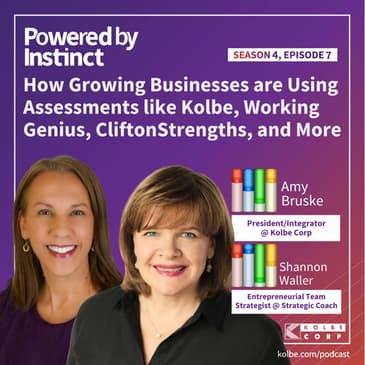
Why do we take assessments? What type of assessments should people and businesses use? How can you use assessments to effectively grow your business?
In this conversation, Amy Bruske and Shannon Waller from Strategic Coach provide the answers to these pressing questions and more. They explore the different types of assessments and how they can provide insights into an individual's cognitive strengths, motivations, and natural ways of taking action. Shannon shares her favorite assessments, including Kolbe, CliftonStrengths, Print and Working Genius, and explains how they complement each other.
They also discuss the effective use of assessments in understanding individual strengths and building successful teams. Shannon also shares her personal insights from taking the Kolbe A™ Index, how Strategic Coach implements it effectively, and how her MO has guided her career.
If you’re thinking about using assessments to improve your business, this is a great guide for how to do that more effectively. If you’re not using assessments to grow your business, it’s a great wake up call to let you know the importance of setting your team up for success!
Host: Amy Bruske (3583)
Guest-at-a-Glance
💡 Name: Shannon Waller (3295)
💡What she does: Shannon is Entrepreneurial Team Strategist at Strategic Coach®. She is also the author of several books, including The Team Success Handbook: 12 Strategies for Highly Productive Entrepreneurial Teams.
💡Company: Strategic Coach
💡 Where to find them: LinkedIn
Takeaways
- Assessments provide a quick and accurate read on people, helping leaders make informed decisions about fit and role alignment.
- Using multiple assessments allows for a more comprehensive understanding of an individual's strengths, motivations, and preferred ways of taking action.
- Assessments should not be used to box people in or as a cop-out for not taking action; they should be used as tools for self-awareness and growth.
- Understanding and leveraging one's unique ability is key to maximizing impact and fulfillment in work. Increase the amount of time spent in your unique ability to achieve life-changing results.
- Use assessments as a resource for understanding individual strengths and building successful teams.
- Be cautious of using assessments as the sole basis for hiring or firing decisions.
- Certifications and consultants can provide valuable expertise in implementing assessments effectively.
Key Quotes from Shannon
"Assessments should not be slapping a label on you because here's the deal. You are not that result, whatever assessment you're using at all times.”
"If you're doing just one assessment, you're only having one dimension. Human beings are incredibly complex and multidimensional."
“I think the number one value of assessments for me is to be able to get a read on people quickly. Business is moving fast. You don't have time to just hang out eight hours a day for three months with someone getting to know what makes them tick.”
“It could take you years to figure something out about someone sometimes that an assessment can help pinpoint for you right away.”
Chapters
The Importance of Using Multiple Assessments
Increasing Time in Unique Ability Activities
Focusing on Teamwork and Collaboration for Success
If you would like to be a guest on Powered by Instinct or get in touch with any of our Kolbe Experts, send us a quick email: info@kolbe.com
[00:00:00] You don't have time to just hang out eight hours a day for three months with someone getting to know what makes them tick. If I want to get a quick and accurate read, that is super important. So I've done a
[00:00:11] Kajillion different profiles. There's only literally a handful that I have curated and actually promote Kolbe being the one. So I think it gives you a really accurate read really, really, really quickly. So that you can actually determine, is this person the right fit for the role?
[00:00:26] Is the role the right fit for them? Welcome to Powered by Instinct, a podcast for professionals who think about how your fundamental nature drives performance. If you're interested in getting more done, more naturally, then let's jump in. Hi everyone, welcome to another episode of Powered by Instinct.
[00:00:43] I'm Amy Brouski, president and integrator at Kolbe Corp, and I'm so excited about today's topic, which is about how to grow businesses and how to do that in a way where you're using assessments successfully.
[00:00:55] So we have a lot of stories about how people are using Kolbe successfully, but today I really want to Round that out and talk about why use assessments, what type of assessments people are using and how to do that in a seamless way.
[00:01:07] Now in season two, we interviewed Dan Sullivan who is the co-founder of Strategic Coach. And now we are thrilled to welcome our entrepreneurial team strategist for Strategic Coach, Shannon Waller. Now, our guest today, the brilliant Shannon Waller is the author of my favorite book for team members.
[00:01:26] So I want to talk about that later. She is trained in multiple assessments and not only has she used them successfully in her own company. She coaches other people on how to apply them to help with the most challenging people problem.
[00:01:39] So that's what I'm excited about because I have learned so much from her. I know you're going to too. So Shannon Waller, welcome.
[00:01:48] Oh my gosh, Amy. I am so thrilled to be here. You're one of my very favorite people as you know both as a colleague and a friend as my, you know, teacher.
[00:01:55] I'm also your coach, your my coach. So I just love all the different connections that we have. And this is one of my very favorite topics. So extra thrilled to be here today. Thank you. Absolutely. So everyone quick background on Strategic Coach.
[00:02:08] And then we'll talk about them a little bit more later. This organization is really kind of the worldwide leader in entrepreneurial coaching. It's run by entrepreneurs for entrepreneurs Shannon. What's the really short description of coach for you? How do you guys change lives?
[00:02:23] Oh my gosh, this is a great question. Hard to do in a short answer. I've been with the companies in 1991 but I've also been in the program for that long.
[00:02:30] And I think we are just really the premier entrepreneurial coaching framework set of mindsets and community that any entrepreneur who really truly wants to grow wants to transform.
[00:02:42] And do it in the way that is the healthiest in the best for them and their family coaches it are clients are the best they're just incredible. Our coaches are all clients too. There's no talking heads. You know, there are people who actually haven't bought this for themselves.
[00:02:55] And the coaching mindset, the tools that we have to help people make their progress are amazing and they're fast and they're simple and they're designed for certain demos.
[00:03:06] Book went to this really great. So people want to self-managing self-multiple in company and if they've explored other things, coaches often where they come to go, oh now I can really make that next big jump.
[00:03:17] Absolutely. And I think one of the things that you said is caring about what's happening at work in your home life. I think that's huge because it is hard to be a leader of any type and especially if you own or running a growing business.
[00:03:29] So, and yes, I've been in the program for over 20 years. I don't remember ever the exact number but Shannon has been my coach for a long time too.
[00:03:37] So, for out all of you, my Colby result is 3583. Shannon's MO is 3295 and Shannon, we're going to talk a little bit more about your Colby strengths in a little bit.
[00:03:50] But first, as a good set up for today, let me cover just a basic concept to help make sure that we're all on the same page. Anyone who's new, want to make sure that you understand the concept of the three parts of the mind.
[00:04:01] And that is that everyone operates in these three dimensions of the mind and you have strengths in all three. So, cognitive or the thinking part of the mind being what you know, your skills or experience those kinds of things.
[00:04:13] Effective or what's called personality traits oftentimes are the feeling part of the mind is what do you want, what do you desire, what are values, motivations and maybe very importantly for taking action is what do you prefer to do.
[00:04:26] And then this last part of the mind is the cognitive part of the mind which is how do you take action. So that's the doing part.
[00:04:34] And Colby is the only assessment that measures this doing part of the mind. So when we start talking about other assessments and play, just know that Colby is this, how do you execute, how do you solve problems, how do you just take action if you are striving and if you're completely free to be yourself.
[00:04:51] So these are problem solving decision making strengths is what I've been saying recently that resonates with people. All right, so with that foundation of Shannon, here's the tip. Let's start super basic.
[00:05:01] Why should anyone in a leadership position even or even individuals? Why assessments at all, what's the value in using them. Oh my gosh, I think the number one value for me is to be able to get a read on people quickly.
[00:05:16] Businesses moving fast you don't have time to just hang out eight hours a day for three months with someone getting to know what makes them tick.
[00:05:24] And I'm a big shortcut fan also indicated by my ammo, but if I want to get a quick and accurate read that is super important. So I've done a gilling in different profiles.
[00:05:35] There's only literally a handful that I have curated and actually promote Colby being the one. So I think it gives you a really accurate read really, really quickly.
[00:05:44] So that you can actually determine is this person the right fit for the role is the role a right fit for them. Hopefully as a leader you care about that.
[00:05:52] And since you want to harness people's strengths because trying to manage people for whom this is not a strength cognitive affective or cognitive. That's a lot of bloody work. Why would you want to take that on? That just makes no sense.
[00:06:05] So if you want to as Dan Sullivan likes to say, write the horse and then directions are already going how are you going to find out the direction that it wants to be going in.
[00:06:12] And assessments to my mind fast as easiest way. And I do get some pushbacks sometimes by people saying, oh, I don't want to be boxed in or it's like, it's not that it simply gives you language and gives you words that are consistent amongst the testing population.
[00:06:29] So you have a way to talk about your strengths, your passions, your capabilities. I love your definition of Colby and the other one that is really being for me is this is how your mental energy plays out.
[00:06:39] Like you can be smart, but if you have no mental energy for fact finding and you pass out in library. I mean, I'm an excellent reader just falls sleep in libraries. Then this will help you understand why.
[00:06:50] And that is critical for a leader to know you have to know all those three aspects of someone and I don't know if you're not doing profiles, you are doing it the long hard way.
[00:06:59] Yeah, it would take you years to figure something out about someone sometimes that an assessment can help pinpoint for you right away.
[00:07:06] But one of the things that you said that really struck me is that it gives you this common language and that's true to so it's going to shortcut it for you as a leader gives you insights right away gets you their factor.
[00:07:18] But that individual also has knowledge to help them self-manage, use words. You know we say people have to get very good at describing what you need and how you need to take action.
[00:07:30] And so this gives you some language to describe your strengths but also observe and self-manage more effectively.
[00:07:37] And then a shortcut for the team it helps certainly when we know we are using Colby there's this shortcut that happens with team members when you're working on a project and trying to solve problems together with that too.
[00:07:49] Yeah, you've used the term self-manage and I think that is I mean we have a term called something everyone inspires to it's having a self-managing company. You can't have a self-managing company unless the people in it are self-managing.
[00:08:01] And I think that gets overlooked and certainly as we're completely shifting from most companies from a big hierarchy to much more of a network team you need self-managing people who know their strengths, know their non-strengths are very clear about oh hey any help over here.
[00:08:16] I've got this you know that's the world we're working in and technologies increasing the number of people available to us to hire is decreasing.
[00:08:25] You know population's not actually expanding. So we have to get really savvy and so to have self-managing people is key and one of my personal rules is no-guyself.
[00:08:35] And these assessments give as we're talking about language to help people do that effectively quickly accurately as opposed to any other kind of pretence you could put on it. Sure, and you said something about boxing people in and I think that's critical.
[00:08:50] So thank you for bringing that up. The assessments should not be slapping a label on you because here's the deal. You are not that result whatever assessment you're using at all times.
[00:09:02] So it should be some helpful information interesting use it when you need it but it is not meant to box you in and explain your behavior in at all times and if you hear that from an assessment I say run.
[00:09:13] Yeah, this is not useful. If they're going to tell you that all of your behaviors explained in one assessment then that is absolutely incorrect. So this is not meant to box you in it's not meant to be a label but also I'm going to say it is not meant to be a cop out on getting things done.
[00:09:31] And talk about that a lot with colbe is just because you don't naturally so shannon your example of a library is great just because you don't naturally dig into the details doesn't mean that if you have to look at a contract.
[00:09:44] So you have to get in there and you have to cover all those details or as I say in the US the IRS is not okay with the fact that I'm a three in fact finder I don't get to say I'm sorry close enough.
[00:09:55] That's not a thing so I don't love when people embrace it so much that it goes the other end and it's a cop out so I think we'll talk about a few pitfalls here in a minute but okay so that's why assessments at all one multiple assessments what value have you found in doing more than one.
[00:10:13] Well it kind of a hundred percent goes back to the three parts of the mind you know if you're doing just one assessment you're only having one dimension I mean human beings are incredibly complex and multi-dimensional.
[00:10:23] Another reason why you can't really be boxed in but however illuminating you know facets of yourself that is incredibly helpful so if you only do want assessment and I know some people like oh well I always do this and like yeah but that doesn't measure the cognitive it's not it's both and it's not an either or.
[00:10:41] So I actually look for and you know head-heart got head-heart hands if I were you want to describe it we've always done cool be I was I'm proud to say I was the first one to bring cool be into strategic coach.
[00:10:51] Part of because I was coaching clients it was assistance at that time who have very different demos than I do and I have a personal rule I will not coach any moment without knowing their cool be but that's only one aspect of someone you know indicators about your affect what are your preferences as you said.
[00:11:05] What are your passions what are your values what do you lean into what are you going to apply your talents to and and actually I had the chance to have Kathy on my podcast which is dreamy and she talked about the importance of the affect.
[00:11:16] And I realize it's the spark without that spark nothing else happens you're not striving if you don't care and then intellect also matters and to me this is funny because we've always done cool be we added a you know a couple of personality assessments as well.
[00:11:31] And then if the personalling assessment and the cool be fit is right for the role but the person still not working out there's only one thing left.
[00:11:39] And that is mental horsepower and that's their cognitive capability and that was actually the case so then we actually added in the time it was wonder like because we need I just realized we really needed a cognitive assessment as well where a fast-paced fast moving company that serves entrepreneurs all of whom are really smart.
[00:11:56] That's not you then we're probably not a great fit for you so I think that the reason to have multiple assessments and sometimes even in the affectors a kajillion and figuring out the two to three that are the most strategic for you it's gold.
[00:12:09] That's great and I guess you mentioned a couple of you're using right now what are your favorite assessments like which for the assessments that you're finding the most value and what do you guys using and how do they complement each other.
[00:12:21] Oh my gosh okay so number one school be and it's kind of fun. We actually like obviously when we're hiring for role, we know what the.
[00:12:28] Colby right fit is we know the Colby C we have the range of success so we we know they're called the Colby range that we're looking for and we updated also key.
[00:12:36] The next one that I would say that's most important in terms of getting to know someone is actually their cliff to the strengths. So that is fabulous to get there you know to the relationships strategic thinking influencing or executing strengths that's super helpful to know.
[00:12:51] We have another affector profile which is available to friends of coach which is called the print profile which is amazing pretty much do that once we've hired someone to it's not it's not an over the counter.
[00:13:02] Profile it helps to have someone who can help interpret it for you but that measures your unconscious motivators it is amazing and that has been really instrumental in helping us understand one another.
[00:13:13] And then when to look as I mentioned for cognitive now the other one I'm having a ton of fun with is working genius.
[00:13:19] And I like how Patrick Lensheone in the table group describes it is 20% a personality profile and 80% a productivity tool because it tells people where in the creative process not the few parts of my creative process are you passionate about and then how you take action on that is your Colby your personality all the things.
[00:13:39] So it's kind of it's the only teamwork tool I've ever found and as a teamwork nerd I'm having a ton of fun with it. And then we also do do Myers Briggs but the ones we really rely on are really Colby working genius print and click constraints.
[00:13:53] As you live through that whole list every time you mention one of the assessments I'm thinking to myself oh I got something here's what I got out of that one here's what I got out of that one.
[00:14:01] I took Myers Briggs so long ago and everyone's a while people say it's so simple but I'll say knowing I'm an introvert was life changing for me because my husband Jim calls me anti social because he needs to be around people all the time.
[00:14:17] Don't get me started on how we had a holiday party and after the party people went to karaoke and I said I'm going home and he asked me hey do you mind if I go to karaoke with everyone so here's my husband with our whole team at karaoke and I went home.
[00:14:32] So knowing that about myself though allowed me to get rid of the guilt about and understand that recharging is actually very strategic for me that's not something that I have to feel badly about and I love being around people.
[00:14:45] I love talking to people getting information but I also need that other end now when you use so many different assessments so all of them have a little bit of insight can you give us an example on how some of them work together.
[00:14:58] The story that I've been telling recently and I just coach our whole team on working genius which is really really fun so Babs Nire kind of profile twins okay so she's 3392 that's her MOM3295 so we're on the same you know almost the same zones and most of them.
[00:15:15] So we're very very similar we have exactly the same motivational imprint which is we both love to enjoy life and be happy and to be strong in self-reliant that's print.
[00:15:24] We have very similar with the strengths so in our top 10 probably 60 70% match which is kind of wild but sometimes we would still rub and then working genius was actually what eliminated that.
[00:15:37] Babs Nire and friends since I joined coach you know I'm Mr. Chegik thinking partner like all the things but occasionally be like this so in working genius and I'll just quickly say the six wonder invention discernment galvanizing enablement to ask.
[00:15:51] So of the so 30,000 feet wonder all the way to now see getting this sucker across the finish line. So it turns out that I'm invention discernment stages 2 and 3 she is invention galvanizing.
[00:16:03] So she has a new idea and she's motivating other people to action on it and I have to tell you it is unbelievable with this woman pull off with people like she'd galvanize our sales team in the summer and we had the higher summer results for the summer we've ever had.
[00:16:18] If I can see an obstacle a roe block I used to think it was my clipped in strength strategic but it's discernment you have to put stock in the assessments to take these series if you don't take it seriously that information is useless and you have to trust the other person to go oh I don't want to slow down but I will.
[00:16:34] And yeah when there's galvanizing like that you know please take action on this with the team right so it's that interplay but it kind of answered a question that I've had forever about why like when we're so similar and this file was like oh now I get it.
[00:16:50] This is the difference so again it gave language experience I was already having and that's again the thing about tools they're giving language to what you already know right own living but now like I'll finally have words for it
[00:17:01] So that's my most recent example it's such a great example to of how you know at what point in the process of putting together a project or whatever you're working on do you need to step up versus bab step up as you're saying if you know you have someone that's galvanizing and a great cheerleader and can sell anybody on anything on taking action.
[00:17:20] Let's have that but not until you've done a little bit of discernment around which of these things makes sense and how can it be strategic about how to take action.
[00:17:29] So to clarify for everybody with the effect if you just keep thinking about it as you were saying earlier Shannon is what are you what is the spark what is the motivation to take action on.
[00:17:40] So when it comes to something needs discernment Shannon's energy is all of a sudden going to get engaged and then the way that she executes on that is her 3295 yes will be resolved and so there's so much richness in when you step back and say why do I do this or.
[00:17:58] The questions I ask myself a lot that I'm still learning every single day of not certainly every week is why does this one thing frustrate me or why am I procrastinating this one thing it's not hard for me to do or any of those kinds of questions whether you're trying to be more productive you're trying to.
[00:18:16] trying to you know always up leveling performance but understanding the combination of those things is expected to three parts of the mind and when it comes to two people as you just described that part is fascinating when two people have similar cold be results but appear very different to all of us as we're working on teams.
[00:18:38] And those of you a lot of you already are using colby all the time who are listening so you see this behavior but it looks different on the surface that's almost always this what we call an affect of overlay.
[00:18:48] Kind of this overlay on top of that so I love that example thank you so those different assessments have different parts of and different uses as we sat.
[00:18:58] What do you say to people who say it gets a little confusing to use when do I use what because I just Shannon and I everyone dabble in all kinds of assessments because this is not only my job but my hobby which is fun for me.
[00:19:13] But entrepreneurs could go a little bit overboard on this they're that it's my favorite tool this time or it's the rolling things out with their teams it's getting confusing what advice do you have for that.
[00:19:24] Several one of the things is one at a time if you present all of them all at once people will get confused I mean you and I have been doing this for every day so it's it's second nature to me like I actually sometimes I remember I was trying to coach people on disk that's another one that we do what have done.
[00:19:43] What have you done and it makes so much sense to me for a whole bunch of our team it didn't make sense so wanted time so if you're coaching your team on Colby get some Colby coaching.
[00:19:52] I know on how best to do that make sure they really understand the part of the mind that Colby is addressing which is the corner to the taking action mental energy that's for things problem solving and then if it's the effective is it what people see from personalities standpoint for example with lived in strengths or is it their deeper motivations which is print just really separate them out.
[00:20:12] We actually do after people have gotten really familiar with stuff we then we actually start to put it together which is okay take your top strengths from three or four different profiles have a minute or two and just pay attention to how does this play out in your life.
[00:20:26] When you're the coach of the baseball team for your kit or if you are leading a project at work or if you're the technical specialist you know how does your clifton strength of analytical work with your eight-fac finder.
[00:20:38] You can start to sound like oh both of those things really line up or if you're the opposite can be true you're analytical but your three-fac finder what does that look like it's different.
[00:20:48] Right and if you're at all interested in learning about yourself these are just fun tools to have to be able to do that. So one of the time first of all please have someone who's knowledgeable and confident and can answer questions like is this valid is this reliable.
[00:21:02] Get some good coaching and then eventually you can pull it together from a strength standpoint because all the profiles are any good help you identify what are your strengths in this area and then you can people can start to put together.
[00:21:14] Ultimately it's a big contributor in strategic coaches process called unique ability and when you can start to describe what you do and the why you do it then you kind of know why you're here.
[00:21:24] You know and what the impact is that you want to have and you have a way of articulating it so that's really fun that's kind of the advanced version but ultimately they all all play together to kind of help you show up as you're very best contributing self and happiest person so that's kind of a few of the steps.
[00:21:40] Go ahead and give us a little bit more on unique ability because I do think that that conversation with any kind of leader and individual every individual needs to understand more about their unique ability but how do you use that because it's quite comprehensive as you said.
[00:21:56] How how is that play out and how you coach people. Obviously aspirations we have for all of our clients and for our team is that they spend as much time as possible in their area what we call unique ability.
[00:22:09] And the bigger context to that is we all have. We categorize into four different types of abilities starting from the outside going in so there are people things but we are not put on the planet to do.
[00:22:21] You put in the time never you do not get the result we call these incompetent most people hate that label because they're like I must be very good.
[00:22:28] No frankly there's certain things that none of us some of us we're not put here to do so there's incompetent then there's things we're confident at these are things we're okay we each minimum standard but so do a lot of other people so they're competition.
[00:22:39] As I like to say I'd rather just win then there's excellent now we're getting into the fun part excellent is where you have superior skill you get great teamwork great reputation, but it's a little bit like.
[00:22:50] Been there done there got way too many t-shirts and so you it's not burnout, but it's brown out so is just not challenging could be at all or anymore.
[00:23:00] And then finally the smallest circle in the center is where you have superior skill and passion you love it your eyes light up you're so excited.
[00:23:09] And then this is also where you have the biggest impact your hero is dense all of them likes to say and it gives you energy so at the end of the day you might be physically tired but after coaching as you know I'm like I'm like lit up from the inside.
[00:23:23] I'm just no thrilled to be able to do what I do.
[00:23:25] And then but you can also always see room to get better so that's never ending improvement which some people flip to go oh that I mustn't be very good no the only reason why you can see possibly is for never ending improvement is because you are superb and love it.
[00:23:39] So that's your capability and but if you're going to do your unique ability you need to be surrounded by other people who are unique and everything you're not and that's what we call unique ability teamwork which is why the whole team needs just for you to know you.
[00:23:53] But if I'm at 3295 this is why I have a full-time person who does nothing but schedule me and her colbe mho is 6733 and he's my support partner she's not just my EA she's my partner because I need her right.
[00:24:08] And so I'm very and I stand my side line as she stays on her side lines perfect but I'm not going to be that astute or that confident or stay on my side line unless I'm not clear I'm my unique ability other people's that's right and I remember when I did the exercise with unique ability very early on in the program and the question was what person of your time are you you're unique ability right now man that was not fun because when I really sat and looked at it I thought oh you know I don't remember what I put down maybe 30 per person.
[00:24:37] Maybe 30 per cent or something or 40 percent and your challenge was how can you increase that just a little bit.
[00:24:44] And so I bring that up when we're talking about assessments to say if you can look at your alignment in a role in all of those areas that you just described and then slowly but surely say what is 10% more look like what is increasing the amount of time that you're in those unique ability activities it is life changing.
[00:25:02] It may too have to be very aware of it and diligent and I do think that's assessments help us really see the full view of who you are.
[00:25:10] Okay so any cautionary tales that you have around assessments gone wrong or anything you want to warn us about before we move on you might have some good client examples.
[00:25:22] I know for me sometimes people who just get their colby result and I think it's the best thing that it's ever happened because it finally explains their stress but then you know they may go too far with what they you know what a great tool can go too far or the way you're implementing it in your business or for yourself.
[00:25:40] Yeah I mean it's always called be really is the best things to play spread. It's not the only part of the picture it's like thinking that everything is only striving it's like well what about your brain and what about your heart.
[00:25:52] You know you have to appreciate those parts to and how they all work together so I think that kind of blindness is a good one the other one and this actually is something that Colby highlighted is that using.
[00:26:04] The assessments to either not hire or fire people first of all there's legal and not legal ways to use profiles so let's make sure you're doing it fairly and equitably across all your constituents all that sort of thing.
[00:26:15] So that's one thing but also just recognizing that they never should be used to punish.
[00:26:20] So that's one also a lot of times people think they want to hire a clone you probably don't you probably want someone who's complimentary to you now one exception that is some high level fact finder fall throughs who actually do need a mini me.
[00:26:33] And they're not going to trust anyone unless they're very similar so there's that so those are some of the things that I that I'm aware of and then using profiles that are not validated.
[00:26:42] I think that's another one I mean frankly I love like what a venture are you one of my favorite ones definitely want to be black widow it has no validity.
[00:26:52] It's really important to if you are going to set your life or your focus and your time and attention by profile please make sure it's a really legit one I think that's the the part of it that I see people go a little great great to.
[00:27:06] Yeah the validity yes please ask good questions if you are thinking of using any other assessment you have to go look at is it valid is it reliable but also has been validated for what you want to use it for so I see people all the time.
[00:27:19] Trying to use personality type tests or affective tests in the hiring process and the distributors of that assessment will tell you do not use this and hiring for example my or sprakes will say this is not meant to be. I think that's what I'm saying.
[00:27:34] You know use it once you've hired someone but you can't use it in the hiring process so be careful on those kinds of things certainly yes and don't assign all behavior to this.
[00:27:43] You mentioned hiring your clone and I think that one's interesting so everyone we all have to admit that we are human and human nature is such that we are attracted to people who are just like us.
[00:27:54] You then get a assessment and you realize oh gosh I got my Colby assessment I actually need people who are different than I am and I've seen entrepreneurs go completely the other way.
[00:28:04] So we're before they may have hired all their clones that's dangerous now they hire everyone who is the exact opposite Colby of who they are and they get frustrated when they go to a conference or go to coach come back with all these ideas get very excited and you've got everyone who is more stabilizing in the one through three in Colby.
[00:28:23] And we're going to be in Colby kind of pushing back so there really is this magic to using assessment successfully and hiring and in the Colby case you have to first look at what the role is but you also need to look at the team too and use it in a way that's objective for you and don't go too far everybody.
[00:28:41] Can I just add two seconds on that one because I think that's a big danger and I'll show you the subject of my next book which I need to get my butt going on but it's I call the teamwork try at and it's really if you're the visionary if you're the make it up person.
[00:28:53] Right and often that will have some quick start associated with it and then you have a team of all well so to make it up make it real make it recur.
[00:29:01] Okay that's kind of the the model and the making real people are really interesting and at least with the people that I profile because of course I'd prefer everyone it's often a mediator profile.
[00:29:11] It's someone who has the fact that find her fall through to put me on the bones flush on the on the idea make sure it walks into box for you.
[00:29:18] I'd be like to see through and it's like will this idea work they'll help you flush it out and then and this they have to be able to let go at this point we just not always easy.
[00:29:26] Then they pass it to the people who make it recur so those are the ones that are more stabilizing in the idea phase this idea has zero dollars.
[00:29:34] In the make it real phase it has revenue it isn't till you get to the recur point that it actually has profit because they strip out the inconsistencies they make sure.
[00:29:44] That you're not changing things every single time so for example one of the programs I created a coach was the strategic assistant program now it's it's an awesome it's a zoom program it's fabulous.
[00:29:54] Well if I'm coaching it I'm changing it every single time to make it more interesting for me. Right three to nine five keeping it this consistent is actually not one of my things is that efficient is that practical no it is not so I should not be.
[00:30:10] I can't keep re-admitting that thing I need to go and that's something new right so I would mess it up because I need to be in the make it up part not the make it recur part I'm very clear I keep my hands out of stuff because I will make it less profitable and more expensive.
[00:30:25] By doing that but those people in the middle of the make it real are precious they are useful they bridge the gap and it prevents that issue where you've got new ideas and everyone's like as Dan says it goes if they've got a list of 20 at number 21 and make it real person's like oh a new idea it goes to the top of their list.
[00:30:42] And that's who you want to be playing your sandbox right so anyway just a little solution to that particular problem that I find and call the teamwork try add.
[00:30:50] Yes, oh I'm excited for that book because it does give you an understanding how everyone has a role to play it's just you have to be in that right time frame or you know part of the project where you can do what you do best it really is that magic of the teamwork along the way.
[00:31:06] Okay, I love that any comments about getting certifications are using consultants before we move on to a little bit more about your strengths because you've been to a lot of different trainings. And so talk about getting a certification or not in an assessment.
[00:31:22] D.I. Y. kinds of stuff versus using a consultant come into your company to do assessments what's your recommendation. It's really interesting because I am certified in a lot of things and I am brought in as it consumes. I actually have both sides as I think about it.
[00:31:37] And the best of the best is a very interesting and mostly bad Steve or credit interesting take at any one point in time roughly might be 70 to 80% of our team is certified in Colby.
[00:31:47] That's really unusual I think your recommendation is a few people now certainly all of our front facing our program advisors. Membership advisors we are all certified and keep up those certifications so just distributing this knowledge across the company means that it's not just relying on a few people.
[00:32:04] So if you want to actually have this way of talking because that's what it ends up being and people to understand it yeah invested in it.
[00:32:11] So certify your people who actually are great at working with other people that's the good investment is because they'll take it and distribute it so that's one please bring in consultants. I know when we've done that it means the knowledge is distributed much more accurately.
[00:32:25] We all hear the same thing at the same time. We have someone who's an expert and can answer those hard questions.
[00:32:30] The thing the DIY at least get yourself certified if you're going to do that don't think just because you've read one profile yours that you understand all of the different dimensions.
[00:32:41] That's when that's just subject to danger so when people just get their results and think they know everything which is not most people with the big clear that's not great.
[00:32:49] Yeah at least get yourself certified a couple other people in your company make that investment it pays off and just understanding how to book teams together better you'd be more efficient and more profitable. That's not a bad thing so that's kind of my take on that.
[00:33:01] Yeah absolutely and I think your point is bring in an expert if you're not going to get someone certified a lot of organizations do not need a fully certified person and an assessment.
[00:33:12] But if you're not going to do that bring in a consultant they have the magic they have the examples and the experience and it's someone who's going to be objective.
[00:33:19] A presenting the results to your team so even if it's an hour webinar something I really think there's huge value and not.
[00:33:27] There's one other point to that Amy is that when you're bringing in for some of the investment in the team they feel cared about because you're willing to pay money to help them get better.
[00:33:36] Get a great return on that just alone also people going to believe it better and more from an outside expert they just have more credibility so you could just you get the pay off from that to kind of yeah it's kind of a no brainer.
[00:33:47] I start a lot of team sessions with people and say.
[00:33:51] Congratulations you work for an organization that cares so much about you that they are willing to invest time especially to for us all to sit together and discover your strengths and share with others and that's a fabulous commitment so okay let's talk about you and in your strengths just a little bit.
[00:34:08] I want to hear any insights that you took I know it was a very long time ago when you originally took your your Colby index what was that experience like and just kind of how does that guide where you are now it still stands out and it would have been.
[00:34:20] And it would have been I would have been 1994 I believe that I first did the assessment which is long time ago.
[00:34:26] I don't know if anyone else had this but growing up in my early 20s because I joined coach when I was 26 long time ago is that I didn't I'm like how am I going to make a living you know and with the three to nine five profile.
[00:34:38] I connect in the moment there's not a ton of planning there's not a ton of fact finding research which so many professions require finally coach and I found each other thank goodness.
[00:34:48] And I ended up doing sales also didn't know I was doing for the first while but finally figured it out and when I did got my Colby MO results it was like this explains me to me it explains how I show up explains why do you think last minute successfully.
[00:35:03] So anyway I ended up was I was doing sales for a long time successful but I was excellent not unique my thought my brain was going to rust.
[00:35:10] Webback to school came up with the idea for workshop for team members of our clients because apparently they needed it and I remember going up to present in a class and I'm surrounded by HR people.
[00:35:21] Now if you meet our HR professional they're organized they had their presentations already printed on foam board like they had easels they had handouts where do I have.
[00:35:33] Right and so I got I got I bumped it was actually a client who is the teacher the professor and I walked in so finally to go like a chance you're turned and I'm swearing to me.
[00:35:41] It's like oh blank oh blank oh blank as I'm walking to the front of the room going come I'm going to present this to this team and I turned around.
[00:35:49] I said you're all entrepreneurs making over a hundred thousand dollars a year and I proceeded to sell them the team tools program.
[00:35:55] Which is actually the thing just that we know and that's when I realized I could really rely on my quick start it was brilliant and maki made a confidence to coach is it's the thing I needed to be confident about coaching about getting out of sales.
[00:36:10] I wanted to do what Dan did with the different audience and so without Colby I don't know how that how I would have pulled any of this off my entire career.
[00:36:18] The foundation of it is confidence in how I do what I do so it would profound and in a good way not a blaming way some of the well-fals are negative. You know this is like oh my gosh this you're perfect. I was like oh thank goodness.
[00:36:34] It doesn't mean we don't need help certain things but it's so transformational because it was so validating if that makes sense. I mean I could go on for days but that is.
[00:36:43] Now full of you in walking up I could just feel that by the way so I'm walking up to the front of the classroom.
[00:36:50] But you're looking around and here's what we all do we look around and there's people with fancy poster boards and they've got all this prepped and those are not my strength. Those are not the things I do naturally and you're able to let go of those.
[00:37:06] You will continue to look around at the way everybody else is getting things done and either waste a lot of time on things that don't work for you or have some level of guilt.
[00:37:15] And so that example I can just feel it I can be in it and think about how you found that all of a sudden you were realizing no I get really good results when I do this. I'm not going to change this about myself.
[00:37:29] No and it's funny because one of the pieces of feedback I think I got an A-Myea's on the course which I told Babs and she's like wait let's do it and I'm like oh what have I got myself into.
[00:37:37] The whole team search it you got a team program so the result of a school project. Great by product and I got so busy coaching that I didn't have time to finish this to figure program.
[00:37:46] I already had my BA but I did which is fun but the one piece of feedback which I thought was hysterical they go what if I nice to have hand out so I was like yeah no kidding.
[00:37:56] But that's where you need your team members right with the handouts. Oh well and the actual class that you created of course I got to benefit from so I love that.
[00:38:06] Alright so she and I tell us like what are you focused on right now at coach and by the way let me mention everyone I mentioned early on that book that you wrote the team success handbook.
[00:38:15] If you have it yeah for those of you that are watching show them how big it is Shannon it is a book that everybody you can crank through this we give the team success handbook to every new employee at Colby Quark.
[00:38:29] I find it so helpful to understand what are the mind sets when you're going to work in an entrepreneurial firm what are the mind sets that you need to be an excellent team member and so I so appreciate that you've put that together.
[00:38:40] What are you working on right now and what's happening in coach. Well it's it's really exciting what coaches up to and where we're going and what our clients are up to oh my gosh we have the best clients you have great clients too but I really love it.
[00:38:52] So I have the team success handbook and then I am multiplication by subtraction which is how to gracefully let go around 15 members but not before you try them.
[00:39:00] Make sure that they're all the free parts of the line line up that's a huge part of the book so the next book is the teamwork triad and last year I was really focused on some marketing projects this year I'm freed up from that so I am desperate to get back to my own creative.
[00:39:12] ideas and outlets because I realize that's a huge part of the value I create but also this has faction I get so new things is really my focus.
[00:39:20] So I love doing podcasts, I love having conversations actually one of the things someone asked oh do you want to talk on this topic. Some of the teamwork I'm going to guess and how to integrate profiles together is something else I'm very keen on it.
[00:39:31] If that's an interest to you synergy of those is is key teamwork triad book I'm starting and doing collaboration starting on Monday on a book about assistance with Steven Nuna and Ryan. Steven Nuna and Ryan Cassen and Kerry Oberbrunner from a Dating Souls I'm very excited about that.
[00:39:46] So getting more of my brain out and into various channels that are useful for people is number one my focus so I'm very excited about that.
[00:39:55] And using my invention discernment my nine quick start all the things maximize or strategic to just get those ideas out there so that teamwork can be better.
[00:40:04] You know, you can be a teamer and people working to better together is my passion and I know I've got more to contribute so that really this year is what I'm on fire about.
[00:40:13] That is fabulous and I'm glad you're mentioning all these tools that if you're not in a strategic coach program everyone you can take advantage especially of these fabulous books.
[00:40:23] I know that Dan Sullivan wrote a book who not how in the last few years that has been a real game changer for me. Thank you. Yeah, for showing not I know you guys have the three books that the transformation trilogy.
[00:40:36] Who not how every time that I am just stock and figuring out how am I going to do something so every time you ask yourself that question the how it really is a who and so many times I think of that book in a given week where I will look and say no stop trying to solve this problem.
[00:40:53] Who is going to help or be able to solve this problem there are some fabulous foundational principles everyone in the coach books.
[00:41:02] So I highly recommend looking at those any any others 10x is easier than two x and I don't have the gap in the game but that's the other one.
[00:41:12] And the gap in the game is key and it ties into who not how a lot first of all if you want to 10x you're not going to do it by doing anything you're incompetent competent or maybe even excellent.
[00:41:21] Unicability is exponential it's 10x excellent is two x it's incremental right so that's super important.
[00:41:29] The gap is and the gain is interesting it's how you measure yourself do you measure yourself against your ideal or do you turn around a look where you came from which is incredible so that's the gain.
[00:41:39] And I think a lot of people especially with with regard to who not how or procrastination you talked about the rest of it they're just in the gap about themselves all the time and why profiles are so useful is like oh I don't have mental energy for this right don't have emotional energy for this I don't have intellectual energy for this maybe that's why you're not doing it.
[00:41:56] It just allows for a lot of grace and for people to go oh but I am really winning and succeeding over here what can I do more of in this direction.
[00:42:04] So the gap in the game is such a profound shift from beating yourself up which everyone does into really living into the game leading from the game because most people don't do that and coaching from the game.
[00:42:16] And then of course who not how is just a whole other way to look at I mean delegation looks like work most people but if you want to do something new and have big goals and you go in the how but that just like you'd be doing it already if it was your thing and you think about who you're like oh that is such a great not shortcut but just such a better easier way to do it and you still get to be the best who that you are because there's sometimes you're the who for certain activities but not for a lot of others.
[00:42:43] So it really puts a just a nice three word description of unicability team mark love it.
[00:42:49] Oh that's great. Oh thank you for that. Okay as we're wrapping up when you think about the topic that we've had today with the assessment successfully is there anything that we haven't talked about. So you have another chance to make a nice.
[00:43:00] No I think I just want to say don't be scared of profiles they're not straight jackets they give language and language is how we figure stuff out.
[00:43:09] So if you don't have the words for something it can be hard to determine the next steps and to take action and the profiles help you know yourself better help the other person know themselves help you
[00:43:19] Understand them and they them to understand themselves and then you can align towards that goal that you really are passionate about.
[00:43:25] It's a set of tools it is nothing more nothing less than tools and tools are frankly how human beings have got where we are so take advantage would be my final message.
[00:43:35] That's wonderful yeah and we started with the know that itself kind of a thought process is the more you can really understand yourself back to the self managing part so why not.
[00:43:46] That extra information is really helpful as long as we are not falling into the pitfalls we had talked about earlier too with you know slapping a label on people using as a cop out putting people in a box those kinds of things.
[00:43:57] If you can focus on strengths so we talk a lot about you know strengths based cultures require some level of knowledge and clarity in what we have there and only then can people start making more effective decisions and managing their energy better to get more done.
[00:44:14] You get a whole group of people that will love what they're doing and that's why I really appreciate the explanation of unique ability. A whole human ability team and company you can't stop them I mean that's when you've got the foundation for really hitting all your goals.
[00:44:29] Yeah a strengths based culture who is cognizant and aware it has language around their strengths will out run eight outpaces out profit to other company people also stay.
[00:44:40] I mean it's a brilliant retention strategy just saying which right now is really important okay so Shannon where can people go to learn more about strategic coach tools or what you're doing please mention your podcasts to us as well.
[00:44:52] Strategic coach dot com I have to tell you the downloads are awesome they're free impact filters one of the best thinking tools and I think what both you and I use to write books and even to design this podcast which is really cool thank you Toby.
[00:45:04] So go to strategic coach dot com certainly there's certain qualifications for our program but if that isn't you yet we have tons of knowledge products if you've talked about Amy lots of brilliant resources where about all things on the material to expand your success freedom and happiness.
[00:45:17] My podcast is team success and then downloads from my site or at your team success dot com so great communication builder exercise positive focus the basis for the actual attitude exercise which is the basics for the team success handbook.
[00:45:30] All sorts of goodies and and also I have recommended reading this because I'm an avid avid avid reader and it actually is up to date at the moment so lots of fun resources there if you want to expand.
[00:45:41] Cause again all things teamwork this is something we spend most about waking hours doing let's make it great and then in advance to connect LinkedIn is a great place to find me.
[00:45:51] Okay thank you. Oh my gosh. Thank you again Shannon Waller this has been incredibly insightful what a great conversation. Please everyone reach out the generosity with strategic coach with all of the tools is incredible and the books are just some great resources for managing a growing organization.
[00:46:10] And as always the best place to start learning about your instincts is make sure you go to colby dot com and take the colby index if you haven't already everyone and see you next time. Thank you so much Amy. Thank you.
[00:46:25] Thanks for checking out this episode of powered by instinct. If you enjoyed this episode then follow powered by instinct wherever you get your favorite podcasts or join us online at colby dot com slash podcast for all the latest episodes.