
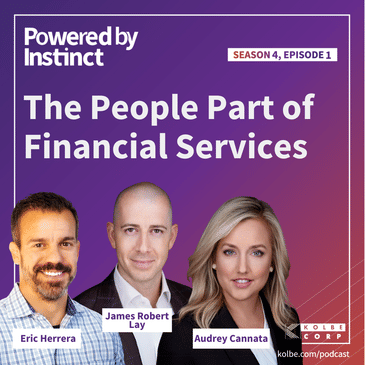
“Technology can only do so much. At the end of the day, it’s people who need to use that technology.” - James Robert Lay
Season 4 of Powered by Instinct kicks off with a look at the importance of human relationships when dealing with complicated industries like finance and technology. In this episode, host Eric Herrera explores the intersection of human behavior and digital finance with James Robert Lay and Audrey Cannata from the Digital Growth Institute.
James Robert emphasizes the importance of people in leveraging technology for financial growth, while Audrey shares her transition from teaching to digital finance and the critical role understanding her instinctive strengths played in that journey.
They also delve into the dynamics at play in key working relationships, how to form a dynamic duo with someone who has very different natural strengths, and how Digital Growth uses Kolbe both to cater to their clients’ strengths and to help financial brands level up their digital growth process.
Host: Eric Herrera (5392)
Guests-at-a-Glance
💡 Names: James Robert Lay (3294); Audrey Cannata (6734)
💡What they do: Founder and CEO; Operations Lead
💡Company: Digital Growth Institute
💡Noteworthy: James Robert is focused on inspiring human transformation in marketing and sales teams within financial brands, aiming to elevate their loan and deposit growth; Audrey collaborates with James Robert at Digital Growth Institute, contributing to research and coaching that facilitate human transformation in the financial sector.
💡 Where to find them: James Robert: LinkedIn; Audrey Cannata: LinkedIn
Embracing Transparency and Honesty in Team Dynamics
Audrey highlights the importance of transparency and honesty in team dynamics. She describes how their team practices radical honesty, allowing them to openly communicate their energy levels and adjust plans accordingly. This approach fosters a more understanding and effective work environment.
"That allows us to be just really radically honest and transparent with each other [...] I can tell that to James Robert and vice versa. He can tell me, ‘Audrey, I am spent. Can we like pause on this meeting, or can we adjust our plans?’"
Adapting to Unforeseen Challenges
James Robert shares a practical example of adapting to unforeseen challenges. He recounts his experience of having a book launch disrupted by the pandemic and how he pivoted his approach. His story illustrates the importance of resilience and flexibility in the face of unexpected circumstances.
"I wrote a book, Eric, that was scheduled to be published in April of 2020 [...] all of the conferences that I was supposed to be going to speak at, to do a launch tour, they all literally got shut down within two to three weeks."
The Personal Impact of Kolbe
Audrey speaks about the personal and transformative impact Kolbe has had on her life. She expresses gratitude for the self-awareness and growth that Kolbe has enabled, both professionally and personally, and shares her enthusiasm for being part of the Kolbe community.
"I truly believe that Kolbe is such a gift, and it is such a gift to know thyself [...] It's been personally very transformative for me. And I just appreciate being able to continuously share this with those in our community and members and even people in my personal life."
If you would like to be a guest on Powered by Instinct or get in touch with any of our Kolbe Experts, send us a quick email: info@kolbe.com
[00:00:00] to bridge the gap between thought and action comes down to one thing. It's feeling it's emotion and emotion is energy. And the desire of the feeling the emotion, the energy, to do different, to be different,
[00:00:12] to think different or to act different has to be greater than the desire to remain the same. Welcome to Powered by Instinct, a podcast for professionals who think about how your fundamental nature drives performance. In each episode, Kolbe experts will interview top performers,
[00:00:27] team leaders, consultants and coaches to discuss identifying team members strengths, aligning those strengths with their jobs, and optimizing individual and team performance. If you're interested in getting more done more naturally, then let's jump in. Welcome back to the next episode of Powered by Instinct,
[00:00:44] and normally we only have one guest on but luckily we have two guests on this time and they are from the amazing digital growth institute. So we're joined by the founder, James Robert, and by Audrey we have a really interesting backstory.
[00:00:57] So we're going to jump into that later on in the conversation but welcome to both you with Thanks for joining us. Thank you, Eric. Thank you. So like I said, Audrey has a really cool backstory, but before we get into that,
[00:01:10] either one of you, can you tell us just a little bit more about digital growth institute and what it is that y'all do? Sure thing, Eric. So we inspire human transformation for marketing and sales teams at financial brands. And we do this so that they can
[00:01:24] coffee level up their loan and deposit growth. And the reason that I highlight human transformation is a lot of times the conversation around digital transformation within banks and credit unions
[00:01:35] leads the way, but we know that technology can only do so much the end of the day as the people who have to deploy that technology. And this is where our collaboration and the work that we're
[00:01:46] doing with Colby through Audrey is providing new insights through research, but also then providing accountability through coaching that helps people make the need of changes and transformations to level up their loans to deposits. And I'm guessing you know, working in the financial slash
[00:02:03] baking sector that they're really quick to adopt new technologies and really take some huge rest, right? Lightning speed. No, it's an interesting opportunity, particularly when we're dealing with the human element. If you think about technology is continuing to move at an exponential rate,
[00:02:23] we as human beings tend to be linear thinkers. And so when you have technology going exponentially and you have people thinking literally it's creating this gap and it's within the gap that people feel confused. They feel conflicted. And when they're in that continuous state, that's where the chaos
[00:02:40] sets in. Yeah, absolutely. And so again, we're going to we're going to jump into a little bit of that when we talk about how both of you work with your clients, but just quick reminder. So right,
[00:02:50] we're on the power by Instinct Podcast and I forgot to tell everybody what all of our MOs are. So I'm Eric again. I'm a 5392 and then I have my handy little cheat sheet here. So James
[00:03:02] Robert, you went 3294 and then Audrey year is 6, 734, right? Yes, correct. So Audrey, we haven't heard from you yet. So if you had to pick one area of your life where your MO has come in the most handy,
[00:03:17] where do you think that would be? That is a great question. I guess either personally or professionally. Yeah, the world is your oyster whenever it works for you. I would say, well, this actually probably applies personally and professionally. It has really given me this just new sense of
[00:03:35] confidence and who I am. I think especially when I transitioned from professions, I was a little unsure about things. I didn't quite know what my strengths were and finding out my MO really just
[00:03:49] solidified that you know, I am who I am. I do bring a lot of value even though I'm different than other people. So for me confidence is everything. I mean, that right there when you have confidence
[00:04:00] to be gained that confidence, that just opens the door for so many other opportunities. Yeah, absolutely. And you mentioned, you know, when you made that career transition, prior to joining you were a teacher, right? Yes, I was a teacher for seven years. I actually was
[00:04:15] with DGI back before right out of college and then I left to go teach for seven years and then I came back for we call it two or number two. And so where you teach an elementary school
[00:04:27] kids, high school kid, middle school. So I was a fourth grade reading and writing and social studies teacher the entire seven years. So for me and my MO that was actually really great
[00:04:38] thing because I was able to really refine my plan and systematize things and make things repeatable over the years. I wasn't forced into a lot of different changes with subjects and grade levels. So I was fortunate in that area. And so right here being that seven in followers,
[00:04:56] they're just mentioned it, right? You created those systems. You had those repeatable process. And so what was the reason for making the shift and going back for your second tour? So for me as a teacher I think when I went into teaching, you know, you have these certain
[00:05:12] expectations. You have this perception of what teaching is going to be like. My mom was a teacher. I really enjoyed school growing up. I had a great experience and so I just assumed that this
[00:05:22] would be a great career for me. And it was for many years. I really enjoyed it. I had a Pinterest classroom, it was organized and systematized but the reality of the situation is your environment that is extremely unpredictable. You've got 20 to 25 students in your classroom
[00:05:42] with different learning disabilities, behavior issues, maybe English language learners and then on top of that all their different personalities in every single day is different. You walk in there with these amazing plans and you have to be ready to pivot and change. You know, simple things
[00:05:59] like a fire drill could do you real your day because you got to stop the kids, you know, they get off track and then you have to come back and decide okay we lost 45 minutes.
[00:06:08] Now what do we do? Do we continue the lesson? Do we change and go teach something else? And so every single day is something different. You've got students who might blurred out something
[00:06:18] inappropriate in the middle of class and you have to immediately decide how you're going to react and respond and address the students. So all of this unpredictability and kind of organized chaos
[00:06:30] if you will, ended up leaving me just really drained by your end of year six and beginning your seven I was pretty much spent. I had two little kids at home and I would come home, you know,
[00:06:43] put them to bed and I've obviously brightened on a clock because I knew I needed every bit of energy to get through the next day. And so it was right in the beginning of 2020 that I reached out
[00:06:52] to James Roberts, you know we've been connected over the years and he had actually told me right after leaving just you know keep in touch if I ever left the profession and so I took him up
[00:07:02] on that and you know at the time I wasn't necessarily expecting to come back to DGI but I knew that James Roberts was someone that I looked up to for his expertise and I trusted him to kind of guide
[00:07:13] me through this next chapter of my life and so yeah we chatted a few times and I guess serendipity happened and here I am he you know ended up expressing some of his his needs at the time and he
[00:07:25] might you know can be a little elaborate that on a little bit more but it was like a perfect little fit. Yeah James Roberts go ahead if you want to throw something in about how it all came together.
[00:07:35] It was it was the the story arc type of voyage in return. Audrey she left, she learned and she came back with a whole new perspective a lot of wisdom but at the same time I was also growing as well
[00:07:50] in 2017 I had joined strategic coach and went through the Colby method there and quickly realized as a 3294 what gave me a tremendous amount of energy and what would just drain me on a day
[00:08:06] and a day out basis and a lot of it was around the area of operations and follow through as a two resistant follow through I can know I could do that work absolutely but
[00:08:20] it's probably going to make me a little grumpy I would rather be working in my nine quick start and making things up and leading and facilitating the work that I do with clients on a day and
[00:08:33] a day out basis particularly as I'm complimentary to those in the financial services space which I think we can loop back on here in a bit but when I was talking with Audrey I said I need someone
[00:08:45] who can help me make things real and so we went through the Colby process with her and it just so happened that she was the who to my how thinking about the the who not how method would Dr
[00:09:01] Benjamin Hardy and then Sullivan a great book and I said hey would you want to come back for a second tour and she said yeah and now we've continuously had been reinventing and envisioning what
[00:09:18] the digital growth institute is and what it can become now when we're working within you know me making things up she's helping to make things real and then go find people to help make that repeat
[00:09:29] yeah absolutely and it's amazing what you find that right person that compliment how much easier everything is and how much more productive you can be because you know James Robert you
[00:09:39] you and I and a room together we can come with ideas to solve all the world problems but then somebody has to go do that stuff because that's that's really not our real house right so they
[00:09:49] need to go find an Audrey go find somebody like that so to go and make it happen so I know that Audrey you went to our one day course Colby plus what was your biggest aha or take away from that
[00:10:02] so this I will always remember this workshop because it gave me such a sense of like clarity and confidence in the decision to change careers because I'll be honest with you I suffered a little
[00:10:16] bit of guilt leaving teaching and it was also coincidentally tearing the pandemic when a lot of other teachers were leaving too and so I kind of felt like I was giving up on the kids like I
[00:10:27] couldn't hack it you know and so I struggled with that a lot and when I set in that and I already had my Colby done before this workshop but you know we dug so much deeper here and when I heard
[00:10:40] and we talked a lot about the my resistance in quick start when I started to see that a lot of these things that I perceived as weaknesses or things that I lacked were actually strengths that you
[00:10:53] know initially started making me feel a little bit more confident but it wasn't until we dug into the idea of energy and draining energy and kind of talking about different scenarios that's
[00:11:04] when the light bulb went off and I thought oh my gosh my Colby score you know my resistant quick start is the reason I was so drained as a teacher every single day like it made like it made perfect
[00:11:16] sense to me and it made me feel validated that I was on the right path I was working in my unique ability and doing things here that that I you know could create value for and the classroom just wasn't
[00:11:28] for me and that's okay it's all good it was a great learning experience but I just will always remember the goosebumps I felt when I finally had that sense of relief that okay this is just who I am this
[00:11:40] is how I operate and I'm in a really great place to show those strengths. Yeah and you know as you're working with people that have you know vastly different levels you know you too aren't an exact
[00:11:51] 180 but you're pretty close right and if it works right you become the dynamic duo you become Batman and Robin but there's always some speed bumps some you know bruised knees and that sort of thing
[00:12:03] along the way you guys have any stories about maybe rubby each other the wrong way or maybe not appreciate each other's elbows a little bit I would say it's a matter of awareness first and foremost
[00:12:16] of who I am and who she is and and that awareness leads to what we call the pyramid of human relationship the pyramid at the foundation of every positive relationship is respect and
[00:12:36] understanding her M.O. and understanding mine I would say it has allowed and created a tremendous amount of respect for one another not saying that I don't annoy her and she doesn't annoy me but
[00:12:54] it's understanding where that annoyance is coming from is typically in a different of not thinking but just a different of the way that we're naturally operating but we're very quickly
[00:13:10] aware of like okay I need to provide her with more clarity or give her some more space to build something out where she understands that I'm probably just quick starting on some things and
[00:13:21] she can just take a lot of notes and maybe one out of a hundred of those ideas will actually be worth talking about down the road. Yeah I mean the fellow three and follow through
[00:13:31] whenever I'm working with a seven through ten and follow through I always tell them like I'm I'm not not following your plan because I'm trying to mess with you right it's just I operate in
[00:13:42] a different way and I think if we can as you mentioned right have that understanding about each other it definitely makes it go a little bit smoother I think Audrey you were gonna you're going to jump
[00:13:50] in there too. Yeah I was just gonna say that it allows us to be just really radically honest and transparent with each other we're able to say you know hey look my energy I'm spent today or now
[00:14:03] I was telling you this Eric before we hit record that after we do this like this podcast right now this is going to use up all of my quick start energy for the day for the most part and you know
[00:14:12] fortunately the rest of my day today is a lot more systems and operations and so we're great but I could tell that to James Robert and vice versa he can tell me Audrey I am spent can we like pause
[00:14:24] on this meeting or can we adjust our plans and we know that it's not that either one of us are lacking you know driver initiative it's just mental and physical and that's okay and so
[00:14:35] that has helped us in our communication I think tremendously. I want to give a very practical example here you brought this up in my mind Audrey was and this is from both sides this is from you know
[00:14:49] my mo to your mo so I wrote a book Eric that was scheduled to be published in April of 2020 and we all know what happened around that time period in hindsight but all of the conferences that I was
[00:15:02] supposed to be going to speak at to do a lot to her they all literally got shut down within two to three weeks and so I spent maybe a day or two in the gap gripping about problems and then my wife was like
[00:15:16] okay so what are you going to do about it and as the nine quick start I just figured I will just solve the problem by doing something and so that's what's launched the banking on digital
[00:15:26] growth podcast which has become a top 5% global podcast so in hindsight I'm very grateful for the experience now I'm always looking for ways to improve and optimize and so we are getting close to about
[00:15:37] 300 episodes in and it has always been my goal to once we got to around episode 300 we would bring video into the narrative and so I vividly remember one day we were having a meeting Audrey and I
[00:15:53] and I had done some very high level you know three fact-finding research on possible optimization opportunities and I literally just did a download I was like what we could do this and we could do this
[00:16:06] and here's the technology and the platforms above all and like just a hundred percent energy like very excited about the possibilities I remember Audrey basically just like I'm drained I'm done I can't I can't take any more if I think it happened all the whole time how
[00:16:26] and it was a hundred percent respect though like I understood where she was coming from she understood where I was coming from and we were able to just walk away give us give her some time to do some more fact-finding and digest and come back with a proposed
[00:16:45] how system a methodology to follow through and build that next iteration and that is now allowed us to what is the bring video capability into our larger podcast content engine yeah that's a that's a per-reexample again it's it's understanding each other's
[00:17:06] differences and look we're all still good to be ourselves right and so sometimes you can't help but it's just it's got to come out but if you know hey when this comes out I'm really draining the
[00:17:16] other person cut them some slack let them go take a breather recharge their batteries then come back and yeah if you do that it can definitely be some magic but I know it's not just the two of
[00:17:26] you that work together right you have some other team members as well so how do you work together as a team how does everyone leverage everyone else's strength on the team well you have the internal team so understanding how their initiating action
[00:17:44] but I would say Audrey I think something too that we have found a lot of value is through the clients that we work with because we've built this not just into our own internal methodology
[00:17:58] and almost like I call it the gift of Colby it's giving the banks and creditors that we work with that gift of awareness and respect within their internal teams and I mean what you've matched
[00:18:13] some patterns this is the pattern matching that we've been able to do to provide better experiences understanding particularly for me I'm almost the exact opposite you talked about the 180 Eric I'm the exact opposite of the MO of bank and credit union leaders but Audrey
[00:18:32] has been able to provide some clarity and really it's a multiplier of perspectives you want to speak to that Audrey because I think to me this was the biggest once again another aha breakthrough moment that it's not technology driven it's it's it's the technology
[00:18:53] appear that sits between your ears yeah so we call be every single person every single member that we have and and sometimes it's you know smaller teams six seven and sometimes it's organizations of thirty to forty and you know we have found a pretty similar pattern across support
[00:19:08] is most of these in our program are initiating factors or possibly initiating follow through very very light on initiating quick start and so that alone is going to create a little bit of friction we mentioned earlier talking about technology and innovation and moving forward
[00:19:28] that is why we kind of see this hesitation this lack of forward progress and so when we're able to bring this awareness out there and help people to realize okay this is why that's great
[00:19:40] that's wonderful there's nothing wrong with your MO at all but let's see how there's this missing area here and how and that's usually where we come in James Robert comes in and plays the role of
[00:19:52] that that initiating quick start to help generate ideas and and keep things moving but I think it's just been a really great level of awareness and really as a team on small team dynamics
[00:20:04] I have had many conversations with with people mainly the team leads who come to me and say I'm having this issue or this situation or I'm feeling friction with this other team member
[00:20:14] and we'll unpack it and more often than not it has to do with their MO and so that alone helps to depersonalize things I'm able to give them a strategy moving forward and it's just really
[00:20:25] help that overall team dynamic. I want to hop in on this because I think it's another very practical example and story and maybe Audrey you could add to this because you you saw this unfolding
[00:20:36] and this would have never have been possible had we not Colby this team and it was a team of about 30 people but we were working with a smaller subset of this larger team and it was all senior leadership
[00:20:49] including the CEO and we were going through we did some diagnostic work we were providing them with a strategy to go forward and to execute an implement against and we were maybe I don't know Audrey
[00:21:04] what 15 20 minutes 30 minutes max into a full day session with the senior leadership team and the CEO of this organization just very bluntly said I can't do this like I just can't keep going
[00:21:23] and we paused and understanding his MO allowed me to meet him where he was at very empathetically because it was going too far too fast for him and I think Audrey you saw a transformation
[00:21:47] happen though because we were able to use this insight to provide a different path forward a slower path forward that made him feel that much better. Yeah absolutely so instead of trying to
[00:22:03] deliver all of this and one sitting you know many many many pages long we just we chunked it up and we broke it up we created this repeatable pattern with him this kind of regular meeting cadence
[00:22:17] where we could just give him all this information and bite size chunks and not have him feel so overwhelmed because basically what we were doing and hindsight was we were diagnosing their situation and instead
[00:22:31] of maybe tackling one thing at a time we kind of laid it all out there at first and so I think that just was very very overwhelming for him and yeah he reacted a little defensively I'm being quite honest
[00:22:44] but we realized that it wasn't personal it's just he needed a different way of receiving this information. A lot of that too was based upon past experiences he had bad negative experiences like
[00:22:57] this before that he was bringing the past into the present and but understanding his MO it was a complete transformation for me to be able to understand that it wasn't personal but to say this is where we
[00:23:11] can take and we stepped out we did a one-on-one we sidebarred on this and we said we're going to pause today let's come back let's reconvene and we're gonna go slower and that made him feel that
[00:23:23] much better and this particular organization has increased by about I would say 35% and assets of the last two years and it has just been an amazing transformational story not from technology per se but a human transformation that has then allowed them to adopt some new technologies going forward.
[00:23:43] Yeah and you know any type of organization you work with so at Colby we work with essentially every industry right from you know construction to skilled trades to work with physicians, financial services and everywhere in between regardless of what the organization does the magic is the people
[00:24:00] right because they all have that secret sauce that's inside of them and if we can figure out how do we let you unleash that how do we let you use your secret sauce all the time that's when you see
[00:24:10] that 30 35% growth and just a couple years if they probably weren't experiencing before. Exactly so we talked a little bit about you know how you use Colby with your clients tell us a
[00:24:22] little bit more just about going broadly speaking how DJI works with their clients and what are some things that you do. So at a very high level we worked them through the banking on growth,
[00:24:32] banking on digital growth method and it has four distinct steps. The step number one is to help the unaware become aware that there's some type of an issue at hand and we do that through secret
[00:24:46] shopping their websites and that's where they learn where they're losing literally millions and loans into deposits takes about 30 days to work them through this. The second though is so there's awareness that there's some problem. Step number two is where we host a team alignment workshop
[00:25:02] and that's where we are ensuring that everyone is speaking the same language that they're on the same page so that they're able to start moving forward together in a unified direction. From there
[00:25:13] we help guide them through a strategic process so where they get their digital growth blueprint their strategy it looks for gaps in growth opportunities and they provide them with a plan for it and then
[00:25:24] finally we help them to implement that plan to build a digital growth engine to provide on going accountability through coaching on a 90 day cycle and it's really in steps two, three and four that's where coal becomes back into play because what does coal be do it helps with
[00:25:43] team alignment. It allows us to understand how they're going to naturally initiate action or solve problems when it comes to their strategy and then instead for when it comes to building that growth engine through providing accountability and coaching, Audrey's also able to provide
[00:26:02] I'm having this problem over here or I'm struggling with this and typically and she's this is happened many times on coaching calls. I'm like what's what's her call me? And so she might send me
[00:26:14] a direct message in Zoom or we look at it ahead of time. I even think recently I was doing an onsite with a team and they just two or three new team members this year and we put everything
[00:26:27] up in the matrix and it showed them where they had some cognitive cloning and things to be aware of what would you add to that Audrey? Yeah I would say it is at awareness piece and looking at
[00:26:41] kind of your team as a whole and realizing where everyone is because just another example for you and I James Robert when I first came back before I had you know a deeper understanding of Colby,
[00:26:53] I would question a lot of your ideas. You would have ideas and I would do the well who, how, where, when and I got a little subconscious at one point because I was you know I was still to kind of
[00:27:06] knew and I told James Robert I hope you know that I'm not being negative or like pessimistic like to your ideas. It's not about that. I'm just I'm thinking systems and operations and processes
[00:27:18] and because he knew my Colby he was like no I totally get it so then I felt more empowered. I suppose to be that you know layer of questioning when he would have ideas so that helps and
[00:27:31] we see that on teams all the time as well you kind of understand why you behave the way that you do in relation to your teammates and that it's not personal you're actually you know you're creating
[00:27:41] value it's your strength so I think being able to visualize the team as a whole and kind of realizing some of those things and the way we operate has been really helpful. Yeah you know learning
[00:27:53] to learning to value the various strengths or use the other person's strengths to your advantage is really helpful right James Robert you and I like you mentioned earlier right we can go with all
[00:28:04] the ideas to solve all the world's problems but we actually need somebody to rain a sin a little bed and be like hey well this is wrong with this one and something else is wrong with this other idea
[00:28:14] that we had because frankly they're not all brilliant some of them are but some of that were terrible right and so we just got to you help us to sort through and figure out which one should
[00:28:23] we actually go and try to implement. It's interesting you talk about solving problems and seeing opportunities I even right now looking ahead and I would say a goal is to provide a way for marketing
[00:28:40] and sales teams within financial brands to integrate the Colby Financial M.O. Plus into their overall account holder experience through it's it's a new methodology that we're working on but calling it banking on coaching because when I look at financial services it's commoditized everyone's
[00:29:01] offering the same great rates amazing service laundry list of look like product features and and I run about this in banking on digital growth it's this idea of providing account holders with clarity into where they've been where they could go next so there's this whole
[00:29:16] coaching component so I'm always looking for the future and even thinking about the Colby Financial M.O. Plus there's a path forward because if you think about the the M.O of people working within financial service within banks within credit unions well they're they're fact-fighting
[00:29:33] they're following through so if we could build a system for them that they could then follow through that's going to increase their confidence going forward which could increase the confidence of the account holders it comes all the way back to odds with you're talking about
[00:29:45] confidence confidence key and I really do believe that confidence is contagious if you can confidently communicate confidence that is a very important asset if we're thinking about financial services we could deposit confidence into the minds of others they're going to leave filling
[00:30:05] that much bigger better brighter when and they think about their future and James Robert earlier you mentioned that when you're working with a lot of these senior leadership teams it's a lot of fact-fighter maybe some fact-fighter followers are you seeing that
[00:30:18] generally throughout the entire organization or you seeing some differences based on whether it's location or division job title that sort of thing Audrey you want to hop in on that because you have the the macro view they're of all the data
[00:30:33] I have the kind of the general trends but you're seeing the day in the day out of that from your perspective so across the board generally the the majority is going to be your initiating fact-fighters
[00:30:44] closely followed by your initiating follow-thers now when you're in the marketing and sales apartment you might see those initiating quick starts but what's interesting in that financial industry is a lot of people in other departments they kind of moved up from say tell our front line
[00:31:01] into these other departments and leadership roles so you will have initiating fact-fighters in marketing and in sales which traditionally we know we don't typically see but because they've kind of grown up in the bank you're going to get that in fact we have we have one marketing team
[00:31:16] of seven people that not one of them's an initiating quick start so where are they getting the new ideas for how they're going to grow their business that's where I tend to come in and
[00:31:29] stir the pot a little bit so I meet with them every 90 days and we go through a process that we review we call them quarterly health checks is where you've been this is the momentum this is the
[00:31:40] progress that you've made this is where you're right now what are the goals what are the roadblocks what are the opportunities ahead that you can execute against and here's what's going on at a
[00:31:48] macro level and then we do an annual strat session it goes all the way up to the 30,000 foot view it's funny you bring them up Audrey this one particular organization because if I think back about
[00:31:59] the progress that they've made over the past seven years it's been another transformational story but I would say they've journeyed through the four elements for human transformation that that I've identified the very first step is to help people see things from a different perspective
[00:32:18] and when they're going through this 90-day growth methodology that's exactly what they're doing when one sees different they begin to think different now I've asked this question Eric at you know over a thousand times the different financial brand leaders I say okay great so you're thinking
[00:32:31] you're seeing different you're thinking different they say yes I said so when you see different and think different what happens next well they say well I'm going to do different I'm going
[00:32:39] to act different I'm going to be different and then I question are you how how how how much do you know right now that you need to take action on but you're feeling to take action and they pause
[00:32:48] for a little bit and they're like a lot and I said to bridge the gap between thought and action comes down to one thing it's feeling it's emotion and emotion is energy and the desire
[00:33:00] of filling the emotion the energy to do different to be different to think different or to act different has to be greater than the desire to remain the same and I think that's where this
[00:33:09] whole coaching aspect comes back into play because it just provides for example this organization who is initiating in fact fighting in fall through but they're resistant on the quicksarting side to have that external perspective to come in respectfully stir the pot a little bit it provides
[00:33:29] them with the way to break free from some of their old perspectives to provide new perspective but also to transform their feelings and emotions to a positive place to where they can't continue to move forward with courage and confidence yeah you know oftentimes we work with teams
[00:33:46] and the ideal team has a pretty healthy mix of strengths right some people here some people there but oftentimes based on the work that you do in a highly regulated environment like banking right we literally can't take certain there's certain things we cannot do right or
[00:34:01] we have to make sure that we're doubting the eyes and crossing the tease and so in those situations where let's say you're missing a strength outsource it right find a consultant like yourself
[00:34:11] to come in come up with some good ideas you have a great process we're helping them overcome a bit of that risk of version and getting them comfortable with it and beginning
[00:34:20] to absorb it and take action with it so yeah you don't have to shake up the team just because you're missing a strength just go borrow it from someone else whether it's internally or externally
[00:34:30] who not how? I'm absolutely so what would you say your best piece of advice is for businesses on why do you use Colby? I would say really to distinguish the difference between the parts of the
[00:34:47] mind and what sets Colby apart and makes it so unique we still get a lot of misunderstanding when it comes to personality and Colby measuring personality and not you know your natural operating mode
[00:35:00] so I would just say spending a lot of time really emphasizing and distinguishing the difference between the parts of the mind really really helps kind of make this break through all home moment because you know we've seen organizations who they've been you know they take in the Colby
[00:35:15] but it's like the third or fourth you know assessment they've taken so by this time they're like okay it's the same thing different day they don't quite take it as seriously but I think that's kind
[00:35:25] of on us and on businesses who really emphasize and one of the ways we do that is we hold a workshop we have a three hour Colby workshop or we'll just dive deep into this so that's my thoughts James
[00:35:34] Robert did you have anything? I'd say it comes down to two points number one is clarity into who I am and why I operate the way that I do and it's not right it's not wrong
[00:35:50] it's just who you are for free to be yourself this is who you are and I love that framing and the reason I'm leaning into clarity first is if if you think about the world right now
[00:36:03] it is filling increasingly complex and there's a lot of chaos but if we give people the gift of Colby and they begin to know themselves as an individual see all transformation that leads to
[00:36:20] future growth that starts with the individual then it goes to the team teams are made up of individuals when you transform the teams that's when you begin to transform the organizations in through the
[00:36:29] work that we're doing my belief is when you transform an organization you can continue to transform the lives of your account holders and then the people who live in the communities that you're your organization serves so there's this multiplication effect with that but it all starts with
[00:36:43] clarity of why I operate the way I do the second though is when you gain that clarity it increases respect respect for yourself but then respect for those that you're working with and collaborating with whether that be internally directly on your team or externally with external
[00:37:07] who's back to your point Eric so I even see you know there's an opportunity to use Colby as an organization not just from the internal team from from those external who's that you
[00:37:19] closely collaborate with on a day and a day out best basis whether it be technology providers marketing providers whoever those external who's might be it provides clarity but it also increases respect yeah Audrey you touched on this earlier right when you made that career transition
[00:37:37] you were actually looking at some of your strengths as weaknesses or deficiencies and when you can kind of flip the script and look at it as hey that whatever I think of the
[00:37:46] deficiency is actually my superpower that's when you do gain that confidence and you can start to make those transformations yeah absolutely I'm I said this from the beginning when I first started
[00:37:56] James with James Robert I felt the need to mirror his strengths I thought I needed to be just like him and so and I expressed that to him and when I got my Colby back and I realized no no you're doing
[00:38:06] exactly what you need to be doing perfect yeah absolutely and so as we begin to kind of wrap everything up any parting thoughts from either of you either on the world at large how Colby has affected you
[00:38:19] where are you seeing your industry going anything like that I know it's a really broad question but it's on purpose I am very hopeful about the future of financial services you know when we look
[00:38:30] out at macro market research right now 85% in the United States feel stressed about money we go down into particular market segments for example the Millennial demographic 8% of them trust financial brands for guidance what does that mean 92% of them don't trust financial brands for guidance so where
[00:38:54] are they looking interesting enough they're going to tick-tock and they're going to Reddit and they're going to YouTube and they're going to Instagram I'm looking out towards the future particularly in this
[00:39:07] age of AI where things have the potential to become you know more automated I'm predicting that the individual brand of a leader of a lender or an advisor has the potential going forward through platforms like social media to be as influential if not even more influential than the
[00:39:33] corporate financial brand that can feel very exciting for a few who are most likely initiating quick starts it can feel very terrifying for those who are initiating fact-finding and following through doesn't mean all hope is lost it means that there's an opportunity to continue to provide
[00:39:51] education for those to say here's what the future could look like here are the opportunities here the potential roadblocks to be aware of and here's a plan here's a path that can continue to guide you
[00:40:01] for so that you as a lender as a leader as an advisor cannot just offer a product but really give people help and hope through the content that you're sharing but the coaching that you can also
[00:40:15] integrate into your organization that helps to increase the financial confidence of those that you're working to get to a bigger better brighter future that's my hope for financial services looking forward into the future then as your talk then actually sounds like a terrific opportunity right if you
[00:40:31] xyz community bank well you have an opportunity as the CEO or one of the lenders to become that local resource yes that's one-on-one connection is what right the the CEO of Wells Fargo
[00:40:44] isn't on take time right so then's your opportunity to take a little bit of market share from some of those those larger players exactly oddry any words of wisdom you'd like to share with the
[00:40:55] team i'd just say this that you know i truly believe that that colby is such a gift and it is such a gift to know that i self and you know it's been personally very you know transformative for me
[00:41:07] and i just appreciate being able to continuously share this with those in our community and members and even people my personal life so it's just been really fun being part of the colby community
[00:41:19] yeah and we obviously were very appreciative we love having have it you guys as a part of as a part of the community is a part of the team and so i want to thank you James Robert thank you
[00:41:27] Audrey for joining us today folks want to learn more about your business your podcast like that where should they check you out www.digitalgrowth.com and check out the podcast banking
[00:41:39] on digital growth or get the book banking on digital growth on amazon and you can find me personally on linkedin james robert lay perfect and yes so yeah obviously check out for our podcast
[00:41:51] go to their website for that we talked about colby for most of the of the podcast here today if you've not taken your colby a yet make sure you go to go to colby.com click that purple button
[00:42:02] in the right hand quarter get your colby results because you can see some of the transitions in yourself that these two have seen in themselves and with the teams that they work with so
[00:42:12] again i would have thank both of you for joining us and to the audience we'll see you next time thank you thank you Eric thanks for checking out this episode of powered by instinct
[00:42:23] this show is brought to you by colby court a company that helps leaders and organizations thrive using the only instinctive strength assessment on the market if you enjoyed this episode then follow powered by instinct wherever you get your favorite podcast or join us online at colby.com slash
[00:42:39] podcast for all the latest episodes