
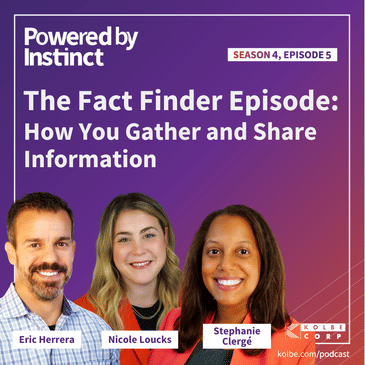
Everyone has natural ways in which they take action. These are measured in four areas — Fact Finder, Follow Thru, Quick Start, and Implementor — called Kolbe Action Modes®.
In this episode, Kolbe experts Stephanie Clergé, Eric Herrera, and Nicole Loucks break down the Fact Finder Action Mode and discuss the different strengths within it, such as specifying, simplifying, and explaining. They provide coaching tips for each strength and address common misconceptions.
They also explore how different Fact Finder strengths can work together in a workplace setting and how you can maximize your Fact Finder strength for more productivity, better communication, and improved collaboration.
Join three Kolbe experts as they delve deep (and also provide an overview and essential facts) into the Fact Finder Action Mode and learn how different people naturally gather and share information.
Hosts:
💡 Names: Stephanie Clergé (8363), Eric Herrera (5392), and Nicole Loucks (5824),
💡What they do:
Stephanie is Kolbe’s VP of People and Product Development.
Eric is Kolbe’s VP of Sales.
Nicole is Kolbe’s Director of Training, as well as VP of Education and Youth Programs.
💡Company: Kolbe Corp
💡 Where to find them: Kolbe.com
Takeaways
Fact Finder measures the instinctive need to probe and the way we gather and share information.
Behavior ranges from gathering detailed information and documenting strategies to simplifying and clarifying options.
This Action Mode deals with detail and complexity, providing the perspective of the past.
There are a wide variety of strengths across this Action Mode, all of which are equally vital.
Key Quotes
“Just because two people have the same strength or even the exact same number, doesn’t mean they will act the same way. It's going to play out differently because of three parts of the mind.”
- Eric Herrera
“It's good to remember that we have in a general population, just as many Initiating seven, eight, nines and tens in Fact Finder as we do one through threes in Fact Finder. It’s important to get out into the world and see the variety that's out there and help all children find places where they can be successful.”
- Nicole Loucks
“When you get your Kolbe A Index result, you get four numbers. People do tend to sometimes focus on the first one, cause it's the first one, or they focus on one that is their longest line, but all four of your strengths are just as important.”
- Stephanie Clergé
Chapters
00:00 Introduction to Kolbe Corp and Action Modes®
01:23 Understanding Kolbe and the Cognitive Part of the Mind
02:58 Exploring the Fact Finder Action Mode
05:35 Coaching Initiating Fact Finders
06:28 Coaching Simplifying Fact Finders
23:23 Working Together with Different Fact Finder Strengths
29:51 Working Together with the Same Fact Finder Strengths
33:08 Common Misconceptions about Fact Finder
37:04 Importance of Looking at All Four Strengths
If you would like to be a guest on Powered by Instinct or get in touch with any of our Kolbe Experts, send us a quick email: info@kolbe.com
[00:00:00] If you need someone to write the paper, you get a 7-10 in Fact Finder like me. If you need just the headline, you're going to get someone in the 1-3 range,
[00:00:07] and if you need the paragraph or one page summary, then we'll get someone like the two of you in the 4-6 range. Welcome to Powered by Instinct, a podcast for professionals who think about how your fundamental nature drives performance. If you're interested in getting more done, more naturally,
[00:00:23] then let's jump in. Welcome to the Powered by Instinct podcast. I'm Nicole Lauks, I'm the director of training here at Ulbic Corp as well as our VP of Youth and Education. My MO is 5-824. Today we have a very fun episode. We're going to be talking about
[00:00:41] Hullby Action Modes and we're going to do a deep dive into one of our action modes that finder. And for those of you who don't know what action mode is, do not worry, we're going to talk
[00:00:50] all about that. First, let me introduce my co-hosts for today, Stephanie Slirche, an Eric Herrera. Hi Nicole. Hello everybody. So Stephanie and Eric spend ton of time working with people and organizations, and they could help the music.
[00:01:04] Instinctive strengths really, really well. So you guys are in for a treat. Stephanie, your MO is 8363 and Eric, you are a 5392. So I'm sure that'll come up a bunch today. Let's go ahead and start at the beginning. So Stephanie, can you give us an idea about what
[00:01:20] even is this thing called Colby? What are we measuring? Sure. Well, the Colby A index tells us about how we naturally take action. And specifically when we're striving. So that means when
[00:01:30] we're taking action on purpose. So not just out of habit or based on our experiences or purely based on our emotions or personality. It's how we creatively solve problems and make decisions
[00:01:41] and really it's about how we get things done. So just for Eric to say that even more simply, right? If you think of the three parts of the mind thinking feeling and doing at Colby,
[00:01:51] we tell you about that third part of the mind. The cognitive part, how you execute, how you get things done. So Eric, can you go ahead and talk to us about each of the different action modes and what
[00:02:01] that even means? Yeah, absolutely. So as Stephanie mentioned, overall, like Colby, it's all about how do you get stuff done or the doing part of the mind. And it turns out we all take action in four
[00:02:12] separate ways. So the one we're going to talk about today is that Red one called backfinder. To get stuff done, we all have to gather information. Then there's that blue one called follow through.
[00:02:22] We all have to deal with systems and processes. And then also bring things to closure. That green one quick start. It's all about dealing with risk and uncertainty. And then that yellow and
[00:02:32] the implementer, so all about the physical world around us, base and tangibles. So we are going to touch on the very first line that you're going to come to in your Colby A index result, that red line,
[00:02:43] and it's called backfinder. So Stephanie, can you tell us about the different parts of the factfinder action modes and kind of a brief overview? What they mean? Well, as you'll see in
[00:02:54] C.E.M. and Aten factfinder. So I'm not sure brief is going to be what is going to happen, but sure I would love to talk a little bit more about it. So backfinder as we talked about is one of the
[00:03:04] four Colby action modes, and it is really all about how we gather and share information. It's about how we naturally deal with details, how specific, or how thoroughly are. Each of the action modes,
[00:03:15] including factfinder, are on a continuum from one to ten. We break that up into three different zones. So in one end of that continuum, there are strengths in the seven to ten range, where we naturally initiate action or get the problem solving process started. And so the fact
[00:03:31] finger in the seven to ten range has a strength that we call specified. People with this strength tend to get really specific. They ask a lot of questions and dig into the details. They gather
[00:03:41] as much information as possible before getting started on a task. Some of them might do this through traditional research methods like reviewing documents or reading books, but you can also get
[00:03:51] information by talking to people. So that's really in the seven to ten range. Then in the one to three range on the other end of the continuum, we call that great strength simplifying in the factfinder mode. This strength really kind of exists because if everybody gathered and shared
[00:04:05] information to a great degree of detail like I do, then we would get mirrored in the details. We would fall into analysis paralysis. So we have folks with this strength on the other side of
[00:04:16] the continuum and that one to three range, who naturally simplify. They keep things high level. They really look at the big picture. They naturally summarize information and avoid the need to justify all of the decisions that they make with data. And so you'll want someone like this
[00:04:30] on your team to keep your meetings or emails from being too long. Right, Eric? Exactly. So then we've got the third set of strengths in factfinder which is in the middle range and in
[00:04:42] the four to six range. And this is a strength we call explain. So this is an amazing strength as well because they're really in the middle. So their talent is really to make sure that they don't
[00:04:51] over explain or over simplify. They're going to get just the essential facts and they're going to be great at fact checking or editing and they're really going to work well within priorities that
[00:05:01] have already been set and react to needs that come about when gathering information. So they're really great bridge between the two other strengths on that factfinder continuum. I think that's covers it right? That was actually, I don't know if that was a brief overview but it was certainly
[00:05:17] a great overview. I told you I tried or knew. Yeah and you know part of the reason to call an I are here is we're both five's in factfinder right so really if you need to know what you really
[00:05:29] need to know ask one of the two of us. If you need the you know encyclopedia Britannica version you asked Stephanie if she will absolutely give you that. All right well actually you know what I'm
[00:05:39] not going to take this from the two of you so I'm going to do this again. So I like to say about the three factfinder strengths. If you need someone to write the paper you get a seven to 10
[00:05:48] in factfinder like me. If you need just the headline you're going to get someone in the one to three range and if you need the paragraph or one page summary then we'll get someone like the two of you
[00:05:57] in the four to six range. So how's that for brief? There we go awesome. I was excellent excellent. And what I love that you said is you talked about all of those strengths truly ask strengths. Each one
[00:06:07] of the three has something amazing to contribute. So I really wanted to dig into each of those strengths and talk about how will we coach them? What are some things that we might come up with because
[00:06:18] you're going to deal with those individuals differently right? So let's start with that first initiating zone that seven through ten the people who specified naturally. How are we going to coach somebody
[00:06:27] in this zone Eric? So I'm going to actually take a step back a little bit just let's look at this regardless of what your numbers are. One five ten somewhere between you're your best
[00:06:38] you when you lean into that strength, when you see it as a strength. So if you're a seven eight nine do more of that is kind of the broad guidance that I would give you if I was coaching you. So if you're
[00:06:49] a seven eight nine or ten then my coaching advice is ask a bunch of questions get everything that you need in order to get started because if you don't that's time sometimes where you get stuck
[00:07:00] you're always left with a wait a minute what about and so it seems as though you're not jumping in on projects you're just missing information. So empower yourself to ask more questions
[00:07:09] get the info that you need. I'm going to approach me that way Eric. There's practical limits right? And I love this because we're going to talk a little bit later about when you have
[00:07:21] differing strengths in fact finder like you Stephanie and you Eric and me what does that really look like and and how does that sort of play out in a workplace environment so excellent. Do
[00:07:31] you have anything to add Stephanie? How would you coach somebody in the song? Yeah I mean actually I think Eric covered it really most of the coaching that we end up doing is really about when
[00:07:41] your in relationship with other people. I do think that because the world really talks a lot about gathering and sharing information people in fact finder in the seven to ten really kind of have
[00:07:52] the strength dialed in it's really when they're working with others that they need a little bit more of that coaching and I know we'll get to that. So what's likely to take the person out of their
[00:08:00] zone or be kind of a barrier to using their strengths or when they kind of just won't take action at all like what it how does that work and what are things that would likely lead to that
[00:08:10] person kind of procrastinating or deciding not to do something. Yeah so I'll jump in and then obviously Stephanie you know throw in as needed. I think there's a couple of things that cause it. I think
[00:08:20] sometimes if you're in an environment you're free in a culture where it's hey we don't need to worry about that stuff let's just you know let's just move forward we don't need to do any research
[00:08:29] then you sometimes start to see that strength as a deficiency. We're actually your the one that can help protect everybody by doing some of that homework doing some of that research and I touched on it earlier but if you don't have all that information that's actually what
[00:08:43] causes you to procrastinate you don't have everything you need you haven't analyzed it enough to say yes this is a good idea let's go forward and make it happen. Yeah well and you know a
[00:08:53] practical example of that is if you're in a meeting and the meeting is 60 minutes long or you only have 15 minutes or five minutes or 10 minutes whatever it is to discuss a specific topic
[00:09:03] and you don't have time to ask the questions that you had on your mind or you don't have time to go and fact check or get a little bit of data in order to make decisions right you have to make
[00:09:14] a decision right now give us a yes or no and it's like I haven't had a chance to look into this at all so you know some of the kinds of coaching we give people are you know give the agenda
[00:09:22] ahead of time those kinds of things so that people can go get their research done or maybe have a separate session for questions so that people have a chance to ask their questions but don't
[00:09:31] bog down the meeting so it's that kind of stuff that I know will really get me if you don't allow me to ask questions you don't allow me to do the research or you force me to only use your
[00:09:40] data source and don't let me kind of dig into my own those are the kind of things that really get to me as a eight in fact finder. So you kind of seguid into this where you kind of mentioned this
[00:09:50] actually is being in meetings how would have initiating fact finders to someone in that 7 through 10 range tend to communicate that information or it or need that information communicated to them. Well Eric might say I'm long-winded which is partially personality too right I'm relatively
[00:10:06] outgoing when I'm with people that I'm comfortable with so I do tend to talk a lot but not everyone because in the 7 to 10 range and fact finder talks a lot but you're probably going to get more
[00:10:15] lengthy emails or a length there documents or those kinds of things often they're going to document Kathy Colby will say that you know someone in the 7 to 10 range in fact finder doesn't feel useful unless they have a pen or something to write within their hand and that's definitely
[00:10:31] true for me I need to document and I refer to documents as well. The written word is often going to be something that you're going to see in terms of communication and whatever that looks like so data
[00:10:43] whether it's a survey from individuals whatever that might look like. Yeah I think Eric and I have both received some wonderful emails from you that we affectionately call Love Notes where we could both attest to that being how you naturally communicate for sure. So how do you
[00:10:59] think the strength shows up in kids because what we know is that this is not change over time. Someone who has a 7 through 10 in fact finder is someone who naturally specifies was brim like that
[00:11:08] this is how they were as a child and so this is how they are in the workplace as well. It's not a learned behavior over time so what might we see? You know as you think about it
[00:11:17] and you mentioned it Nicole right it doesn't change over time so some of the stuff that you see in grownups that are let's say an 8 in fact finder like Stephanie you would see in little
[00:11:27] Stephanie when she was 5, 6, 7 years old running around on the playground right so Stephanie naturally gives the verbal version of a 20 page report when you're having a conversation with her so we didn't grow up together but I'm guessing little Stephanie on the playground still gave her friends
[00:11:42] the verbal version of the 20 page report it was just about you know what so and so said or can you believe our teacher asked us to do this assignment she gave the verbal version of that when
[00:11:52] she was little Stephanie. Yeah I think I always did research I actually still have my childhood encyclopedias uh all of them and so I was always gathering information it was always about stuff
[00:12:05] I was interested in right so I wasn't sitting and just reading the encyclopedia that might be more cognitive but I would if there was something I was interested in I was going to do the research
[00:12:14] I was going to go spend time with the library or if I had a question I was going to ask I was going to stay after class all those kinds of things so really I needed the detail in order to move
[00:12:23] forward and other people just don't need that same level of detail. When I was teaching I would see in the classroom students who have this the strength some of them would ask lots of questions
[00:12:32] right because how they needed to gather information or even share information they knew was very verbally others would do a lot of research on things on their own or ask for extra resources and
[00:12:43] how to look into things more deeply than we maybe could in class and so it's interesting because you talk about yourself Stephanie and what we know is that you know that initiating fact-fender strength can show up so differently for different people depending on their personality and interest
[00:12:57] and other things so glad you touched on that let's move this party to the other end of the continuum so there's one through three is in fact-fender people who naturally simplify how do we
[00:13:07] coach these people. So if you think about a one to three in fact-fender their gift is you can throw that verbal version of the 20 page report at them and they're able to sort through it and
[00:13:18] they pick the most crucial thing the essence of what you're trying to say so this is super helpful when you need to relay a bunch of complex information to a broad audience and so the way I coach these
[00:13:30] folks is think about you know when you're having a conversation when you're at a team meeting what's at the harder matter what are we really trying to get done and latch on to that keep the team
[00:13:40] focused on hey guys we're trying to solve for X and I think we're wandering off the road a little bit let's get back on the on the path to get there yeah and what happens when you're in
[00:13:50] an environment where maybe that is not appreciated um that strength or you're expected to potentially get the information know everything essentially kind of being an initiating fact-fender how would you coach that person to really be themselves. Understand that it is a strength and that you don't
[00:14:06] need to do all that research to do all that homework ahead of time so that's the first part then from there it's how do you help the rest of the team understand it and how do you sometimes if you're
[00:14:17] in an environment where it's not appreciated to boil things down and people are constantly firing questions that you can feel a bit like an interrogation right and so just being able to back off and
[00:14:28] go wait a minute okay there it's not a personal attack on me there's nothing wrong with me I just have a very different gift that's where you really should start and that's the same thing you know
[00:14:38] for small kids because I know you know co obviously you had kids in your class that had this wildly different strength and so for them right sometimes school is hard because you're doing you know
[00:14:48] giant outlines and ring through these long lengthy books they don't need to do all of that right they can skim it and they got enough to make things happen so be proud of it lean into that strength
[00:14:59] and as much as you can push back when people ask you to give them that longer port. Well and I think sometimes too you have to find other individuals who can help you do that because in
[00:15:08] certain situations the data is required or you know you've got to get the book report done or what have you so maybe you find a different way to do it like I know my daughter in school she's a three
[00:15:20] in fact binder and she is really looking at audiobooks that she can speed up so she can just easily speed through it get the essence she doesn't have to take it he notes I would be taking
[00:15:29] pausing and taking notes throughout she doesn't do any of that she listens to it on the fast to speed that she can comprehend and then if she has certain questions that she has to answer then she'll
[00:15:38] go back to those specific parts and then just answer the questions versus slogging through like might be recommended her teacher might say you've got to outline everything and highlight the
[00:15:47] stuff and she doesn't do any of that and can still be successful. When my a person who has this strength procrastinate or put something off so I think you know they may procrastinate when they
[00:15:58] are asked to give more detail then they naturally are going together right so if they don't have it and you give them this task and you're like hey right the 28 page paper then they may procrastinate
[00:16:09] because that just feels pretty overwhelming to them and like I said the best the best way through that is finding some strategies that work whether it's partnering with other people or there's other different ways to get creative and that's the great thing about living in the aid
[00:16:22] we're living in we have so many technology solutions that can help with some of that as well. And what are going to be some because I know that you have a someone who has a one through three
[00:16:32] in fact finder and some of these giving them tons and tons of information you almost see their eyes glaze over Eric talk can you talk to that a little bit yeah and you know sometimes while they may not
[00:16:43] completely roll the eyes and the back of the head you do see them start to wander off a little bit and so you have to be aware of that right read the room read of the person that you're talking to
[00:16:52] but it does become painful and at a certain point they just kind of throw their hands in the air if you keep firing info at them they're like forget it like I give up whatever you guys come up with is
[00:17:02] finding with me and then you miss out on the amazing strengths of that person has. Yeah well and I think this is where communication is really important and being able to you know write little scripts for yourself something that you feel comfortable with saying in a group setting
[00:17:16] and really communicating hey listen I know we've got to get this data I know we have to have this information but this is really more detail than what I need so how about I leave you guys can keep
[00:17:27] debating this or you guys can keep gathering more information and you guys can call me if you need me to come back and simplify or summarize or I'm gonna leave the meeting
[00:17:36] and I'll catch you guys at the next meeting after that part of it has been done so you kind of have to not be afraid to stand up for your strengths and really get what you need out of a situation
[00:17:46] and tell others this really isn't going to work for me because you're just wasting your mental energy if you continue to stay in those types of situations. So now let's talk so we've talked about
[00:17:55] the people who are 70 and 90s who naturally specify those who naturally simplify one through three let's talk about those people who are in that middle area who are four or five or six who naturally explain Stephanie what insert us off how would you coach somebody in this area.
[00:18:10] Yeah so folks at this great straight of explaining our really an great position especially when they are working with others to really give their full contribution so they were only should be listening for what is needed and jump in there as I mentioned before one of the things
[00:18:28] they're really great at is not just you know being in between over explaining and simplifying but also finding those places where maybe things need to be edited or proofread or something like
[00:18:39] that so they can really contribute those great strengths to the group so that can be great as well. Sometimes people though think that any of the strengths that are in the four to six
[00:18:48] range it's like oh well they're smack dab in the middle so they could just do it all and so you really have to kind of guard against being treated like a 7 through 10 in fact binder or being treated
[00:18:57] like the one in one to three they can maybe dip into that occasionally like we all can but the four to six range strength of explain is a strength on itself and they will definitely
[00:19:07] run out of mental energy if they get placed in one or other end of the continuum for too long. Yeah and you know if somebody's giving you that 20 page report I think the gift in that four to six
[00:19:20] ranges you able to pull out those nuggets right those really impactful pieces it's almost as if the other stuff is kind of cloudy or murky and those things just like come at you like really
[00:19:31] shiny objects and you can just grab it right and it comes really simple and you see what those things are or the other side if you're working with a one two or three you're able to take what they come up with
[00:19:42] and you add some color some context kind of shine that nugget up a little bit and make it a little bit better so yeah you you get to kind of play in both rooms but it's definitely said it's not oh I can
[00:19:52] do a whole bunch of information and oh and oh I can bottom line because I'm in the middle now it's it's a very different piece where you're pulling from over here or shining this thing up over there.
[00:20:01] And I saw this a lot with kids where they could take something that was already written or already sort of produced a lot of times an in-group project or something like that and they could kind
[00:20:09] of whittle it down or edit it to make it really really good but it was a little bit more difficult for them to either start from scratch or pull out just the one headline so kind of like we're
[00:20:18] Stephanie started with her brief overview where you know that strength is something that shows up a lot of times for kids in school if given the opportunity to kind of collaborate with some other
[00:20:30] people as well so now let's talk about what happened and we don't live in a silo right so Stephanie's in fact-finder does not live all by itself and she's just in her office all by herself and Eric and I
[00:20:41] are doing our own thing and then anyone who's a one three three we all have to work together so let's talk about how the fact-finder strengths all three of them sort of work in concert
[00:20:51] in a workplace so what happens when we have wildly different strengths and fact-finder somebody who is a one through three um simplified and someone who's a seventy nine or ten specified what does that look like?
[00:21:03] In order to work together better you have to have kind of a baseline or a foundation right if we appreciate each other's strengths you say hey you're amazing at this and I'm amazing at this
[00:21:14] different thing and we value that on each other that's really the starting point. Then from there now we can start to use it to our advantage so you know someone in the one to three range may go to
[00:21:24] Stephanie with an eight and say hey Stephanie I'm thinking of doing this and then Stephanie's going to go and she's gonna figure out oh well you know here are some of the challenges and here's all
[00:21:33] of the people that are going to be needing to be involved she's going to do all of that research for you and so that's how you can kind of become a little bit of Batman and Robin the dynamic duo so they
[00:21:43] kind of tossed up over to Stephanie she does all the homework or when Stephanie is writing something and she's trying to figure out how do I just make this easier if everybody understands
[00:21:52] kick it over to that one two or three and again they're going to pull out that S citizen that full love letter that we talked about earlier right they're going to boil it down to a
[00:21:59] bullet point or a phrase so Stephanie let's look at a real example you and the president of Colby Corp Amy Brucekey Amy as a three in fact-finder anywhere in E and you work so very closely
[00:22:11] together how does that play out for you guys yeah um it plays out a lot like Eric just described actually you know Amy will have an idea or something that actually what happens a lot is she will
[00:22:21] read a book and she will sort of have the essence of what that author was really trying to get across and I will take some of that content and really flesh it out into a bit more of a training or all
[00:22:33] you know write some of the workbook materials or that kind of thing to go with it so kind of take that idea do a little bit of research and extend it into to something that's that's longer
[00:22:43] and bigger and what does Amy bring to the table when kind of like when you're at a point where you might be stuck when I'm stuck that she's really great at reflecting back and saying okay so
[00:22:54] what I hear you saying is this and this and this right like these are the three most important things because Eric did a great job earlier of not saying verbal vomit I think he said you have a horrible
[00:23:03] something else but sometimes it feels like blah all this information right and so she's really great at just finding those two or three key points and then I can go back right so if I have a client
[00:23:14] that I'm working with and you know there's a lot of information and a lot of complexity she's really going to simplify that and remove some of that complexity and kind of give me some key points
[00:23:24] that I can then go off and decide how much do I need to elaborate but sometimes when you have lots of information even as the seven to ten in fact finder it can be overwhelming absolutely what happens
[00:23:35] when you bring somebody in in the middle between the two of you guys? Wow I think you should tell us what happens when we bring someone in the middle because you are often that person that is why
[00:23:45] Eric talked about the dynamic duo but we are I don't know the terrific trio or something because between all three of that we cover all three of these drinks in fact finder so having you on our
[00:23:56] team is just amazing because really you can bridge those things so Amy might have an idea I may have gone and put together 50 slides and that's probably not an exaggeration since though you can go
[00:24:07] through and sort of say you know these are the ones that really seem like they meet the essence of what Amy was trying to get across right and just kind of really stand as that great bridge between us
[00:24:18] what what else do you see is your contributions to our lovely team? Well it's so interesting because not unlike probably other people but it feels very natural for me to do those things so it doesn't
[00:24:29] seem like anything special and so I think that's something we always have to keep in mind it's like the things that come most natural for you if you're allowed to do them and encourage to do them in
[00:24:38] that way then it doesn't feel like work all the time some of the things I noticed the most is that people like you, Stephanie who haven't seven eight nine or ten and Amy at one through three
[00:24:49] sometimes I can tell that you guys are saying the exact same thing like you really are talking about the same endpoint. Derek does this happen to you sometimes too you're like wait guys like
[00:25:00] we are an agreement like you guys are acting like we're not or you know you're sort of maybe digging into the details and someone trying but we are an agreement in essence and it's so funny
[00:25:11] because I see it so clearly but yet it's it's hard so I do feel like I can help kind of like bridge that gap a little bit and be like you know this is kind of what Stephanie saying
[00:25:20] this is what Amy is saying so yeah we are on track to move forward together so sometimes it helps with the communication aspect of it. Derek does that happen to you at all?
[00:25:30] Yeah definitely does and yes I've been in that same room where they are agreeing and they're saying the same thing but just in wildly different ways and so you got it as I talk like
[00:25:40] kind of pull the pieces from each person and say like here's the common ground and they go oh okay and then we can all we can all move forward. Well and I love that example because but we're all
[00:25:51] managers we're all leaders in the company and so you two feel really empowered to make that contribution but I think what's really important is for other people with the four to six range who maybe haven't been empowered haven't been given permission or haven't just naturally take it
[00:26:05] upon themselves to do that but they really make sure that they're volunteering that contribution because it can be overlooked if you are not assertive enough to actually make it happen and so I love
[00:26:16] that. So let's talk about really briefly what happens when we have two let's if initiating fact-finders or two people who have the same amount how does that play out when working together so
[00:26:26] I'm going to take a real life example Stephanie you are initiating in fact-finders seven eight nine or ten and so is our CEO David Colby what does that look like? What's really interesting about
[00:26:35] that is you would think oh you know we're actually both eights in fact-finders so you'd look at that and say those two people are going to be exactly the same and there are a lot of similarities
[00:26:45] about the way we take action obviously we're both going to get into lots of detail we both worked hard to become experts in certain things and so certainly we can provide lots of detail
[00:26:56] and information we need data to make decisions all of those kinds of things but just because two people have the same strength or even the exact same number it's going to play out differently
[00:27:06] because of three parts of the mind right so David and I when were at our best he's going to do the things that he does well right a CEO he's a lawyer by experience and background and so if it's
[00:27:17] a legal thing I'm not going to try to go do research on something that is a legal issue I'm going to leave that to him so what works well is if you can kind of have some of that separation between
[00:27:28] tasks and duties and those kinds of things and then it becomes less of an issue some of the time but I'm sure Eric would love to tell you about all the times that's a bit of good because of an
[00:27:37] issue right this is kind of what Konaive Cloning is all about yeah so as Stephanie mentioned right you would expect the same things and you do see the same things like as an example of I throw
[00:27:48] the same problem at Stephanie and David they're both going to go off and do their research they may find they may have different resources that they feel comfortable with and using it all of that
[00:27:58] and they're going to study it and read through it so then when they get back together they are both absolutely sure that they are right because they've read through all of the data all of the
[00:28:07] research but if the facts from one don't line up with the facts from the other they're both absolutely right that they are correct because they did all of their research and that's where
[00:28:17] sometimes you can start to butt heads a little bit and we say oh law on page 47 line paragraph six blah blah blah and then that's when I kind of zone out but then they go back and forth
[00:28:27] with all of their data and so yeah that's where it came going wrong a little bit so this is how we get long meetings right Eric? Yeah absolutely right it's always one more
[00:28:37] question will wait a minute what about this and oh wait did we ever think about that and so things that obviously can help is setting timers whether it's for the meeting for specific topics
[00:28:47] that can really help if you have one of those fantastic one twoers or threes in fact finder in the room that's where they can you know step back look at their big picture of you and go
[00:28:57] everybody plus this is not getting as towards our 10 year goal right this is not getting as towards what we were trying to solve for so it's kind of table that and get back on track to
[00:29:07] where we need to have wonderful next I would love to move on to what are some common mis misconceptions you hear about fact finder I mean the one I hear all the time from bystanders or
[00:29:17] you know initiating fact finders or smarter seven you do want to talk about that that's true let's absolutely that's what I want to say about that that's how we disagree with that same well then maybe you should talk about it Eric. Right it's it was a 70-mile
[00:29:34] real job and right it's not about natural intelligence right it's not about be think of something may measure in some of the other cognitive assessments speed of processing or some people call it G that has no bearing on whether you're a one-in-fact finder 10 remember anywhere
[00:29:50] in between so you can be crazy smart and be a one-in-fact finder so you're gonna get to solutions really really quickly whereas let's say a 10-in-fact finder still crazy smart still gonna have to do all of that homework of this and whatever cognitive or if you're
[00:30:06] this smart doesn't equal of this in your fact finder's form we know that because we've done lots of research on it. Is it too much brown-nosing to say that's that the case in point for
[00:30:15] that is our boss Amy right she is a three-in-fact finder and extremely smart right but I do think that there are misconceptions on you know sort of both sides of the continuum right sometimes
[00:30:27] people see people who naturally simplify maybe they assume they don't read or they don't you know use data right and that is very far from the truth in fact you know Amy's a great example
[00:30:37] of that she reads more books than I do I actually tend to read articles versus whole books right but as I kind of alluded to before if I'm reading a book I'm going to take a while right down that's
[00:30:49] one of the reasons I don't read books because I mostly listen to them in the car because if I have a book I'm going to highlight it I'm going to make notes I'm going to go along the way but she
[00:30:57] really gives those great summaries and gets down to the essence and gets down to the heart of what is important in the book much sooner than I do and she does that in our meetings too right as we
[00:31:07] mentioned really stopping the debate refocusing us on what's critical and so when you see that in action then you realize that as Eric said the cognitive is really a separate part of the mind
[00:31:17] than the the cognitive because there are others who who don't do some of those things. And this the call you can speak to this. This is also something we need to look out for with
[00:31:25] young children because those ones, two's in three's in fact writer often are in a seven through ten in fact finder world and so if they don't have all of the research all of the facts to back up
[00:31:36] whatever their argument is you know they can start to feel dumb and that's absolutely not the case it's just that's not the way that they get things done they don't need all of that. Absolutely and they're
[00:31:46] not given opportunities all the time to demonstrate their learning and or learn but really demonstrate their learning in a way that works for them so they might be able to solve the problem
[00:31:57] or do something but you know not doing it in a way that is natural for them can cannot a lot of stress for their lives and ultimately make them very unsuccessful so you're absolutely
[00:32:07] right Eric and we often see that because teachers we see have a seven tend to have a seven through ten in fact finder so they create environments and classrooms and things and the the system is sort of
[00:32:19] built to work really well for people with that strength and so the people who fall outside of that can sometimes not be as successful in those environments but it's it's good to remember that
[00:32:30] you have in a general population just as many initiating or seven eight nine's intends in fact finder as we do one through three's in fact finder so just because insert an environment it might seem
[00:32:42] unbalanced get out into the world and then and then we can see sort of the variety that's out there and find places where they can be successful so I absolutely love remembering that as well.
[00:32:52] All right so today we focus just on fact finder which we know is not the only action mode so can go ahead and Stephanie can you remind us why it's important to look at all four of your strengths
[00:33:02] not just the one in fact finder? Sure yes there are 12 cool these strengths but there are four that are most natural for us and so when you get your cool be a index result you get all four of those
[00:33:13] and people do tend to sometimes focus on the first one because at the first one or they focus on one that is their longest line but all four of your strengths are just as important they are
[00:33:24] equally sort of a potions to each other they just have you know sort of different strengths to them and so I'm excited that we get a chance to go through all four of the action modes and so everybody
[00:33:34] gets a chance to look at the strengths that they have in each mode. Thank you both Stephanie and Eric for your wisdom today. Ask Stephanie mentioned we're going to be releasing episodes for all four
[00:33:44] of our cool be action modes so stay tuned for our follow-through quick start and implement our episodes and if you haven't already done so go to colbe.com and take the colbe A index to see what
[00:33:54] strength you have in fact finder and if you're interested in working with a colbe consultant we have a global listing on colbe.com so you can find somebody in your area to work with you
[00:34:03] individually or with your team have a great day. Thanks for checking out this episode of powered by Instinct if you enjoyed this episode then follow powered by Instinct wherever you get your favorite podcast or join us online at colbe.com slash podcast for all the latest episodes.