
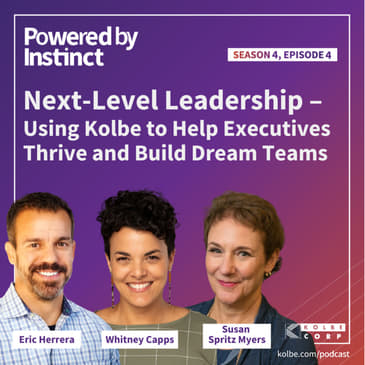
Nobody is asked to make more decisions, more difficult decisions, or more important decisions than executives. So anything that gives leaders an upper hand in making those decisions more efficiently and effectively is pure gold. Enter our guests: Susan Spritz Myers and Whitney Capps. Susan and Whitney are both incredible leadership coaches who know how to help executives achieve amazing results and build remarkable teams. In this episode, they discuss the impact of knowing your MO (Modus Operandi) and how it can shape your personal and professional life. They share specific case studies of how they used Kolbe to help clients solve major problems through understanding their strengths and working together more effectively. They also discuss the importance of building teams with diverse strengths and using a whole person approach to company culture. If you’re a leader (or you work with them), listening to this episode will lead to great things and high-performing teams!
Host: Eric Herrera (5392)
Guests-at-a-Glance
💡 Names: Susan Spritz Myers (4392) and Whitney Capps (8562)
💡What they do: Whitney has experience coaching a variety of leaders and specializes in emerging leaders, law and government, tech leaders, entrepreneurs, and non-profit leaders and activists. Susan provides executive coaching and team development to CEOs, business owners, VPs, senior-level leaders and teams of mid-market companies.
💡Companies: Susan Spritz Myers, LLC and ClearSpace
💡 Where to find them: https://susanspritzmyers.com/ and https://clearspace.net/
Takeaways
- Knowing your MO can have a significant impact on your personal and professional life, providing clarity and confidence in decision-making.
- Kolbe assessments can help individuals and teams understand their strengths and work together more effectively.
- Building diverse teams and being intentional in leadership development are key to creating high-performing teams.
- Self-awareness, trust, and collaboration are essential for success in team dynamics.
Key Quotes from Our Guests
“I have two children and I gave them Index A when they were in high school. One is graduated, one is in graduate school for physical therapy. But the fact that they got to do college or make choices based on knowing that MO I feel like is the best thing I ever did for them.” - Susan Spritz-Myers
“There's opportunity for the short term and long term with Kolbe. Whether you have your results or not, just understanding that those striving instincts are at play for yourself and for others can really be life-changing. And what I think we've been able to leverage is we don't just stop there.” - Whitney Capps
“If we have autonomy and freedom and psychological safety, we are much more likely to be engaged at work. And Kolbe is a huge part of helping an organization, helping an individual, helping a leader, make sure that people feel like they can be themselves.” - Whitney Capps
Chapters
00:00 Introduction and Welcome
01:11 Impact of Knowing Your MO
02:14 Personal Impact of Kolbe
03:23 Impact of Kolbe on Leadership Teams
08:32 Building a Relationship with a Law Firm Client
13:23 Understanding and Leveraging Different MOs
16:36 Supporting Individuals in Teams
22:25 Looking at the Whole Person
26:21 Shifting Roles and Responsibilities
29:40 Opportunities with Kolbe
32:58 Building High Performing Teams
37:40 Conclusion and Contact Information
If you would like to be a guest on Powered by Instinct or get in touch with any of our Kolbe Experts, send us a quick email: info@kolbe.com
[00:00:00] If we have autonomy and freedom and psychological safety, we are much more likely to be in the stage that work in Kolbe's huge part of helping an organization, helping an individual helping a leader. Make sure that people feel that they can be themselves.
[00:00:15] Welcome to Powered by Instinct, a podcast for professionals who think about how your fundamental nature drives performance. If you're interested in getting more done, more naturally, then let's jump in. Hello, everybody again. And welcome back to another episode of The Powered by Instinct podcast.
[00:00:31] I'm our VP of Sales, Era, Correra and I am pumped because I get to work with and talk to two really fantastic certified consultants today. So you can see there are smiling faces if you watch the video.
[00:00:43] In a minute, I'm going to introduce you to Susan and Whitney. But I want to say thank you to both of you because I know it's ballpark negative 40 degrees outside. So hopefully you're inside your stay in war. Well, I am in balmy Phoenix and it's roughly 60 degrees here.
[00:00:58] So Susan, Whitney, thanks you for joining me. Yeah, thank you so much. So Susan is a 4392. So that means her Emma was almost perfect. Whitney is a 1556 new. And the reason I said Susan is almost perfect. She's a 4392. I'm a 5392.
[00:01:17] So obviously all that mosa fantastic, all of your four numbers are strengths. Everybody's a little bit biased towards their own Emma and that's totally okay. Oh my gosh, I have to say though, I'm so we're online quick starts. Like you guys are wonderful superpowers for us.
[00:01:35] We come with all kinds of fun ideas and then folks like you when you got to figure out how do we actually make this stuff work? How do we turn it into a real something? Exactly.
[00:01:42] So on that, when you first learn that you were in eight five six two, what impact did that have on you? I got my debrief when I was 18 years old, had it off to college.
[00:01:53] So huge difference maker in terms of my ability to understand and root into what was most important to me when I was going off to, you know, this incredible social experiment of college.
[00:02:08] And I didn't have to look to other people to understand how I should be taking action or actually got a lot of wonderful wisdom from myself through those years.
[00:02:16] The major I chose was actually quite good for my eight five six two of the screenwriting major way, way back in the day. But it really did give me tons of permission to be myself. I mean there's no gutter way to say it than that.
[00:02:29] Yeah, you know, speaking to someone who didn't get their MO when they were 18 and Susan, you're probably the same for you. Right? I really wish I would have had it. It would have saved me a lot of headaches and challenges and questioning myself and those types of things.
[00:02:43] Because I didn't really know what I wanted to be when I grew up. So went to college, had a couple of ideas in mind and luckily I was smart enough to pick up on the fact that he had really hate doing this stuff.
[00:02:55] So there's probably not a job or like a profession that I should pick. But a lot of folks that's not the case, right? And so they end up in the role because hey, this is what my parents did or you're going to make it good living.
[00:03:06] You can create, you know, some welfare family, whenever it is the reasons that they choose. And then they end up understanding this wasn't the right path and they go through all of that.
[00:03:15] Hey, and so yeah, if you can get someone when they're much younger, help them understand their strengths. You have a giant impact in their life, both personally and professional. Yeah.
[00:03:25] So Susan, I know you've been using Colby for a long time and you've seen some of the impact that you've had with your clients. What impact did it have on you? You know, Eric, that's so interesting.
[00:03:35] So I've often thought about how I known about it at 18, what I've made other choices. Right, obviously that's hard to know. I learned about it about 40 and it made is everybody says it was confirming it made a lot of sense to me.
[00:03:51] I feel like it's given me so much more confidence in stopping comparing myself to others. But particularly on fact finder, like I'm just sort of forward by fact finders who can remember a lot.
[00:04:04] To just share one other tidbit that made me truly good as I was listening to Whitney. So I've two children and I gave them index A when they were in high school. And they're both initiating implementers. One is graduated, one is in graduate school for physical therapy.
[00:04:21] But the fact that they got to do college or make choices based on knowing that, ammo. I feel like is the best thing I ever did for that. I mean, almost makes me cry when I think about like you're saying, Eric, I save them so much pain.
[00:04:37] Like in the 20s and 30s because they're on the right track for them. Yeah, absolutely right kids, your kids are fairly young. So it could have been when they were in school, crypto was hot or you know AI was the thing.
[00:04:49] So they could have chosen the path of hey I want to go work in AI. Well if someone's a 79 and implementer, I mean unless that's translating their building like the actual robots, that's probably not the right choice for them.
[00:05:02] So yeah, that was fantastic when you give it to your kids that young. The other thing just further answer your question because I really didn't. I feel like relationships with other people are so much better knowing my ammo relative to
[00:05:17] where they are, whether I know they're score or not. I feel like I'm less annoying to people. Like I like to think I can manage the 9 in quick start and the you know the other lower numbers.
[00:05:30] I like to think that I'm not sure if that's true or not. Yeah, absolutely right. What it helps me do when I'm working with someone who's in the way I know like Susan and Susan,
[00:05:38] I work together all this time is it actually just helps me recognize what are the things that I should be asking her for where are the blind spots where I need her wonderful, a coldly carded genus to kind of come in and support.
[00:05:53] We probably could have figured that out working together over a longer period of time and probably the bigger, more uncomfortable bumps in the road but it was really lovely that we didn't
[00:06:03] have to that we could just sort of use the Colby cheat code to get into a state of slow in our partnership that I think has really carried us far. I want to just add something there. I did work with Whitney's father for quite a bit.
[00:06:18] He's a 9 in follow through and then one day he wasn't available and he said not a lot of people know that they're related but anyway, so Whitney, help me with a big team and literally since that
[00:06:31] I asked her all the time to work with me because of her eight in fact finder. If so many clients seems like most leadership teams, law firms, accountants, they're all fact finders and so I do my best in terms of I like to think I have more
[00:06:48] fact thinner than a four with Colby but happy Whitney she gets them, she gets the concept, there's so much to that age that is such a good compliment that it again it allows me to relax and feel confident because she's there.
[00:07:06] Yeah absolutely I've said it a couple of times but it's worth repeating right all of us are amazing at something none of us are amazing at everything and so if you can figure out who should
[00:07:15] I lean on for which particular parts right and you can lean on each other that's when you become the dynamic duo that high-performing team whatever it is that you're trying to build absolutely.
[00:07:25] You mentioned you work with a lot of leadership teams and you've worked with the Neonoprop law firms so I'd like to ask you a question about a particular client that you started working with I think
[00:07:35] back in 2019, how did you initially start working with them and that how has that relationship evolved over time? So it's a law firm on the East Coast and I was asked by a coaching colleague
[00:07:50] to do some leadership 360 work with their executive committee and then we were coaching those leaders and I of course gave them Colby and the chairman of the firm turned out that his Colby
[00:08:04] was 3393 we're caught in him gym. Anyway the hilarious thing was he was blown away by Colby he thought that other stuff was interesting but if you think about if you're an attorney and
[00:08:18] everybody else is probably a fact-finder follow through it was life changing for him and he was in his 50s and so he invited me to do a partner retreat. So I had already worked with Whitney so she and
[00:08:33] I came and did that in 2019 and as a result of that relationship one of the partners in the room hired Whitney as her coach. She's still her coach okay what is that? That's five years ago
[00:08:48] she's still coaching her and so we've done other Colby what they will call a practice group so like 20 or 30 attorneys and then this past year Whitney did a pod which she called it a pod mentoring group for associates and Colby's included in everything right so there's individual coaching
[00:09:09] that's going on multiple people now not just the one partner there's coaching going on there was as mentoring group for the associates and right now we're in the queue to work with three more
[00:09:21] practice groups there. It's cool I always feel like Colby sells itself right? The chairman loves it he wants everybody to get it Whitney what would you add to that? I'll say I think that there's
[00:09:33] opportunity on sort of both the short term and long term was called me we all know that the awareness that we get right off the bat with with an interpretation with getting your result really is
[00:09:46] meaningful just that feeling of knowing that co-nation is a thing is meaningful to people whether you have your results or not just understanding that those striving instincts are at play for yourself
[00:09:57] and for others can really be life-changing and what I think we've been able to leverage is we don't just stop there. We're thinking about ways that co-nation can be a part of how they partner together
[00:10:09] on different projects. We're thinking about ways that co-nation can be a part of these young associates as they are growing and thinking about the kind of work that's meaningful to them that feels peaceful that feels really inflow with what their natural instincts are and it helps them
[00:10:26] make decisions about where they want to go in their career and they were really wonderful case study of some attorneys who's in it to build their own practices Susan mentioned the client that I'm
[00:10:36] working with Veronica she has been trying to be that 339 through her entire life. She was mentored by Jim he was the big rainmaker and the firm it was so easy for her to look at him and say
[00:10:50] well that's how I've got to be we did her for Colby and she's a 773 so there's a very distinct difference in who she's trying to be and who she naturally is and you know in being able to do that she
[00:11:03] was actually able to let go of a lot of expectations she had for herself nobody else actually expected that of her but that then made it possible for her to bring on different partners and work with
[00:11:13] associates differently and and work with generally differently to be able to say you know that's your way of doing it I got that I'm actually going to take a little bit of a different path this time
[00:11:24] and again there's short term and long term and I think we've done a really good job with this client of that's not a super unfamiliar situation right somebody in any type of business is wildly
[00:11:37] successful and oh I need to do it like them and if that's the opposite of you it's a really painful path trying to get there. I would add one other piece that's really important I think for
[00:11:48] new consultants or consultants that only do A we always do B and so in the couple team engagements that we have done at this law firm if you look at the distribution report right you have A report and it turns
[00:12:05] out no surprise the majority like 88% of them are initiating fact-finders very high follow through and probably another 70 to 80% are in resistant quick start then when we look at that same chart for
[00:12:21] the B's it's the flip and so everybody's B and this is a partners and practice group leaders down to the associate level they're all trying to be Jim they're all trying to be 3393 so
[00:12:34] they're trying to let go of that stabilize and they're trying to improvise they're not necessarily letting go of the fact-finder they're trying to push their follow through down so that that was really interesting so they're pushing quick start and they're trying to pull back on their follow through
[00:12:52] and so looking at those two charts together has been illuminating and brought a lot of conversations up what it really connects to is their compensation pattern that they're compensated for a
[00:13:05] originating work and so they're looking at the big rainmakers and trying to be like them but I think it out is something that everybody's living with a lot of stress and the organization
[00:13:17] and if you don't do B we know it yeah and we obviously we have a mixed audience at listen to this right some of the folks at listen to our podcast or sort of I consultants and they know all the
[00:13:26] terms that you just threw out there some folks are brand new to Colby so for those of you that are new to Colby think of it like this. Colby A is all about U as an individual how you're actually
[00:13:37] problem solved how you get stuff done. Colby B is how do you see your job and essentially what Susan is talking about here is they put the real person side by side with how they see their job
[00:13:49] anywhere where there's a difference that's where someone is in pain they need some help because they're stressing themselves out they're not producing at a high level and I know that's the
[00:13:59] work that the two of you have definitely been doing what this client. And I think a lot of that coaching not only are we talking about at the team level but we're also talking about it like we're
[00:14:08] Whitney was talking about Veronica trying to be just the flip right pull back that all the through and push the quick start and that's exhausting. Whitney we also have Katie who is an associate
[00:14:20] that's sort of sitting between them you want to talk about her? Yeah absolutely so this came out of the work we were doing in this sort of pod mentoring normally we think about mentoring is being a
[00:14:31] one-on-one relationship and a lot of our innovations when trying to set up these these one-on-one relationships things that normally happen organically when we tried to be intentional about creating those they often don't work very well so we went a different approach and we had pods so a group
[00:14:49] of associates with a single or a group of partners or of councils who could act as those mentors. And in that space there was a lot more room for people to gravitate towards you know that the
[00:15:01] affective personalities that made them most sense but it also gave them opportunity to see different MMOs for those different leaders. And so we did identify there's a wonderful young woman in
[00:15:13] Katie and one of the pods who had started working in the same group as Veronica and Jim and what we noticed is that her MMO kind of supported both of them so she's a 7472 and with that she started working
[00:15:28] really closely with Veronica again 773 to help support her in her short line quick start that stabilized instinct made it really hard coupled with that long line follow through for her to take on
[00:15:43] discreet tasks. She sort of you know she's a principal she's like at that level where she's thinking about the pictures she's thinking about strategies she's working on very complex problems for
[00:15:53] her amazing clients and so when a random email comes through it totally throws her off. And what we found was that Katie was probably the perfect partner to come in and support her in this before in
[00:16:05] follow through really helped her be a lot less strict when it came to sort of seeing things through sequentially she could much more handle that sort of discreet tasks coming in here and there
[00:16:17] and then that quick start made her willing to just jump in even if she didn't know the the full background even if she didn't have the full context of the client there was a willingness
[00:16:26] to jump in and just get something started that Veronica could then come in and sweeten or support were coming in and proof and edit and so we really recommended to Veronica and this was something we
[00:16:38] worked a lot in her individual coaching was how she was going to build a practice was very different than Jim she couldn't look to him for the formula and so what she recognized is she needed
[00:16:48] people to come in and support those tasks and Katie ended up being a really wonderful fit to come in and do that and we worked with a lot of other kind of executive presence pieces as well
[00:16:58] it wasn't just about Colby but it was how does this relationship support you and the ways that you feel like you need supported how does this relationship bring in some of those instinctive ways of taking action that actually just feel really difficult for you and it's really interesting
[00:17:17] because Veronica has not typically had sort of a right hand manner woman this hasn't been a part of her practice and they've been working together for a couple years we've worked on really giving high quality feedback really using the real world practice as a way of strengthening
[00:17:34] their relationship not just strengthening the work that they have together and they are such a wonderful fit together and it's so interesting of course because again Veronica has this panel that's so different from these two other people that she works with so closely but you can tell that
[00:17:49] that it really helps her stay in her sweet spot and do the things that she is really driven to do and enjoys doing yeah and obviously you know when you have someone who how they naturally do
[00:17:59] things is wildly different than how they see their job right they're A to B a fantastic way to bridge that gap is find that Robin to your Batman right find that right hand person that you can give
[00:18:11] so what happens if you don't have that what other pieces of advice can you give to someone to close some of those gaps yeah really good question a lot of the individual coaching with
[00:18:21] Cole B helps think about just what you're saying right how do you use Cole B to engage with people to ask for the thing that you need to get clarification on things or to answer a permission to do
[00:18:32] it the way that you need to do it so one of the things that we worked on and this is true with these individual relationships and I think this goes across the board when we think about how
[00:18:40] we're working with these teams overall is really getting clear on how are we asking for the thing that we need if somebody says hey I need to buy Friday and you know this is going to be
[00:18:50] working against your MOT get it to them by Friday how do you just ask for a little more time how do you check in to see what flexibility exists here or how do you just be clear you know I
[00:19:00] could get you a draft by Friday you know my high follow through or excuse me high fact finder is not going to allow me to not say that I have to be like you know what this is just a draft
[00:19:10] this is completely done I don't have all the facts and research yet and so knowing what your MOT helps you ask for the thing that you actually need for other people instead of just being in a space
[00:19:22] where you're you're living with whatever they request just what would you add to that well the one thing I was thinking about so where were these doing coaching and this pod mentoring group she's bringing tons of leadership content that has nothing to do with Colby Colby's always
[00:19:39] threaded in there right so she's expanding their view of what does it mean to be a leader to be proactive in the kind of roles that they have but she always is cognizant of what's their pattern relative
[00:19:54] to the leadership content and how does that play out so I think that that's a huge important piece what I think separates us as leadership coaches because we do have that foundational understanding
[00:20:07] of co-mation yeah you mentioned it right you have to look at all parts of the person right if I just focus on the Colby the cognitive piece well I'm gonna miss will something about this person's
[00:20:19] personality or some of the skills that they have or cultural differences or whatever it is right so you have to when you're trying to grow development or somebody look at them as an entire person and
[00:20:30] figure out what are the couple pieces here and there that I can answer them in the perfect world you have the silver bullet right and you could just hand them us something and say all right here you go
[00:20:40] now you're an awesome leader in real life that doesn't actually work and so it sounds like the two of you I figured out all of those different components and how they interact together and
[00:20:49] you have to understand the environment in which they live in right like having gotten to work with this firm for five years six years we have an understanding like last week I think what he was focusing
[00:21:01] on conflict and feedback well we know that the senior leaders in this particular firm aren't great at that we have to thread that in with what's it mean to be a leader what's your
[00:21:13] cool be what's going on in the organization like as Eric says you got to think about three parts of the mind three parts of their world really is key to be successful I think it comes down to
[00:21:24] as well what their intention is right so when we think about something like you know not being great at feedback can mean a lot of different things and if your intention is to create an
[00:21:36] organization where you continue to develop the people that are coming behind you it's exactly why they wanted to invest in this mentoring program they wanted to ensure that these young attorneys were really talented felt connected to the firm felt like they had places to go felt like they
[00:21:50] could go get that feedback from somewhere and not every single leader is going to be really intentional about you know the gross of the people coming up underneath them I think you know we
[00:22:02] would all sort of agree a best practice of leadership is that you consider yourself responsible for the development of the people under you but you know there's a very difficult tension that
[00:22:12] they have with how do I take the extra time to explain these edits I made versus just doing it myself because it's actually going to be a whole lot faster and then I can get it out to the
[00:22:22] client onto the next thing and so we do try to focus with like what really matters to this organization and the organization is really committed to keeping their young leaders and growing them so they
[00:22:35] don't feel like they have to go somewhere else being able to be yourself is a pretty good way to keep someone at an organization you know we know that the research tells us employ engagement
[00:22:46] if we have autonomy and freedom and psychological safety we are much more likely to be engaged at work and call these a huge part of helping an organization helping an individual helping a leader
[00:22:58] make sure that people feel like they can be themselves yeah you know all of that right you're talking about how do you grow and develop the organization as a whole and it starts with the leaders who
[00:23:08] then grow and develop the people underneath them that's how you grow the entire organization and obviously we can make some strides you know I can shift the way I communicate with you Whitney and you know communicating your style and that's different than the way I communicate with Susan
[00:23:21] but there are sometimes some practical limits right we can only tweak things so much we can only adjust things so much and I know that sometimes we actually have to shift roles a little better
[00:23:33] reconfigure redesign roles so I think you did some more of like this as well with that client right where you started to adjust what folks will responsible for and what they were doing right
[00:23:43] I wouldn't necessarily say we were shifting what she was responsible for what I would say is we were helping her recognize you know if you think of a firm like that every individual partner is their own little almost many organizations right they're bringing in their clients they're
[00:24:02] thinking about who are the of councils that are coming in support who are these associates that are going to be my go-to's and I wouldn't necessarily say it was shifting her responsibility but she thought very differently about the structure of the practice she was building under
[00:24:16] me through because of what of what Colby created and you know she went from thinking that she had to go be the hunter because that's what she saw Jim doing to saying actually you know I can be
[00:24:27] more of a farmer I can actually be getting more work it's meaningful and then I care about if I really focus on continuing to build relationships with the clients I already have almost no
[00:24:40] work that she has comes you know like little blu-blu-birds in the window it's all referrals it's all continuing to deepen the relationships with the client she has and to be fair she has brought in
[00:24:49] some really big clients you know obviously mums the word but she is still bringing in really in person clients and she's doing it more slowly she's doing it a bit more deliberately than
[00:25:00] Jim might but she really is thinking about her own practice as something that is reflective of her as opposed to reflective of what she's seen around her and again having Katie come on board was a
[00:25:12] big part of that too right recognizing that she hasn't really had somebody who's been her go-to for some of these smaller more discrete parts of the of her you know more larger complex projects
[00:25:24] and recognizing that in order to actually focus on that big picture stuff in order to focus on building those relationships she's gonna need help I mean unless you wanted to stay up until
[00:25:33] three in the morning every single night which nobody wants to do so it was a really wonderful way for her to build that practice but you know in terms of shifting her priorities or her
[00:25:44] mandates as a maternity I don't think Colby necessarily changes that I think it's just how I think it's just how she reaches those goals how she works out getting that new business and he's
[00:25:56] really changed that just to share something one I think this is a good example of how serving a client in lots of different ways creates an ongoing relationship right like in terms of
[00:26:09] us being a consultant the other thing this is this is different than that I'm noticing in the last few months I've been getting opportunities with teams that are using Colby but they don't
[00:26:22] understand it like I just had a hard company reach out to me the one they said was our CEO loves Colby everybody's done their Colby but we don't know what it means and I'm like oh my god that's Jerika right
[00:26:37] so those you know I think as Colby gets shared further out into the world there's opportunities there the other thing that happens I have a client in Chicago they hire and then they give everybody Colby
[00:26:52] and they've started coming to say can you have a conversation with these two or these three because they're not working well together you know it's just sort of fun to see but if you're
[00:27:05] curious and supportive and available and you're known as a Colby expert there's all kinds of opportunity that just keeps coming anytime you get a group of people working together at some point there's going to
[00:27:18] be some challenges right doesn't matter how much they love each other they carry about each other they have a common mission whatever it is and at some point we're gonna rub each other the wrong
[00:27:27] way we're gonna disagree on something and so in those situations if we can figure out right how do we help those folks just make it a little bit better smooth out those rough edges a little bit more
[00:27:38] becomes life changing for those individuals for the leader for the organization so yeah there's definitely lots of of opportunity to help folks understand their strengths and use them for sure right and the more sort of we understand different facets so just to give you an example they had
[00:27:56] me watch a team meeting and the leader of the team was a nine in follow through and so she was acting as like this super duper project manager but she had no leadership presence so I was able
[00:28:09] to come back to the HR person and say you know what she needs leadership development like it's she's over using that nine it's not serving the team it's not serving the business
[00:28:21] and so being able to have multiple ways to look at somebody like you were saying the three parts of the mind is really key for us to be helpful to our clients yeah yeah right it's look at the entire person
[00:28:33] as we we want to help folks looking at the entire person what's the best piece of advice that each of you would give to leaders on how to build a high performing team and avoid some of the
[00:28:43] potential pitfalls I guess if I'm if I'm giving a leader a single piece of advice my thought process is starting with yourself first leaders get the organizations that they deserve and so you're not
[00:28:56] devoting the time to recognizing your own presence or recognizing your own weaknesses or your own challenges when it comes to the performance aspects or whatever it is that your organization is dealing with maybe there's not issues with performance but there's opportunities and there's
[00:29:10] general table and recognizing first how you are responsible how you are the source in the solution of what you're experiencing I think it's probably the best place to start the organization that
[00:29:23] that comes from you will be an outcropping of who you are and so investing in yourself is a really wonderful thing to do so for the entire organization yeah that's a great that's a great
[00:29:34] response no I would add I think building self awareness which often is our number one goal one we're coaching whether it's individual or team and I think being able to understand when do you
[00:29:46] serve the agenda and when do you get in the way of the agenda I think is huge and the second piece is to ensure that your team is different enough there's so many teams of work with where
[00:30:00] they are so similar individually and it's very difficult to collaborate I mean this past year I think at Colby Con, Kathy said that role is more important than synergy but still overcoming cognitive cloning is very difficult for teams and so being able to build a team that's different
[00:30:22] the other huge piece which is an in the affect is to build a trusting environment I think is huge I want to make mention just one thing that Susan said which is that the challenge of
[00:30:34] cognitive cloning and it goes back to that idea of short-term among term again if we're looking to really just focus on what we're experiencing the short-term more sameness could actually feel really good and can help support us to get to their short-term goals longer term organizations
[00:30:51] will not scale create the innovation that is necessary to stay competitive if they are not seeking out those very different perspectives Colby is one of fantastic way to add diversity to your organization to be looking for people who will add to your culture not just sort of
[00:31:08] stick within what it currently is our individual leadership our team culture or organizational culture is always changing the question is are we directing that change or just you know letting it happen organically seeking out diverse types of people or diversity in your organization is a really
[00:31:27] great way to set yourself up for long-term success and working with a team right now using the Colby hiring suite we're going to have a conversation this week actually about their seas and I'm actually
[00:31:38] very interested to see what they think of what they've come up with that there's a little baby bit of cloning going on and I'm wondering if they're going to see it it's very different
[00:31:47] from the conversation I then have it so I'm really interested to see what happens and it's one of the reason why Colby tools can be so successful is it shows you playing something that you can then
[00:31:57] have a really wonderful conversation about so they're going to you know go into interviewing in a couple weeks and I'm really excited because this conversation is going to set them up for really thinking
[00:32:07] critically around what is actually going to be necessary for the role not for what makes us feel comfortable or for how we feel short-turn in our culture but who's actually going to be that
[00:32:18] person to help push us to the next level that's what they asked us to help them do so Colby's a really big part of. I think what I took from both of you is you need to be intentional right be
[00:32:29] intentional about your own development be intentional as a leader at how you develop the people that work for you be intentional as you're building teams and as you were just talking about Whitney being intentional is you bring new people into the organization if you do that that's
[00:32:44] really how you set yourself up just success long term we can talk about this kind of stuff for hours an hours but I know you two are both in deep so I want to thank both of you I want to thank
[00:32:54] you Susan I want to thank you Whitney for joining us Susan if somebody wants to connect with you where should they go my site is uh Susan'spritsmyers.com and that in my ars is myear s I'm also on the
[00:33:06] Colby consultant website you can click on there and find me and my email is co-chathsusencepritsmyers.com very good perfect what about you Whitney? I work for a lovely firm out of Chicago called
[00:33:17] Clear Space so you can find us at clearspace.net so excited to plug that because our email got a face lift so go see us tell me what you think of our new branding and I'm doubling you see a
[00:33:28] pps that clearspace.net I'm so happy to share the journey that I've had with Colby thus far happy to give anybody any tips it's really been a wonderful tool and a foundational part of
[00:33:41] our business I want to thank the both of you for joining us and I definitely want to thank the two of you for the work that you do out in the community especially in the cold of Chicago I
[00:33:49] don't want to go left there right now but appreciate the year up there doing it for those of you that are interested in having taken your Colby A yet go to Colby.com click that purple button in the
[00:33:59] upper right hand corner get your strikes and then as Susan said on Colby.com if you're looking for a local consultant there is a section on the website where you can go and you can find folks like
[00:34:10] Susan folks like Whitney to go and work with but until next time thanks everybody for joining us thanks for checking out this episode of Powered by Instinct if you enjoyed this episode then follow powered by Instinct wherever you get your favorite podcast or join us online at
[00:34:26] Colby.com slash podcast for all the latest episodes