
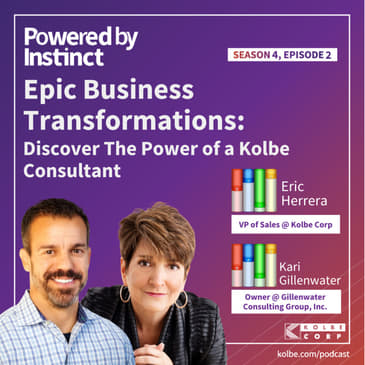
When Kari Gillenwater first integrated Kolbe into her practice, she had no idea the level of impact it would have for her clients. In this episode, Kari shares how discovering her Kolbe strengths has improved both her life and her business. She explains how she uses Kolbe to help top business owners build teams and empower their employees. She also offers advice for coaches and consultants looking to incorporate Kolbe into their practice at the highest levels.
If you’re a consultant or coach looking to make a bigger impact on your clients’ businesses and lives, then this is a must-listen. If you’re simply interested in how to improve your own life and work through better understanding your strengths, this is also a can’t-miss episode!
Host: Eric Herrera (5392)
Guest-at-a-Glance
💡 Name: Kari Gillenwater (6482)
💡What they do: Founder and CEO of a successful financial services and insurance consulting firm, Kari is known for her extensive work with business owners helping them to accelerate their businesses, their brands and their teams. A coach and certified Kolbe™ consultant and Team Specialist, she specializes in helping business owners find right-fit talent, improve personal productivity, team performance and communication.
💡Company: Gillenwater Consulting Group
💡 Where to find them: LinkedIn
Takeaways
- Understanding and embracing your Kolbe strengths™ can have a significant impact on your life and business.
- Kolbe can be used to build teams and empower employees in a way that aligns with their unique strengths.
- Communication and understanding each other's Kolbe strengths is crucial for effective teamwork and collaboration.
- Kolbe can be powerful for coaches and consultants to help their clients find their voice, align with their strengths, and achieve their goals. Self-reflection is essential for personal growth and development.
- Understanding personal values helps guide decision-making and prioritization.
- Identifying strengths and weaknesses allows for targeted self-improvement.
- Setting goals and taking action is crucial for progress and achievement.
- Self-awareness enhances relationships and leads to a more fulfilling life.
Chapters
00:00 Introduction and Background
02:30 The Importance of Self-Reflection
03:40 Understanding and Embracing Kolbe
09:16 Using Kolbe in Business Coaching
10:45 Understanding Personal Values
17:28 Working with Individuals and Teams
20:15 Identifying Strengths and Weaknesses
28:12 Client Success Story
30:00 Setting Goals and Taking Action
36:00 Advice for Coaches and Consultants
40:00 The Power of Self-Awareness
41:14 Connecting with Kari Gillenwater
43:04 Closing Remarks
If you would like to be a guest on Powered by Instinct or get in touch with any of our Kolbe Experts, send us a quick email: info@kolbe.com
[00:00:00] I talk a lot about not being a boss, but being a leader. And I believe that knowing your Kolbe and knowing your team's Kolbe is really can help you much more lean into being a leader and empowering your people as opposed to here's a task to do it.
[00:00:15] That's what lights me up about this work. It's just so fun to see the Ahaz and to see them come together. Whenever I do a program, I always have three goals. It's to unite the team, to engage the team so they can grow.
[00:00:28] Welcome to Powered by Instinct, a podcast for professionals who think about how your fundamental nature drives performance. In each episode, Kolbe experts will interview top performers, team leaders, consultants and coaches to discuss identifying team members' strengths, aligning those strengths with their jobs and optimizing individual and team performance.
[00:00:48] If you're interested in getting more done, more naturally, then let's jump in. All right, welcome back to another episode of the Powered by Instinct podcast. I'm Eric Carrero, our VP of sales and today I'm going to welcome our special guest, Cari. That's right,
[00:01:03] Cari just like Ferrari and she's a strategic business coach and she's really integrated, Kolbe into her practice in some incredible ways. And so we're going to talk to her about that. We're going to learn a little bit more about her and her background, all that fun stuff.
[00:01:18] But I just want to say welcome and thanks for joining us. Thanks for having me. This is always such an honor. Yeah, and obviously right on the the power by Instinct podcast, we want to figure out what's everybody's M.O. So as a quick reminder,
[00:01:31] I'm a 5392 and then Cari, what's your M.O? I'm a 6482. All right, perfect. So you're a 6482. Tell us about the impact it had in your life when you learned that that's what your strengths were.
[00:01:44] Oh my gosh, so much. I think my whole life, I think people are like, we're not really sure what to do with her. And I know my parents are like that. And so,
[00:01:55] you know, sometimes I always thought, gosh, I wish I could just be more like them and why am I like this? And now I'm like, oh, those are my superpowers. As an example, because I'm a 6482,
[00:02:06] I'm a business owner and I have a lower follow through or I'm, you know, I have a four. So I'm in the react zone, right? So I need a little help there. And so one of the things that I learned, it was so funny,
[00:02:20] I had an organizational person come in and help me with my office and we found 17 day planners. And we were like, what is going on here? She's like, why? And she looked at,
[00:02:32] she's like, there's like three days filled out in every single one of them and then they're blank. And she's, and then I was like, you know, she kind of talked to me and I'm like, here I am. The
[00:02:41] she's like, when are you going to embrace that that's not how your brain works? And I'm like, oh my gosh. So that's a really good example of just kind of like, wow, yeah, like it's okay than I'm a four.
[00:02:53] Like I can still be a successful business owner as a four. But I have learned that I have to build support, you know, around me. I have a wonderful assistant and I have systems that are easy to follow
[00:03:05] and very flexible. And, you know, I think being, being initiating in quick start for me, again, that's not the only thing I am as an as she in quick start. But I think one of the things
[00:03:19] that has really helped me as a business owner is that because I'm not so worried about the how with the follow through, sometimes I just try things and I find that sometimes other consultants,
[00:03:33] they're so worried about being perfect or worried about, oh, do I have everything? Do I know everything? I have the luxury of being a quick start and, you know, an initiating there. So I don't
[00:03:43] have to know everything before I start. It's just kind of like I go and I wing it and see what happens and what doesn't. And to me, the open architecture of Colby just really helps me with my Colby,
[00:03:56] because it does give me so much freedom to innovate and to have I new ideas and to try things. You guys give us a wonderful structure. But then I can experiment and play, which is a huge
[00:04:07] core value of mine. So I think Colby is such like I said, it's like the missing puzzle piece for my puzzle. I feel like it was something that really completed me as a person. So for me, knowing my
[00:04:22] strengths and knowing that, you know, my uniqueness is actually strengths. That was really very validating for me. And you touched on it a little bit when you were talking about some of your follow-through strengths. And sometimes people want to use their Colby results as an excuse.
[00:04:42] I'm a three in follow-through so even more so than you, I don't follow systems and processes. I kind of make it up as I go and, and I follow, you know, I change things as needed. But the thing is
[00:04:55] the work still has to get done. Right? I still need to show up for meetings on time. I still need to be prepared. I just have to do it in a different way than many other people would do it. And so
[00:05:05] regardless of what your four numbers are, it's not an excuse. You still have to get this stuff done. Just we're giving you the framework or the path for how to get it done in a way that works for you.
[00:05:17] Absolutely. And again, you know, I have had to really lean into my Colby and also, I always talk about, you know, for every positive strength there's a shadow side to every strength
[00:05:27] as well, right? And so, you know, we all have to manage our M.O.s. And so because I do initiate in quick start, I have to be careful sometimes in meetings because I can steam roll. I can have
[00:05:39] too many ideas and derail the whole meeting. And so we do have to, I think that's the power of Colby is now I understand that I can do that. So I have to be careful and I do have to
[00:05:50] manage my M.O. in a way that serves everybody not just me. Yeah, absolutely. And so I know that you are, you're doing some kind of high-level coaching with business owners. So tell
[00:06:00] us a little bit more about the coaching that you do. So I'm very fortunate I get to work in the small business owner world. I specialize more in the finance area in the financial but I also
[00:06:10] have different clients that I get through referrals. And so I don't just specialize there, but I do get to work with small to medium business owners. And I love it because it's so
[00:06:23] my goal is to help support them to build a team around them so they can entrepreneur the way they need to. And, you know, according to their Colby. And, you know, it's, it's so amazing for me when I see
[00:06:36] an owner who really, when they light up and go, oh, I can do this. All right? Oh those are my strengths I can do this. And then we also say, okay, how can we support you best by building that team
[00:06:51] around you? And so as I work with business owners, I use Colby as a door opener to my consulting services. The first thing I do is make sure I do somebody's Colby A. So if I meet a business
[00:07:04] owner on a plane and we talk and I'm like, I'll send you a Colby. And so we do that. And then once I, we do the interpretation, it's kind of like, I mean, who's not going to love it, right?
[00:07:16] And so then we talk about what can we do with their teams. And that you let usually leads to me doing A's and B's for their entire team. Then we do a team debrief. And then I come in and do an
[00:07:27] on-site workshop or program designed to integrate Colby with their team. And then that is kind of the foundation for all my other consulting. And so from there, I might do leadership coaching.
[00:07:41] I might do a strategic summit with the team to really say, okay, what do we want to focus on for the year and who are the strengths and who's going to help get this done? And then also sales
[00:07:52] coaching. And I also help with hiring and firing and interviewing and building teams. Another thing is really, I didn't realize how much it would be come into play due to Colby but communication. It's really teaching the team how to communicate. And I just did an amazing
[00:08:10] on-site with 25 people. And the leaders are all initiating quick starts. But then most of the team are more high-fact or initiating back-finders, initiating follow-throughs. And there was a lot of disconnect. And so it was amazing to see the A's and really exciting to see the leaders go,
[00:08:31] oh, okay, we get it now. So that's really fun for me. But for me, my focus again is working with the small businesses to empower them to get back to what they love doing, the business owners
[00:08:44] and then building a team and empowering their team around that. I talk a lot about not being a boss but being a leader. And I believe that knowing your Colby and knowing your teams, Colby's really
[00:08:58] can help you much more lean into being a leader and empowering your people as opposed to, here's a task to do it. And so to me, that is, and that's what lights me up about this work.
[00:09:10] It's just so fun to see the A's and to see them come together. Whenever I do a program, I always have three goals. It's to unite the team to engage the team so they can grow.
[00:09:22] And so for me that's kind of the premise of everything that I do. And so that's been really successful. And I'm so excited. I actually have, when I'm very big about putting things out in the
[00:09:35] universe and manifesting. And I said, I wanted to have a global company. And so I'm really excited that I now have international clients. I work with people in Luxonburg, London, Singapore, Thailand, Ireland, Australia, and it's just been a ball. And I love it. And I think
[00:09:52] the really unique thing about Colby, there's not too many businesses that are literally universal and can help any human. And that's how I feel about Colby. Like we can work with literally any
[00:10:04] human. So I think that gives us a really good broad business model. And I love that. Yeah, and you know, that's kind of the blessing sometimes because to get every business, it doesn't matter if it's literally one person or it's hundreds of thousands of people.
[00:10:19] The magic inside of that company is the people. Right? And all of the amazing stuff that they do to make that machine work really effectively. And so that's the positive side of it. Sometimes
[00:10:29] a bit of the challenges because as you said, right? We literally can help 8 billion people if we wanted to. But there's just one another. Yes. And like you and I, we can kind of get a shiny
[00:10:41] objects in Joe and Bouncer round a little bit. So trying to to narrow our focus. Like I know like you said, right, you, you kind of found a niche in the financial services financial advisor world.
[00:10:52] If you can find that area where, hey, I'm really good. And I really know stuff in this industry in this geography, whatever it is. And you really dig into that. While yes, you can venture outside of that sometimes you'll be more effective by kind of
[00:11:10] holding your focus and becoming the expert in that one area. So, lately, and I feel, you know, they always say the ridges are in the niches, right? And so I didn't grow up and, you know,
[00:11:18] no, when I was little that I wanted to do this, it was just something that kind of happened and I gravitated into this space. And I have a very niche business. But I do have wonderful clients
[00:11:27] that also refer me. So now I work with real estate. I work with accounting firms. I mean, it's really fun and I love to go outside the main industry because I learn so much.
[00:11:37] And so it's been really fun. And again, it's the great thing about Colby is it's super flexible in that open architecture really allows me to grow my business my way. And so next year,
[00:11:48] I don't know if I'm going to work with but I'm really excited about it and whatever they need, I can work it out. And so that's the fun part for me. I have to say the Colby team
[00:11:57] is so amazing and responsive. Like yesterday I had some stuff going on with this software on my end, and they immediately got back to me and just having that support and being able to use the software to deliver the reports and show our the initiating backwinder's out there,
[00:12:13] the data behind it and really help with a one picture dashboard, you know, of like our strengths, matrix, all that for the initiating quick starts and counteracting follow-up, there is they need that one page. There's so many tools that allow me to be able to bring a lot
[00:12:34] of value with what I do around Colby. But again, to me, Colby's just the door opener to so many other things. But at the end, it's really the foundation of it all because everything
[00:12:45] kind of comes back to, are you communicating right? You know, are you thriving? Are you in the right seat on the bus doing the right job in the right way? Are you thriving or surviving? And that's
[00:12:57] really what we talk about. You know, one of the things that I'm always coaching about is if we work for 30 years for 40 hours a week, that's around 80,000 hours and my mission in life is to
[00:13:09] help make those 80,000 really awesome and Colby allows me to do that because we kind of have this, you know, combination to the safe on on communication. And so I think, you know, if you think
[00:13:21] about it no matter what you sell no matter what you do, communication and relationships is the business. And so, you know, having Colby and being able to do that is such a superpower, and I love that.
[00:13:33] Yeah, and I know you had an existing practice before you kind of plugged Colby into it. Once you plugged Colby and what did that growth trajectory look like? Oh, um, wow, I had no idea. I thought, yeah, I would dabble in it. It would just be another
[00:13:48] arrow in my Quiver so to speak. I had no idea I now almost have two whole businesses. I have one that is Colby and one that is my consulting practice. They definitely integrate but I had no idea.
[00:14:01] So I about two years, I guess, right when we were coming out of COVID, I put out my intention that I wanted to create another pipeline of revenue that kind of was a bolt on to what I was
[00:14:12] currently doing. You know, COVID, if COVID taught us anything, it's we need to be ready to pivot because we don't know what's coming and I thought, you know, I have one big client and
[00:14:23] although my, I do have a diversified practice, I do have one very large client. And if that goes away, whoa, what am I going to do, right? So for me, I wanted to diversify my revenue pipeline but also
[00:14:36] go deeper with my clients and bring more value for my large client. And that's what this is it allowed me to do. And I'm happy to say that in two years, I now make another six
[00:14:47] figures plus just don't Colby. And so it has allowed me to, you know, also, you know, financial freedom, it's allowed me to really be able to invest back in my company and it's just been an
[00:15:02] incredible list to my business revenue wise but also opportunity wise because I have such an amazing offering that I, to be honest it's very, very few and far between where I get told no.
[00:15:16] I don't want to do Colby. And wherever everyone's like, of course I do. So it's really fine. My, I always joked my assistant a lot of times I fly, you know, I'm flying a lot so I get
[00:15:26] upgraded to first class. And she's like, you got to stop flying in first class. You keep on finding your clients and she's like, you got to stop. So it's a lot of fun. And I know, you know, I kind of
[00:15:37] on both sides of your business, you work sometimes with individuals, sometimes you work with teams. What are some of the differences in how you approach it or how you do your thing within
[00:15:48] individuals versus when you're working with a group? Well, the first thing I do when I'm coaching an individual is obviously do their Colby because that really, you know, sets the stage for that same
[00:15:58] thing with a team. And it's really, I think the first thing is I'm very customized with my coaching. So I don't know, whether it's a leadership person that maybe hasn't found their voice yet,
[00:16:11] you know, things like that. I work very one-on-one with them to kind of help their self-limiting beliefs and things. But the first thing we always start with this Colby so they can really understand their strengths. And then are they applying those strengths? Are they using those
[00:16:27] strengths to the best of their ability? And then we also incorporate a lot of this strategic coach, you know, issues about like the unique ability grid. Like are you focusing on and doing what
[00:16:38] only you can do and what you rock at and really helping them stay kind of above the line into their unique ability? That's something that I'm a big proponent of doing that. But, and then
[00:16:52] far as teams it's really, again, I think the biggest thing I do is help them understand each other and then with understanding they learn about each other and with that knowledge comes power
[00:17:02] because then you can make better decisions and you can support each other better. And I feel, you know, I do a lot of sales coaching and understanding not only your Colby but your teams Colby but understanding the behaviors for the different strengths that are, you know,
[00:17:19] the more I work with clients they kind of learn like oh okay if they're asking for agendas and they want it. They always have a checklist and you know that's someone that's initiating
[00:17:28] in follow-through. You need to lean into that right? And so understanding that it's not just for you it can also help with your partner, it can help understanding your clients. If you're working
[00:17:38] with someone who is not a fact, not an initiating fact-finder but more an initiating quick start that's a much different meeting right? And so really helping and able, you know, helping and power them
[00:17:53] to understand their clients better so that they have a better outcome. So, whether it's one on one or team, it really all starts with Colby and then it's very customized on what they want to do.
[00:18:06] But usually it's either for the one-on-one, it's to help them find their voice in whatever it is they want in their leadership, in their company, you know, and the team, the same thing, they kind of have to find their collective voice together and that's what I help with.
[00:18:21] Yeah, and you kind of touched on it and you mentioned it in different ways as you were just describing how you work with your clients but whether you're a leader, whether you're a sales
[00:18:29] person, whether you're just a person on a team, the process is kind of the same. Right? Like, you need to understand yourself, how do you naturally do stuff, then understand and appreciate those around you who may have different strengths and then figure out, how do we work together,
[00:18:44] right? Because we can create amazing things as a group it's hard to go and create really huge things all by yourself. And so we like when I'm working with clients, I always kind of start with the foundation of we have different strengths that's awesome, appreciate that, then let's
[00:19:00] create kind of a common mission, a common vision, what are we trying to get done? And then from there we can start to adjust our style to the other person. If you think about it as a leader,
[00:19:11] you absolutely have to do that with your team, because hitting people over the head isn't going to get the results to go. And just because you say to do it, I think one of the biggest things that
[00:19:21] a lot of my leaders don't understand is that it's not just telling your staff or your team what to do, it's why. Why is it important? And I think that that is a big thing that gets left out a
[00:19:34] lot. We're also busy. We're so in GoGoGoGoGo, we're so reactive. Everything's all these new ideas and constantly trying to grow. But if I feel like if we can equip our teams with the why,
[00:19:47] it really helps make them impassioned and you nights them for that common goal. And one thing you touched on to me understanding core values is so important. And I think the cool thing about
[00:19:58] Colby is it aligns with my core values so much. Empowerment is one of my core values. And so courageous authenticity is another one of my values. And so connection and collaboration, these are
[00:20:11] things that Colby doesn't think but feel the fire for. So I think that's another reason why I have had such success with Colby because it is so aligned with who I am. Yeah, and so we've been talking about people with different strengths and how you got to adjust
[00:20:27] your communication style. Let's say you're working with two separate clients. One client, the entrepreneur is a 2, 2, 8, 8. And the other client, the other entrepreneur is an 8, 2, 2. How much do you really vary your approach when you're working with those two business owners?
[00:20:45] Oh, a lot for that 2, 2, 8, 8. I've got to hire someone who initiates an implementer and they've got that co-action. And so they're going to, I'm probably going to want to have them
[00:20:59] get up and write and do things on the board and be more kinetic aesthetic in what they do. They're going to be more worried about the quality of things. And then also, they're going to want to create something new and challenging in unique. And it's never been so
[00:21:15] I have to keep what I'm doing new and challenging in unique. And fun, I can't have to realize how much they can process also. So if I'm working with someone who's an initiating quick start and someone who's a 2 in follow through and I give them 15 to do's,
[00:21:41] that's not good. I have to help them focus. Whereas if I'm working with the 8, 8, 2, 2, they're going to probably want the research and the data that shows why this works. And they're going to want to process. They're going to want an agenda for our call.
[00:21:57] They're going to want to know what's the process? What are we doing next time? How far are we? What have we checked off today? When is this due? It's a totally different vibe and energy really.
[00:22:10] And helping leaning into that, I can then decrease frustration and help open. They will trust me more as a coach if I get them. They will feel, oh, she gets me. I can share everything.
[00:22:24] If they feel misunderstood, they're going to be like, wait a minute. Why are you coaching? You don't even get me. And so for me to be able to really understand what I love about Colby
[00:22:35] and I get so much geek about it. It's so prescriptive. And I always do the A's and the B's. And it is amazing to me to go, okay, I can literally tell what it's going on without even seeing
[00:22:47] this person. Like, I can see, okay, there's not enough, you know, they're having to operate and move quicker and faster than they want to. And things like that. So it's just been, it's just such an elegant system because those numbers are, I haven't ever had anyone come to
[00:23:06] me and go, that's not me at all. I mean, it's more like, oh my god, you've seen me. And so that's so empowering. And it's really fun to do that. So would I approach a 228-8 differently than an 8-8-2-2
[00:23:18] you betcha? One thing I do find, especially I find this a lot in my readership. And especially with the females is that if they initiate in fact find there and then they're more of a counteract
[00:23:33] in the quick start. Sometimes, they don't want to be wrong in any meeting so they will be more quiet. Now I'm not set generalizing and saying that everyone does that. But I do find a lot and so one
[00:23:44] of the things that I offer there is to say even if you don't know the answer, your 8-8-2-2 or whatever it is brings a valuable perspective with your questions. Even if you don't know the answers,
[00:23:58] don't not speak up because of that. It's like it's like painting a beautiful picture but missing a color. It's like you've got to add your perspective so even if you don't know the answers, that's okay. Your questions are so valuable because of the different perspective that you bring
[00:24:16] to the table. And so just understanding that someone's Colby might, I don't know, keep like again, they might be thinking more internally where I process outwardly because of my Colby, right?
[00:24:33] And so I would invite them to say there might be a way to use that voice and still remain true to your 8-8-2-2, right? So these are the things that I work on. I don't know, I may want a little
[00:24:44] deep there, sorry. You kind of reminded me of something so folks like you and I 7-8-9-10s in Quickstar were often described as we think with our mouths open. Absolutely. So it's just stuff
[00:24:57] starts flying out. Sometimes they're amazing ideas, sometimes they're not so good ideas but either way let's get it out first and let's start to fix it. The way I say that is we think
[00:25:08] openly outwardly and it's like trying long-close we're going to try them all on but we don't buy them all, right? We just try them on because we got to see how they fit and that's what our
[00:25:17] ideas are to us. Whereas someone who's more maybe initiating in fact-finder, they might internally process and they may seem quiet and ameating but their brains going just as fast as mine it's just internal conversation whereas you know and again if you are a counteracting
[00:25:37] quick start you may not want to voice your opinion for fear of it's not perfect. It's not right. It's not you know you don't know and for me as a quick as someone who initiates and
[00:25:46] I don't care if I'm wrong. Oh maybe my bad idea will give you a good idea so it's it's so amazing to see that different perspective that what comes so naturally and easy to me
[00:25:56] and doesn't bother me at all might actually send someone else into you know cold sweat. And so being aware of that is so important and I do find that my leaders go oh I had no idea
[00:26:09] that stress to her out or you know really made him upset or you know they really had no idea because they see the world through their colby lens. Yeah, absolutely. Are there any challenges
[00:26:20] that you see that all leaders face regardless of M.O. of communicating the why? You know I feel like all of us you know if we own a company or lead a team it's almost like we have gladiators
[00:26:38] that are suited up and ready to go fight for us and yeah they'll fight if they're putting the ring but if they know what they're fighting for and why it's important they're going to be
[00:26:50] passionate and they're going to be there to just you know they're going to become warriors in that way. And so I think that's one of the biggest things that I would tell any any business leader or
[00:27:02] team leader is that the more you can share about why this is important and how it impacts people and why this decision or this project is important it really fuels that passion to get it done.
[00:27:16] It's not just here's a task to do it it's here this actually helps you know our clients live better lives or we can save somebody you know money here and that would mean a lot to their
[00:27:28] family and their legacy or whatever it is and whatever you know market that we do but just understanding the big why I think that's an overarching need that I think sometimes business owners
[00:27:41] and team leaders get so busy with the day to day and the quick quick we got to go go go they forget to bring their team along with them they know the why in their head they have the curse of
[00:27:50] knowledge but not the team may not understand that because they're each in their own little silos and so I think that is something that's overarching that I that I find pretty much universally another thing is communication with in teams no matter how much wonderful software you have
[00:28:13] a lot of times one hand might not know what the other is doing and you really have to keep it simple if they're checking five six seven different you know they've got CRM Slack email teams
[00:28:24] you know project slacks whatever it is you know there's a lot going on there so I would I think that really figuring out less is more in that way is better for me
[00:28:38] I mean I just feel like sometimes we're asking where people to do a lot and they don't understand that because they're not in the trenches doing the day to day yeah absolutely and you know I'm
[00:28:47] not surprisingly the two of us have been kind of speaking in broad generalities right about some of the cool stuff that we've done and how we've helped people with digging a little bit
[00:28:56] than be a little bit more specific do you have one particular client success story they kind of pops to the top of your head that you can share with us? Oh one then I love because it's it's kind
[00:29:06] of very different for me I worked with a company that was a truck company and the entrepreneur was an eight in implementer and he initiated an implementer for a CEO which I don't find that a lot in
[00:29:20] my industry that I work with and he was really struggling he's like I don't think I'm cut out to be a CEO and I'm like why would you say that? He's like why just don't think like everybody else I don't
[00:29:32] I don't you know everyone else is you know doing this and this and this and that's when I say you're kind of shooting all over yourself like I should be this way I should be that way
[00:29:39] and so we really talked about what he loves and what lights him up and one of the things that as a CEO he wasn't able to be on the tarmac anymore with the guys in the trucks and fix
[00:29:50] in the stuff and you know very implementer stuff right and so what I did was I said you know what I'm gonna prescribe that you spend three hours a week out on the tarmac in your coveralls with
[00:30:03] your guys fix and stuff doing stuff go do what you love and instead of constantly being on zoom get up go move into the office go talk to somebody there or travel go get on a plane go be in person
[00:30:18] to some of your most important clients and so once we started doing that he was so much happier and he's like I can't do this and it was just like we had to remember to align it with what
[00:30:29] his what his loves are and what his strengths are another thing in that company we found that the director of compliance and the director of safety were literally in the wrong seats and they were both miserable their Colby bees were just completely misaligned so all I did
[00:30:45] and after a 30 minute call I said I think we should switch them and we did and six months later happy aides doing great love in life oh my god we should have thought of this ourselves and it was
[00:30:58] just literally because Colby is so prescriptive we just took the director of compliance and the director of safety and we switched them they were in the wrong seats and it was that simple so
[00:31:09] that's a really favorite case study of mine I have a million I've got you know father son stories I've got partners that were completely different stories but it's amazing that it really comes
[00:31:21] down to are you being true to your Colby are you using your strengths and doing things your way and I think that you know the gift that Kathy Colby gave all of us is that Colby really allows
[00:31:34] us to understand what that is and that it's okay to be an eight implement or CEO we may have to build systems and support to help us to do that because we may not be initiating another
[00:31:47] things and we may be we might need to you know create a support structure to help us but we can all again just like she says just because we show up most actually in four doesn't mean we can't do
[00:31:58] the other strengths we can automate delegate we can surround ourselves to help lift us up and do we'll be love in our Colby way yeah and that's one of the cool things about what I get to do is
[00:32:09] we touch basically every industry, every size of company and so I get to poke around and see inside all of those various ones and it's never done just a one way right kind of two your points
[00:32:22] I've seen CEOs who grew and founded a hundred million dollar business that are two to eight eight and some that are eight eight to two and everywhere in between because they figured out how to
[00:32:33] really lean into their superpower and say all right if I focus on doing when I'm really amazing at and then build the network, the team, the structure around me to fill in those gaps now we can all be
[00:32:44] successful yeah and so again I think it's again it's just doing it your way and you know understanding your Colby is the first start of doing that and I think there's so many people that
[00:32:59] especially in my world that were really great salespeople then all of a sudden they became a company owner and they never had training on how to deal with people, they never had training with how to run a company
[00:33:12] and then all of a sudden they get so tied up in the people when they're running the company they don't get to sell anymore they're not even talking to clients anymore and so then they're like
[00:33:20] well this isn't so much fun running this company and so I love the fact that I can help get put the plan back in their life and help them to do their unique ability and build a team around them to
[00:33:29] support them to do that and Colby allows me to do that. All right so during the podcast we always like to recap it or I like to call it lessons learned right like we've we've been talking for
[00:33:39] I don't know roughly 30 minutes somewhere that neighborhood so I want to again kind of encapsulate it wrap everything up so and you know if you were going to give advice to other coaches,
[00:33:50] other consultants as far as using Colby growing their practice what's the best piece of advice you would give them. Again I think using Colby as that door opener as that foundation is so key
[00:34:03] again because it is universally I mean as long as you have a human that you're talking to or that you work with Colby can help. One thing I do find is that like at first I was so excited about Colby
[00:34:16] I could Colby all over somebody and I'm sure they were like oh wow and so when I spoke it Colby call one of the things I said it's don't scare the deer and so that's something that I used
[00:34:26] with my kids from very small age it's like don't don't be so like oh my god you can you can totally do Colby with everything just more really instead of jumping on them with Colby
[00:34:37] talk to them about what Colby can do then start asking questions what do they need? What are their pain points who's on their team? Things things and then you know the best way for me to develop
[00:34:51] an engagement is to do their Colby and it's okay to give away a Colby and here's my thing that $50 or whatever it is to do Colby A is such a lost leader so because by getting that here's the
[00:35:07] thing if they don't engage you you can charge them the $50 if they do engage you that that A can be rolled into some of my engagements or $30,000 I really don't care about the $50
[00:35:20] or A right and so and you have to think of like also as ongoing lifetime clients span right and so I think that was the first thing of first like oh I don't I don't know if they're going
[00:35:30] to do something that's $50 I'm not worried about that that is the best money I can spend to help get that engagement and I think a lot of people go oh well you know I do Colby you should
[00:35:43] hire me and I think don't go that fast I think it's really more first talk about Colby what you do the problems that you solve in whatever your capacity that you do and then let's do your A
[00:35:56] and let's talk you don't have to sell them on the engagement that first time you meet them your next goal is to get on that call to so that you can learn more and do their Colby
[00:36:08] and so for me that would be some I think at first I might have Colby people a little hard and so because I was so excited about it and now I just have to kind of be like okay back off
[00:36:19] and and also just I learned a lot of business things like you know charge I always do half up front so that my Colby's are paid for and I don't carry that interest on my credit card right
[00:36:33] and so just there's some business things that to consider too that and you know it doesn't I think I have so many high or initiating fact-finder and follow through consultants that come up to me
[00:36:48] and go well how do you charge and what do you do and how do you and I'm like one page it doesn't have to be you know a 17 page proposal it's just a one page B structure here are the
[00:37:00] deliverables in here so much it costs phase one phase two break it down make it easy so don't over complicated keep it simple I think is key and then keep trying new things every time I do a
[00:37:14] workshop I throw in something new or do it in a different way and I have fun with it and see what works and it's amazing the stuff that comes out of it I'm like oh I didn't know that was
[00:37:23] gonna happen but that was really great and so how fun with it I think that's one of the biggest things is don't take yourself so seriously you will figure it out just try and the more you do
[00:37:35] the more you're gonna get more comfortable with it and and do it in your way I think a lot of people like obviously I'm an initiating quick start and I have a very extroverted personality I can go
[00:37:48] talk to a wall and you know sell ice cube decimos but not everybody has to have my personality you do Colby in your own way and you know I think there's a lot of people that have different
[00:38:02] Colby's that might you know be better at some things than I am and that's it you know and they're gonna they're gonna thrive there some people are way more organized than I am and that's something
[00:38:12] that they might want to coach to or lean into again based on your Colby so one of the things based on my Colby I'm a motivator I get everyone excited I walk in with a lot of great energy and
[00:38:24] that's one of my gifts and you know and I am very experimental and playful because of my Colby but there's lots of ways to do this business and so don't should all over yourself that I should
[00:38:38] do it this way or should do it your way because you're always gonna be awesome it's going to be special in your own unique way and the cool thing about Colby open architecture is each one of us
[00:38:49] get to be we get to entrepreneur in our own way and I love that and that's the freedom that Colby gives you yeah that's awesome so don't should all over yourself you know what you're self you
[00:38:59] would in your do it in your own way perfect so we're gonna wrap this up but I'm sure there's some folks that want to reach out to you and maybe they have some questions maybe love the part
[00:39:09] and with you something like that where should they connect with you um you know the best way to get me um is to email me at cari k-a-r-i at gc3c dot com or you can reach out to my assistant
[00:39:22] jillion at gc3c dot com and my phone number is 511 9520 998 I'm pretty open you can text me call me DM me on LinkedIn I get a lot of those everyone like hey let's connect so I for me
[00:39:38] I absolutely love collaborating with other Colby people I have amazing people in my tribe that I look to as other coaches I learn from other people in other ways I love that I think one of the
[00:39:53] best gifts that Colby can give me is now I have a tribe of me is out there that get the Colby you know we all have growth minded you know we're very like minded we're growth minded and powering
[00:40:04] and we get it and so for me that's really fun that we can collaborate as a group um and I'm you know I welcome talking to anybody and I think that a lot of times you know some of them might call me
[00:40:18] to learn something but I'm gonna actually learn from them yeah absolutely so yeah as she said right she is a wealth of knowledge she's happy to help so if you have something definitely reach out
[00:40:30] if you have not taken your Colby yet obviously that's the place to start right that's my god please take your Colby a you will thank your future self I mean you just you got to do it and
[00:40:41] it all it I you know it may sound hyperbolic or whatever but it will change your life for the better because knowledge is power and I truly believe that and once you really you know
[00:40:55] know that I sell right once you really get your Colby and understand that then you are so much more passionate about taking that out to other people and again it's like opening
[00:41:09] it's like cracking the code to a safe to yourself and then to other people and I love that about Colby yeah absolutely so if you haven't taken your Colby yet make sure you do that you can connect with
[00:41:20] Cari she will help you out or go to Colby dot com click that purple button in the upper right hand corner but again Cari I want to say thank you for joining us to the audience we'll see you next time rock on